Table of Contents
This updated guide examines How to Uninstall Deep Freeze and organizes the essential facts, background, and practical takeaways in clear American English.
Method 1of 2:
On Windows
 Find the Deep Freeze icon. You'll usually find this polar bear face-shaped icon in the lower-right corner of your computer's screen, though you may first have to click ^ here to view a list of currently running services.
 Open Deep Freeze. While holding down the⇧Shiftkey, double-click the Deep Freeze icon. The login window will open.
- You can also just right-click the Deep Freeze icon.
 Enter your password. Type in your Deep Freeze password and click Log in .
- If you don't know your password, you'll have to back up your computer's data, erase the hard drive, and then reinstall Windows.
 Click theBoot Controltab. It's in the upper-left corner of the window.
 Check the "Boot Thawed" box. This box is in the middle of the window. Doing so will ensure that when you restart your computer, Deep Freeze will be disabled.
 ClickApply and Reboot. It's in the bottom-right corner of the Deep Freeze window. Your computer will begin to restart.
- You may have to click OK and then Yes when prompted before your computer will begin restarting.
- Restarting your computer from this menu will take several minutes, so just leave the computer alone and allow it to restart.
 Wait for about half an hour. Once your computer restarts, it will run incredibly slowly, and some features (e.g., the Start menu) will not load for several minutes. To allow your system to finish loading, give your computer around half an hour to finish starting.
 Find the installation file. You'll need to look for the EXE file that you used to install Deep Freeze.
- There is no uninstall file for Deep Freeze; instead, you will need to run the file that installed the program to begin with. If you no longer have the installation file, you can download it again from the Deep Freeze website.
- The file for Deep Freeze 5 is typically DF5Std.exe
- The file for Deep Freeze 6 is typically DF6Std.exe
 Run the installation file. Double-click the installation file, click Uninstall in the window which opens, and follow any on-screen instructions. Eventually, your computer will reboot, and Deep Freeze will be completely removed.[1]XResearch source
- Removing Deep Freeze also removes any Deep Freeze-associated files.
Method 2of 2:
On Mac
 Open Deep Freeze. Find the Deep Freeze icon, which resembles a polar bear's face, and click it. A drop-down menu will appear.[2]XResearch source
- You can also pressCtrl+⌥Option+⇧Shift+F6to open Deep Freeze.
 ClickLogin. It's in the drop-down menu. Doing so will bring up the password text field.
 Enter your Deep Freeze password. Type in the password that you use to log into Deep Freeze, then press⏎Return.
- If you don't know your password, you'll have to back up your computer's data, erase the hard drive, and then reinstall macOS.
 Click theBoot Controltab. It's in the upper-left corner of the Deep Freeze window.
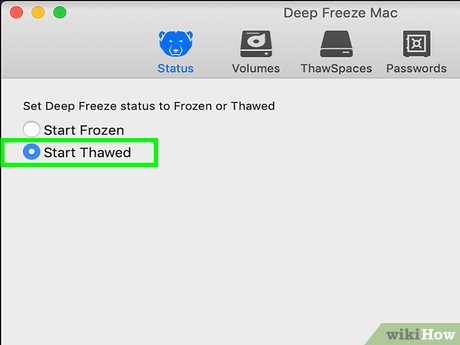 Check the "Boot Thawed" box. You'll find this box in the middle of the window. Doing so will ensure that Deep Freeze will be disabled when you restart your Mac.
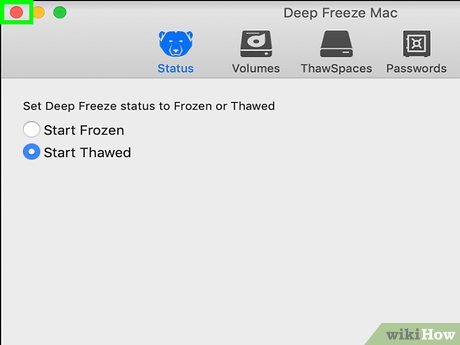 ClickApply. It's in the bottom-right corner of the window.
 Restart your Mac. Click the Apple menu
  , click Restart... , and click Restart Now when prompted. Your Mac will begin to restart.
 Wait for about half an hour. Once your computer restarts, it will run incredibly slowly, and some features will not load for several minutes. To allow your system to finish loading, give your computer around half an hour to finish starting.
 Open and unlock Deep Freeze again. Click the Deep Freeze icon, click Login , and enter your password.
 Click theUninstalltab. It's in the upper-right corner of the window.
 Check the "Delete Existing Thawspace(s)" box if available. You'll find this option in the middle of the Uninstall page.
 ClickUninstall. It's near the bottom of the Deep Freeze window.
 Follow any on-screen prompts. Your Mac will eventually restart, at which point Deep Freeze will be removed.
FAQ
What is How to Uninstall Deep Freeze about?
It provides a structured overview of freeze, explains the main context, and highlights practical takeaways for readers.
Why does this topic matter?
Understanding the main concepts helps readers evaluate the issue, avoid common mistakes, and make better-informed decisions.
How should readers use this information?
Use the guidance as a practical starting point, confirm details that may have changed, and follow current product, safety, or security recommendations.
Related Articles
 How to Install Deep Freeze, Software to Freeze Computer Hard6 minutes read
 Deep Freeze Standard - Deep Freeze Standard Download and5 minutes read
 Steps to Install Deep Freeze Computer Freezing Software6 minutes read
 Deep Freeze - the Best Hard Drive Freeze Software5 minutes read
 How to Use the Software to Freeze the Computer's Hard Drive12 minutes read
 What Is Deep Web? Where Is the Deep Web? Good or Bad?9 minutes read
Reader Comments 0
Sign in with email or Google to join the discussion.