Table of Contents
This updated guide examines Click: How to Turn Off Automatic Updates in Windows 10 and organizes the essential facts, background, and practical takeaways in clear American English.
Method 1of 4:
Disabling the Update Service
 Understand the limitations of this method. While disabling the automatic update service will temporarily halt any Windows 10 cumulative updates, the service will re-enable itself after a certain amount of time.
 Open Start
 . Click the Windows logo in the bottom-left corner of the screen.
 Type inservices. This will search your computer for the Services program.
 ClickServices. It's at the top of the Start menu, just right of a gear-shaped icon. Doing so will open the Services window.
 Scroll down to the "Windows Update" option. You'll find this near the bottom of the window.
 Double-click the "Windows Update" option. Doing so opens the Windows Update Properties window.
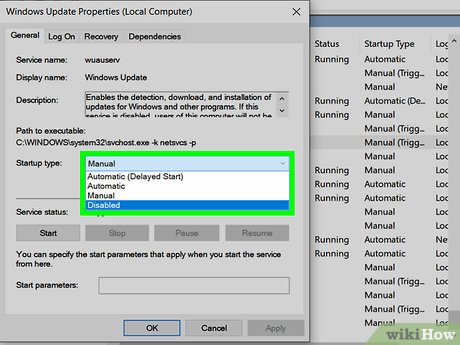 Click the "Startup type" drop-down box. It's in the middle of the window. Clicking this option prompts a drop-down menu.
- If you don't see this option, first make sure that you're on the right tab by clicking General at the top of the Properties window.
 ClickDisabled. It's in the drop-down menu. This will prevent the Windows Update service from automatically starting itself for the time being.
 ClickStop. You'll find this option near the bottom of the window. Clicking it prompts the Windows Update service to stop running.
 ClickApply, then clickOK. Both options are at the bottom of the window. Doing so will apply your settings and close the Properties window. The Windows Update service should now be disabled.
 Check the update service periodically. Any time you restart your computer or go more than two days without shutting down, open Services and check the "Windows Update" status to ensure that it's still disabled. While the Windows Update service shouldn't turn itself back on often, it will occasionally do so.
- If you see "Disabled" to the right of the "Windows Update" heading, Windows Update is still disabled.
- If you see anything other than "Disabled" to the right of the "Windows Update" heading, disable the Windows Update again.
Method 2of 4:
Using a Metered Connection
 Understand that this method won't work forEthernet connections. You can only disable automatic updates by using this method on a Wi-Fi connection.
 Open Start
 . Click the Windows logo in the bottom-left corner of the screen. The Start menu will pop up.
 Open Settings
 . Click the gear-shaped icon in the lower-left side of the Start menu. This will open the Settings window.
 Click
Click Network & Internet. It's in the Settings window.
 Click theWi-Fitab. You'll find this option in the upper-left side of the window.
 Click your current connection's name. It's near the top of the page. Doing so will open the Wi-Fi connection's settings page.
 Scroll down to the "Set as metered connection" section. This section is near the bottom of the page.
 Click the "Off" switch
 . This will turn it on
 , which will prevent Windows from downloading updates over your currently connected network.[1]
- If this switch is colored and has "On" next to it, your Wi-Fi is already set up as a metered connection.
Method 3of 4:
Using Group Policy Editor
 Make sure that you're using the right version of Windows. You'll need a pre-Anniversary edition of Windows 10 Pro or an equivalent. You can't use this method if you're using Windows 10 Home edition.
- The Windows 10 Education and Enterprise editions also include the Group Policy Editor.
- You can check your version of Windows by typingsysteminto Start , clicking System Information near the top of the menu, and looking for "Microsoft Windows 10 Professional" to the right of the "OS Name" heading.
- The Windows Anniversary update removed the option to turn off automatic updates from the Group Policy Editor.
 Open Start
 . Click the Windows logo in the bottom-left corner of the screen.
 Type inrun. Doing so will search your computer for the Run program.
 ClickRun. It's the speeding envelope icon near the top of the Start window. Doing so opens the Run program in the bottom-left side of your computer's screen.
 Launch the Group Policy Editor. Typegpedit.mscinto the Run window, then click OK . The Group Policy Editor window will open.
 Navigate to the "Windows Update" folder. In the sidebar on the left side of the Group Policy Editor window, do the following:
- Click
 to the left of the "Administrative Templates" folder.
 - Click
 to the left of the "Windows Components" folder.
 - Scroll down and click the "Windows Update" folder.
- Click
 ClickConfigure Automatic Updates. It's an item in the main Group Policy Editor window. Doing so selects this item.
 Open the "Configure Automatic Updates" properties window. Right-click the selected Configure Automatic Updates item, then click Edit in the resulting drop-down menu.[2]
 Check the "Enabled" box. It's in the upper-left side of the window.
 Click the "Configure automatic updating" drop-down box. This option is on the left side of the window.
 Click2 - Notify for download and notify for install. It's in the drop-down menu. This option ensures that you'll be asked before updates are installed, allowing you to decline the updates.
 ClickApply, then clickOK. Doing so saves your changes.
 Apply your changes. To do so:
- Open Start
- Open Settings
- Click Update & Security
- Click Windows Update
- Click Check for updates
- Wait for Windows to identify available updates (Windows will not install these updates).
 Restart your computer. Click Start
  , click Power
  , and click Restart in the pop-up menu. Once your computer finishes restarting, your update preferences will be saved.
- You'll still be able to manually allow updates as they become available.
Method 4of 4:
Disabling Automatic Windows Store App Updates
 Open Start
 . Click the Windows logo in the bottom-left corner of the screen. The Start menu will pop up.
 Click
Click Microsoft Store. You should usually see this option on the right side of the Start menu.
- If you don't see the Store icon in the Start menu, typestoreinto the search bar at the bottom of the menu and then click Store when it appears at the top of the menu.
 Click⋯. It's in the top-right corner of the window. This will prompt a drop-down menu.
- On older versions of Windows 10, you'll click your profile picture in the upper-left corner of the Windows Store.
 ClickSettings. This is in the drop-down menu.
 Click the colored "Update apps automatically" switch
 . Doing so will turn off the switch
 .
.
- If this switch is off, updates for Windows apps are already disabled.
FAQ
What is Click: How to Turn Off Automatic Updates in Windows 10 about?
It provides a structured overview of click, explains the main context, and highlights practical takeaways for readers.
Why does this topic matter?
Understanding the main concepts helps readers evaluate the issue, avoid common mistakes, and make better-informed decisions.
How should readers use this information?
Use the guidance as a practical starting point, confirm details that may have changed, and follow current product, safety, or security recommendations.
Related Articles
 How to Stop Windows Updates on Your PC10 minutes read
 Why Should You Never Turn Off Automatic Application Updates on Your Phone6 minutes read
 Instructions to Turn Off Chrome Automatic Updates in Windows4 minutes read
 How to Turn Off Automatic iOS 26 Updates on iPhone: Step-by-Step Guide3 minutes read
 How to Turn Off Automatic App Updates in Microsoft Store4 minutes read
 How to Disable Driver Updates via Windows Update: Step-by-Step Guide5 minutes read
Reader Comments 0
Sign in with email or Google to join the discussion.