Table of Contents
This updated guide examines How to Enable Automatic Updates and organizes the essential facts, background, and practical takeaways in clear American English.
Method 1
Updating Windows 7 and Vista
 Click the Start menu at the bottom left of your computer screen. In Windows Vista and Windows 7 the word "Start" is not shown on the icon. Look for the four-colored Microsoft rectangles arranged in a square.
 Type the words "Windows update" into the Start menu search box.
 Click the Windows Update program, which will appear in the Start menu at the top of the list of programs.
 Click "Change settings" in the window that opens. ("Change settings" will appear in a pane on the left side of the window.)
- Select one of the four options for automatic updates from the drop down menu.
- You can select, "Install updates automatically (recommended)." If you select automatic installment, Windows will download and install updates in the background while you work, then restart the computer automatically after a designated amount of time.

- If you select, "Download updates but let me choose whether to download and install them," the icon in the Start menu to the left of the icons you click to turn off or lock your computer will change to red when updates are ready to be installed. To install updates, click the red button. Your computer will shut down and install Windows updates next time you restart your computer.

- You can also choose, "Check for updates but let me choose whether to download and install them." If you select this option, frequently check the Windows Update program via the Control Panel or the Start menu.

- There is also an option that says, "Never check for updates (not recommended)."

- You can select, "Install updates automatically (recommended)." If you select automatic installment, Windows will download and install updates in the background while you work, then restart the computer automatically after a designated amount of time.
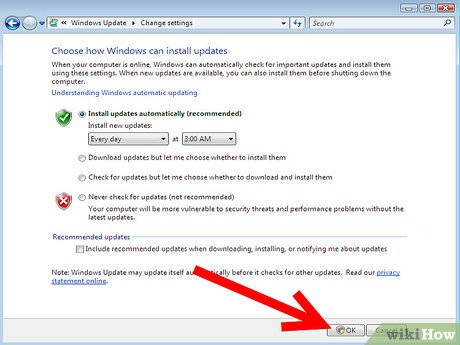 Click "OK" after selecting the option you want to save the settings and close the window.
Method 2
Updating Windows XP
 Click "start" in the bottom left of your computer screen.
 Click on run and type "sysdm.cpl" then press Enter.
 Click the "Automatic updates" tab in the window that opens. There will be four options.
- Click, "Automatic (recommended)" Automatically download recommended updates for my computer and install them. In the drop-down menu, designate a day and time when you want the computer to install updates.

- You can also click, "Download updates for me, but let me choose when to install them." This option will prevent your computer from shutting off automatically after downloading updates.

- You can also turn off automatic download by clicking, "Notify me but don't automatically download or install them."

- You can also click next to the option that states, "Turn off Automatic Updates."

- Click, "Automatic (recommended)" Automatically download recommended updates for my computer and install them. In the drop-down menu, designate a day and time when you want the computer to install updates.
 Click "OK" after you select the option to save the settings and close the window.
FAQ
What is How to Enable Automatic Updates about?
It provides a structured overview of updates, explains the main context, and highlights practical takeaways for readers.
Why does this topic matter?
Understanding the main concepts helps readers evaluate the issue, avoid common mistakes, and make better-informed decisions.
How should readers use this information?
Use the guidance as a practical starting point, confirm details that may have changed, and follow current product, safety, or security recommendations.
Related Articles
 How to Enable Automatic HTTPS on Edge2 minutes read
 Why Should You Never Turn Off Automatic Application Updates on Your Phone6 minutes read
 How to Stop Windows Updates on Your PC10 minutes read
 Why Shouldn't Auto-update Automatically Be Updated in6 minutes read
 Instructions to Turn Off Chrome Automatic Updates in Windows4 minutes read
 How to Turn Off Automatic Software Updates on macOS Sierra4 minutes read
Reader Comments 0
Sign in with email or Google to join the discussion.