Table of Contents
This article provides a clear overview of CUMIPMT Function in Excel, with the main facts, useful context, and practical details organized for easy reading.
Introducing CUMIPMT Function
What This Feature Does
The function helps calculate the accrued interest to be paid from the beginning of the period to the end of a certain investment loan.
Syntax
CUMIPMT (rate, nper, pv, start_period, end_period, type) .
Arguments
- rate: The interest rate to be paid, it is a required parameter.
- nper: The number of periods payable during the borrowing period, which is a required parameter.
- pv: The present value of the loan, is the required parameter.
- start_period: The first payment period of the loan, is a required parameter.
- end_period: The last period of interest payment of the loan, which is the required parameter.
- type: The basis of determining the payment time, is a required parameter. There are 2 values, type = 0 → payment at the end of the period, type = 1 → payment at the beginning of the period.
Example
Give the following data table:
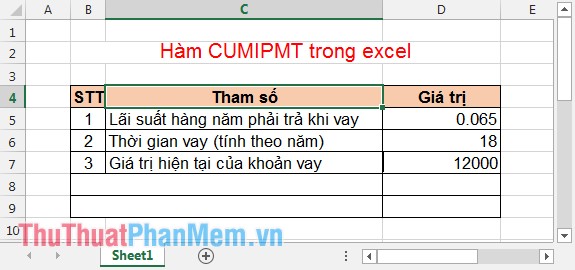
Calculate:
- Interest payable in the first month.
- Interest payable from 2nd to 15th month.
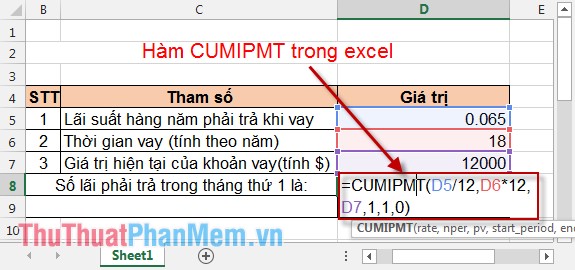
1. Interest Paid in the First Month
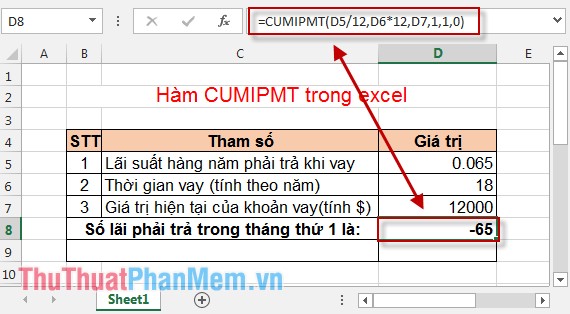
in the target cell, enter the formula: = CUMIPMT (D5 / 12, D6 * 12, D7,1,1,0) .
Result:
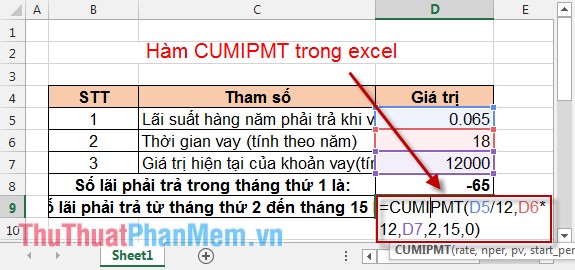
2. Interest Paid from the 2nd to the 15th Month
in the target cell enter the formula: = CUMIPMT (D5 / 12, D6 * 12, D7,2,15,0) .
Result:
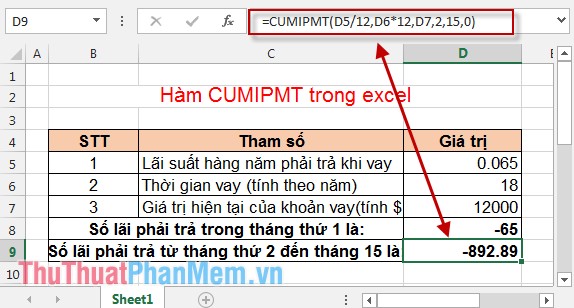
From February to November, total 14 months if paying interest by month → Total payable = 14 * 65 = 910 $ but accrued interest from February to 14 has to pay 892.89 $. Thus, accrued interest for many months saves you 1 money.
FAQ
What is the main focus of CUMIPMT Function in Excel?
The article explains the most important facts, context, and practical details related to CUMIPMT Function in Excel.
Who may find this information useful?
It is useful for readers who want a clear overview, practical context, and a better understanding of the subject.
What should readers verify before taking action?
Check current product versions, official requirements, regional availability, and any details that may have changed since the original publication.
Related Articles
 Use the Cumulative Interest Calculation Function in Excel6 minutes read
 How to Use the EFFECT Function in Excel3 minutes read
 How to Use the MOD Function and Quotient Function in Excel5 minutes read
 How to Use the SUBTOTAL Function in Excel4 minutes read
 NPER Function in Excel: Syntax and Examples3 minutes read
 How to Use the SUM Function to Calculate Totals in Excel8 minutes read
Reader Comments 0
Sign in with email or Google to join the discussion.