Table of Contents
This article provides a clear overview of Common Math Functions in Excel, with the main facts, useful context, and practical details organized for easy reading.
1. ABS Function
- Syntax: ABS (number).
+ Where number is a numerical value it can be a parameter, reference or valuable expression.
- Functional meaning: is the function that returns the absolute value of a number.
- Example: abs (-5) = 5; abs (5) = 5
2. Power Function
- Syntax: power (number, power)
Arguments
+ Number is the real number.
+ Power is an exponential function (or is understood as a factor that is multiplied).
- Meaning of the function: A function that performs exponentiation.
- For example:

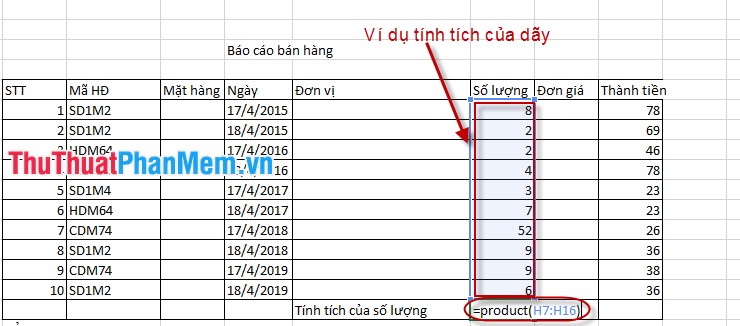
3. Product Function
- Syntax: Product (number1, number2,.).
Arguments
+ Number 1 is the 1 factor.
+ Number 2 is the second factor..
+ Contains up to 255 number arguments.
- Meaning: As a function of product of a sequence of numbers.
- For example:
4. Function Mod
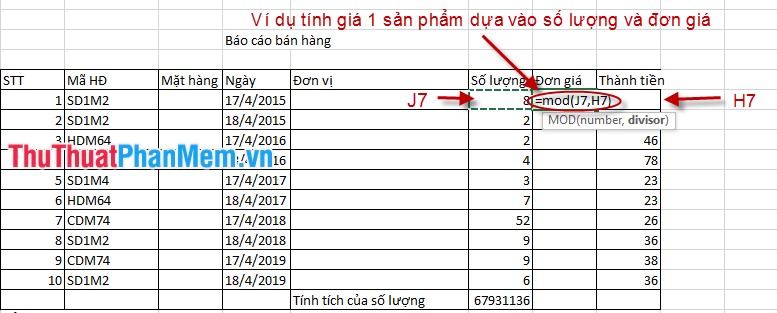
- Syntax: Mod (number, divisor).
Arguments
+ Number: is the divisor.
+ Divisor: is the number to be divided.
+ If the divisor = 0 return value is False.
- The meaning of the function returns the remainder of the division (the signed balance of the dividend).
- For example:
5. Roundup Function
- Meaning: is a rounding function for decimal numbers.
- Syntax: roundup (number, Num_digits).
Arguments
+ Number is the number you may need to round.
+ Num_digist: is the range to be rounded up to a few digits. Based on num_digist will determine the rounding rule.
- For example:
+ round (2.45, 0) = 5
+ round (2.45, 1) = 2.5
+ round (2.45, -1) = 10
6. the Even Function
- Syntax: Even (number).
+ Where number: is the number to be rounded.
- Meaning: A rounding function but rounded up to the nearest even integer.
- Example: even (4.45) = 6 (6 is the nearest even number of 4).
7. the Odd Function
- Syntax: Odd (number).
Where number is the number to be rounded.
- Meaning: A function to round but round up to the nearest odd integer.
- Example: odd (4.45) = 5 (5 is the nearest odd of 4).
8. Rounddown Function
- Syntax: rounddown (number, digits).
A rounding function, but rounded down to 1 unit.
- Example: round (4.45,1) = 4.4
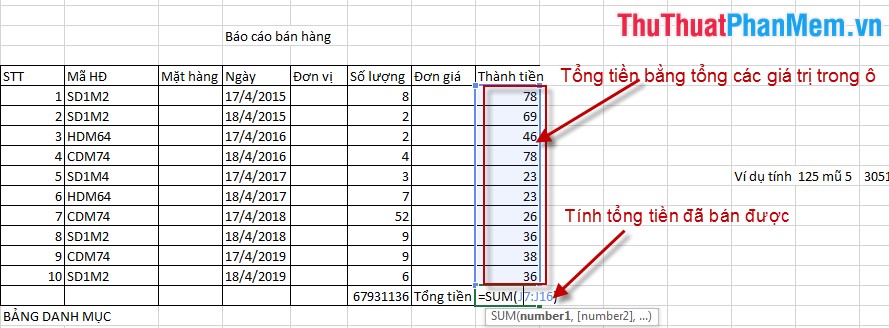
9. Sum Function - Function Sum
- Syntax: Sum (number1, number2,.).
+ Where number is the value to sum.
- For example:
10. Sumif Function - Function for Calculating Conditional Sum
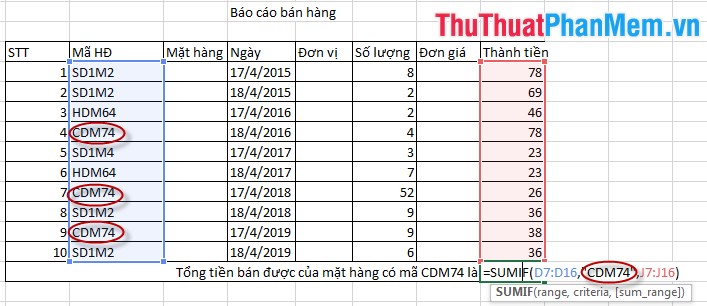
- Syntax: Sumif (range, criteria, num_range).
Arguments
+ Range: range to determine conditions.
+ Criteria: conditions.
+ Num_range: value to sum.
- For example:
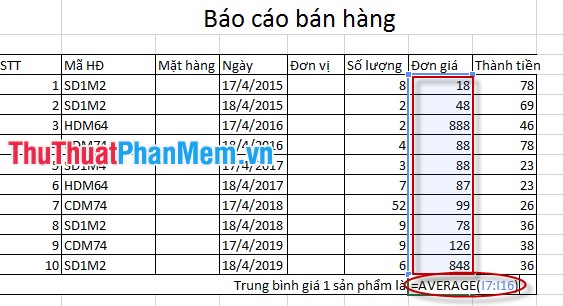
11. the Average Function
- Syntax: average (number1, number2,.).
In which: number1, number2 are average numbers.
- For example:
12. Sumproduct
- Syntax: sumproduct (array1, array2,.).
Where: array1, array2 are arrays where:
+ The product of each array is included and then summed.
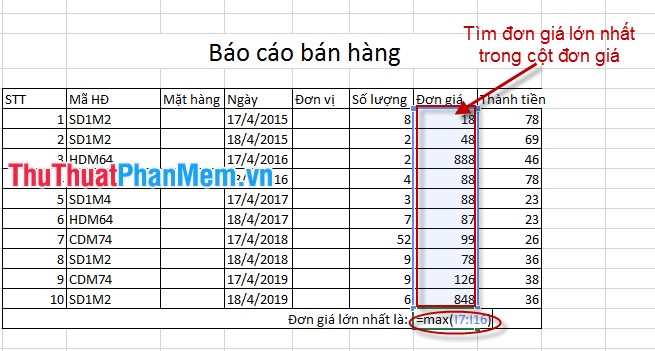
13. Ham Max
- Syntax: Max (number1, number2,.).
Where: number1, number2,. number n is the sequence to determine the maximum value.
- Meaning: The function finds the maximum value of a sequence of numbers.
- For example:
14. Ham Min
- Structure: Min (number1, number2,.. number n).
- Meaning: The function takes the smallest value in the sequence. Similar to the Max function.
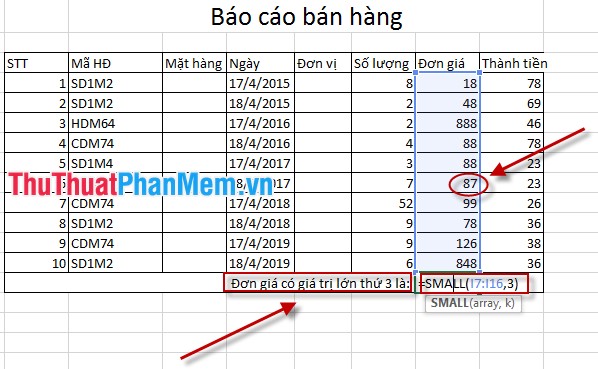
15. Small Function
- Syntax: Small (array, k).
Arguments
+ Array is an array of values.
+ K is the ordinal number of the element with the smallest value k.
- Meaning: The function returns the smallest k value in the sequence.
- For example:
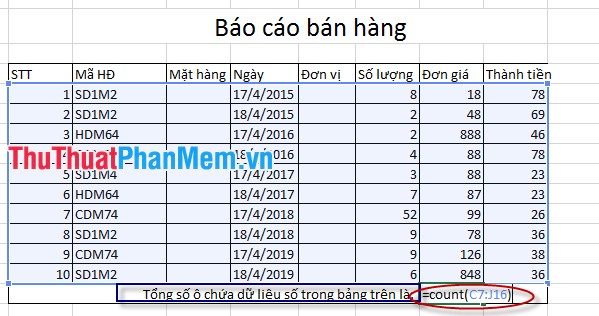
16. Ham Count
- Syntax: Count (Value1, value2,..).
Arguments
+ Value1, Value2 are values in the range.
+ Value1, Value 2 are numeric.
- Meaning: Data counting function is numeric.
- For example:
17. Counta Function - Counts All Cells That Contain Data
- Syntax: Counta (Value1, value2,.).
18. the Countif Function
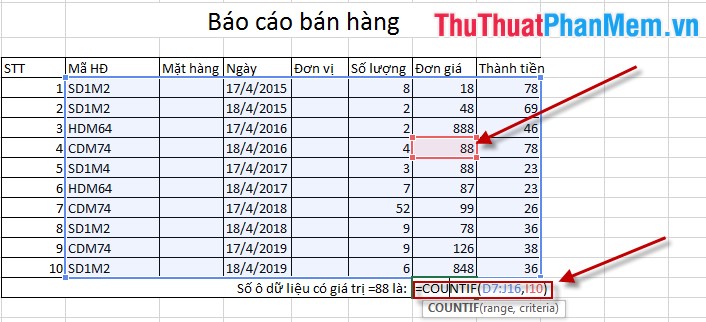
- Syntax: Countif (range, criteria).
Arguments
+ Range: Data range of operation.
+ Criteria: Conditions for counting.
- Meaning: Using to count cells containing data under 1 condition.
- For example:
FAQ
What is the main focus of Common Math Functions in Excel?
The article explains the most important facts, context, and practical details related to Common Math Functions in Excel.
Who may find this information useful?
It is useful for readers who want a clear overview, practical context, and a better understanding of the subject.
What should readers verify before taking action?
Check current product versions, official requirements, regional availability, and any details that may have changed since the original publication.
Related Articles
 Summary of Trigonometric Functions in Excel6 minutes read
 Common Excel Functions You Need to Know About Accounting13 minutes read
 How to Use Math Functions in C#: Clear Instructions8 minutes read
 Common Calculation Functions in Excel, Formulas, and Examples10 minutes read
 Common Calculation Functions in Excel9 minutes read
 Math. H in C23 minutes read
Reader Comments 0
Sign in with email or Google to join the discussion.