This guide provides a practical overview of Collection of Useful Microsoft Excel Shortcuts, including its main features, benefits, limitations, and important considerations.
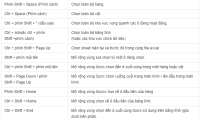
Ctrl + Space: Select the entire column.
Ctrl + Shift + * (asterisk): Select the entire area around the active cells.
Ctrl + a (or ctrl + Shift + spacebar): Select the entire worksheet or areas containing data.
Ctrl + Shift + Page Up: Select current and previous sheet in the same Excel file.
Shift + arrow key: Extend the selection from an active cell.
Ctrl + Shift + arrow keys: Extend the selection to the last cell in a row or column.
Shift + Page Down: Extend the selected area to the bottom of the screen.
Shift + Page Up: Extend the selected area to the top of the screen.
Shift + Home: Extend the selection to the first cell of the row.
Ctrl + Shift + Home: Extend the selection to the first cell of the worksheet.
Ctrl + Shift + End: Extend the selection to the last used cell on the worksheet (lower right corner).
F8: Turn on the feature to enlarge the selection (using additional arrow keys) without holding down the shift key.
Shift + F8: Add a (adjacent or nonadjacent) range of cells to selection. Use the arrow keys and Shift + arrow keys to add to the selection.
Enter / Shift + Enter: Move the current cell selection down / up within the currently selected area.
Tab / Shift + Tab: Move the current cell selection to the right / left in the currently selected area.
Esc: Cancels the selected area.
Shift + Arrow Left / Shift + Arrow Right: Select or deselect a character to the left / right.
Ctrl + Shift + Arrow Left / Ctrl + Shift + Arrow Right: Select or deselect a word to the left / right.
Shift + Home / Shift + End: Select from the text cursor to the beginning / to the end of the cell.
Arrow keys: Move up, down, left, or right in a worksheet.
Page Down / Page Up: Move down / up in a worksheet.
Alt + Page Down / Alt + Page Up: Move screen right / left in a worksheet.
Tab / Shift + Tab: Move one cell right / left in a worksheet.
Ctrl + arrow keys: Move to the edge cells of the data container.
Home: Move to the beginning of a row in a worksheet.
Ctrl + Home: Move to the first cell of a worksheet.
Ctrl + End: Move to the last cell containing content on a worksheet.
Ctrl + f: Display the Find and Replace dialog box (open the Search - Find item).
Ctrl + h: Display the Find and Replace dialog box (open the Replace item).
Shift + F4: Repeat the previous search.
Ctrl + g (or f5): Display the 'Go to' dialog box.
Ctrl + arrow left / Ctrl + Right arrow: Inside a cell: Move to the left / or right of the cell.
Alt + down arrow: Displays an AutoComplete list.
Ctrl + z: Undo previous action (multiple levels) - Undo.
Ctrl + y: Go to the next action (multiple levels) - Redo.
Ctrl + c: Copy the contents of the selected cell.
Ctrl + x: Cut contents of the selected cell.
Ctrl + v: Paste content from clipboard into selected cell.
Ctrl + Alt + v: If data exists in clipboard: Display the Paste Special dialog box.
F2: Edit the current cell with the mouse pointer at the end of the line.
Alt + Enter: Go down a new line in the same cell.
Enter: Complete a cell entry and move down the cell.
Shift + Enter: Complete a cell entry and move up the cell above.
Tab / Shift + Tab: Complete a cell entry and move to the right / or left cell.
Esc: Cancels the editing in a cell.
Backspace: Delete the character to the left of the text cursor, or delete the selection.
Delete: Delete the character to the right of the text cursor, or delete the selection.
Ctrl + Delete: Delete text to the end of the line.
Ctrl +; (semi-colon): Insert the current date in the cell.
Ctrl + Shift +: (colon): Insert current time.



Reader Comments 0
Sign in with email or Google to join the discussion.