Table of Contents
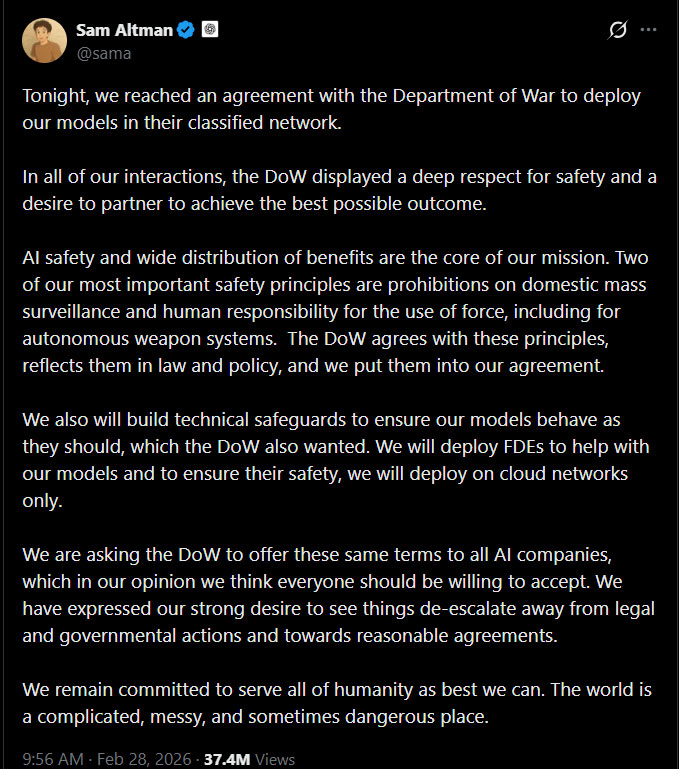
The “Cancel ChatGPT” backlash centered on objections to OpenAI’s agreement to deploy AI in classified US military environments. Some users called for subscription cancellations because they opposed the partnership or doubted whether restrictions on surveillance and weapons use would be enforceable.
The dispute emerged in late February 2026. Understanding it requires separating the companies’ stated safeguards from claims about what their technology would actually do.
What OpenAI announced
In its February 28 announcement, OpenAI described an agreement with the Pentagon, using the name Department of War. It said its restrictions covered mass domestic surveillance, directing autonomous weapons systems, and high-stakes automated decisions.
OpenAI said the deployment would use its cloud infrastructure and safety systems, with cleared personnel involved. A March 2 update added language addressing deliberate surveillance of US persons, including use of commercially acquired personal information. These are the company’s descriptions of its protections; they do not independently demonstrate how every future deployment will operate.
Why Anthropic became part of the debate
Anthropic’s February 26 statement opposed removing restrictions on mass domestic surveillance and fully autonomous weapons. It argued that current frontier models were not reliable enough to operate weapons without human involvement.
That position should not be mistaken for opposition to all military AI. Anthropic said Claude was already used for national security work and that it wanted to continue serving the military with those restrictions intact. The disagreement concerned permitted uses and safeguards, rather than a simple choice between military cooperation and no cooperation.
What the controversy means for users
A subscription boycott expresses dissatisfaction, but social media posts alone cannot establish how many people canceled, how long the campaign lasted, or its financial effect. Claims about those outcomes need separate evidence.
The useful questions are concrete: which uses does a contract permit, who checks compliance, what technical controls exist, and what happens when a restriction is breached? TipsMake’s discussion of commercial AI in military systems provides related context.
The defense agreement also should not be treated as proof that ordinary ChatGPT conversations are being supplied to the military. Users concerned about their own information can separately review chatbot training and privacy settings. Those settings address a different issue from oversight of classified deployments.
Related Articles
 Why Do Many People Stop Using ChatGPT Permanently?9 minutes read
 How to Cancel ChatGPT Plus to Avoid Losing Money3 minutes read
 ChatGPT Will Soon Be Able to See Everything Happening4 minutes read
 Learn About ChatGPT-4o: Features, Benefits and How to Use It: Complete Guide7 minutes read
 What Is ChatGPT Pro? Is It Worth It in 2026?8 minutes read
 How to Convert ChatGPT-5 to ChatGPT-4o3 minutes read
Reader Comments 0
Sign in with email or Google to join the discussion.