Table of Contents
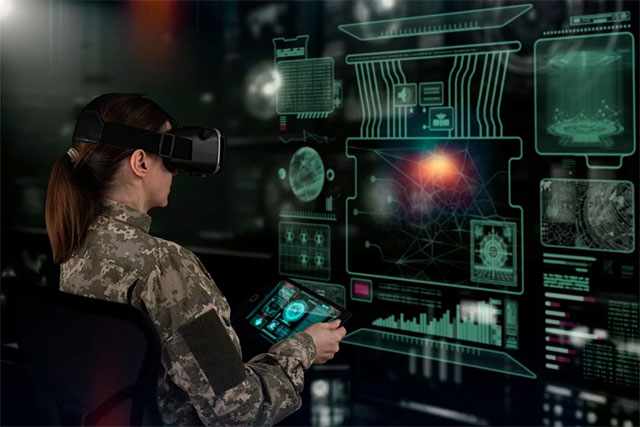
Artificial intelligence in modern warfare is used mainly to process information, identify patterns, support planning, and automate narrowly defined functions. Some weapon systems can also select and engage targets after activation. These are different categories with different technical, legal, and humanitarian risks.
AI can make an organization faster, but speed is not the same as sound judgment. A model cannot assume legal or moral responsibility, understand every feature of a changing battlefield, or decide which political and humanitarian consequences are acceptable. People and institutions remain responsible for decisions and outcomes.
A reported example: AI-assisted operations
In March 2026, The Washington Post reported that the U.S. military used Palantir's Maven Smart System with Anthropic's Claude during operations in Iran. The report attributed rapid intelligence analysis and target prioritization to the combined system and said more than 1,000 locations were struck in the first 24 hours.
Those operational details come from reporting about a partly classified environment and should be presented as attributed claims, not as independently verifiable measurements of AI accuracy or effectiveness. The number of targets processed or struck does not, by itself, establish whether recommendations were correct, decisions were lawful, civilian harm was avoided, or AI caused the speed.
Military AI is broader than autonomous weapons
“Military AI” covers systems with very different roles:
- Intelligence analysis: sorting imagery, sensor feeds, documents, and reports so analysts can focus on relevant material.
- Decision support: ranking information, forecasting outcomes, recommending options, or helping planners coordinate resources.
- Logistics and maintenance: predicting equipment needs, planning routes, and detecting faults.
- Cyber and communications: finding anomalies, managing networks, translating material, and prioritizing alerts.
- Autonomous functions: allowing a system to navigate, track, defend, select targets, or apply force with varying levels of human involvement.
A remotely piloted drone is not automatically an autonomous weapon. Remote control describes where the operator is; autonomy describes which functions the system performs without further human intervention.
Decision-support systems and autonomous weapons are not the same
| Category | Primary function | Central risk |
|---|---|---|
| AI decision-support system | Analyzes data and presents assessments, predictions, rankings, or recommendations to people | Humans may trust an unreliable output, overlook missing context, or make a rushed decision |
| Autonomous weapon system | After activation, can select and engage targets without further human intervention | Users may be unable to predict, understand, or control how force is applied in the actual environment |
| Automated defensive system | Detects and responds to tightly defined threats, often at machine speed | Misclassification, escalation, or operation outside the conditions for which it was tested |
The International Committee of the Red Cross uses the select-and-engage definition for autonomous weapons and separately identifies AI decision-support systems as tools that assist military decisions. Its current military AI overview explains why both categories require scrutiny.
Why the human role cannot be reduced to clicking “approve”
Human involvement is meaningful only when the person has enough authority, time, information, training, and technical understanding to question or reject the system's output. A nominal approval step after an opaque recommendation has already framed the decision may provide little real control.
For decisions involving force, a reviewer may need to evaluate matters that are difficult to encode reliably:
- whether information is current, complete, and corroborated;
- whether a person or object is a lawful target;
- whether expected civilian harm is excessive in relation to the anticipated military advantage;
- whether circumstances have changed since the data was collected;
- whether the system is operating within its tested conditions;
- whether an attack should be delayed or cancelled despite a technically available option.
Under international humanitarian law, responsibility rests with parties to a conflict and with people, not with a model. AI output can inform a decision; it cannot absorb accountability for it.
Automation bias is a central failure mode
Automation bias is the tendency to accept a system's recommendation too readily or to stop searching for contradictory evidence. The risk is especially acute when an interface appears precise, the operational tempo is high, or the user believes the model has seen more data than any person could review.
A human can also make a poor decision without AI. The important point is that adding a person to the workflow does not automatically correct model error. The organization must design for active review by showing sources, uncertainty, alternatives, and known limitations—and by protecting the reviewer from pressure to approve every recommendation.
The same basic discipline applies to lower-stakes AI: a confident answer is not proof. TipsMake's guide to recognizing hallucinations and AI limitations explains why outputs need verification against reliable evidence.
Why battlefield data is difficult for AI
Military environments contain several conditions that challenge machine-learning systems:
- Incomplete and conflicting data: sensors fail, reports arrive late, and sources disagree.
- Adversarial deception: opponents deliberately use camouflage, decoys, spoofing, misinformation, and electronic interference.
- Rapid change: a civilian vehicle, medical site, unit position, or surrender status can change after collection.
- Rare events: unusual but consequential situations may be poorly represented in test data.
- Context dependence: the same visible behavior can mean different things in different locations and phases of an operation.
- System interdependence: an error can pass from a sensor to a data pipeline, model, planning tool, and command interface.
Generative models add variability and may produce unsupported statements. Classification and detection models have different failure modes, including false positives, false negatives, and performance degradation when real conditions differ from training and testing.
Automation has a long military history, but AI changes the scale
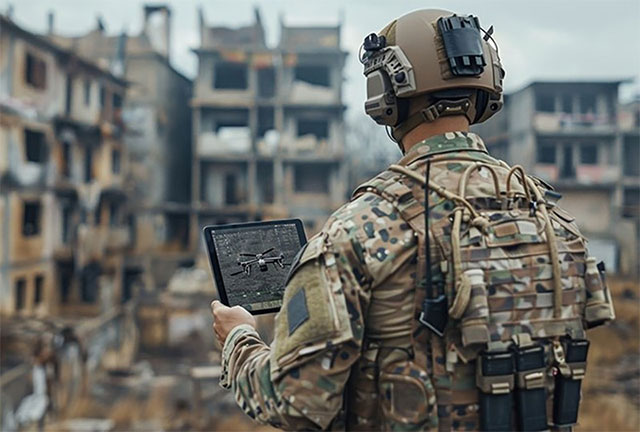
Contact mines, guided torpedoes, heat-seeking missiles, and automated air-defense systems all predate today's machine learning. Their existence shows that delegating limited functions to machines is not new.
Modern AI changes the volume and variety of information that can be processed, the complexity of patterns a system can learn, and the speed at which recommendations can circulate through a network. It can also make behavior harder to specify and predict than in a conventional rule-based system. Historical automation is therefore useful context, but it should not be treated as proof that newer systems pose no new risks.
The organization determines whether the tool helps or harms
A capable model cannot compensate for poor data, unclear authority, weak training, misleading interfaces, or incentives that reward speed over verification. Effective and responsible use requires more than buying software:
- Define a narrow task and the conditions in which the system may be used.
- Test it under realistic conditions, including deception, degraded communications, and unfamiliar inputs.
- Measure false positives, false negatives, calibration, and failure by relevant context—not only an average accuracy score.
- Give operators access to sources, uncertainty, and alternative assessments.
- Require independent corroboration for consequential recommendations.
- Record model, data, configuration, operator action, and decision rationale for later review.
- Provide a safe fallback and clear authority to pause or disable the system.
- Investigate incidents and near misses, then update training, procedures, and technical controls.
The U.S. Department of Defense's policy announcement on autonomous weapon systems states that systems should allow commanders and operators to exercise appropriate levels of human judgment over the use of force and calls for care, testing, and compliance with applicable law and rules of engagement. A policy requirement still has to be implemented and evaluated in practice.
Questions to ask about a military AI claim
- What exact task did the AI perform: detection, translation, prioritization, prediction, navigation, selection, or engagement?
- Was the output a suggestion, a filter, an automated action, or one input among several?
- What evidence supports the claimed improvement, and what baseline is used?
- Who checked the result, with what time and information, and could that person reject it?
- How was the system tested against adversarial manipulation and changing conditions?
- What error rates and civilian-impact measures are reported, not merely speed or volume?
- Which parts of the account are confirmed, reported by unnamed sources, vendor claims, or classified?
These questions help separate useful analysis from dramatic claims. They also reflect a general rule for choosing suitable tasks for AI: the higher the consequence of an error, the stronger the evidence, constraints, human review, and fallback must be.
AI changes human responsibility; it does not remove it
AI can reduce the time needed to search large data collections and can support people performing complex coordination. It can also compress decision time, hide uncertainty, spread one flawed inference across a network, and encourage overconfidence.
The responsible conclusion is not that AI will categorically replace or never replace a particular military role. The more defensible point is that current systems do not remove the need for human legal judgment, accountability, organizational design, and political responsibility. As automation becomes more capable, those human obligations become more demanding—not less.
Related Articles
 The 'Terrifying' Impact of AI in Modern Warfare: Explained8 minutes read
 COD Modern Warfare 2 Campaign Remastered - A Worthwhile8 minutes read
 The 'Terrifying' Influence of AI in Modern Conflict7 minutes read
 Call of Duty: Modern Warfare 2 Remastered Was Released Today3 minutes read
 This Guy Played Call of Duty: Modern Warfare 2 on the OnePlus 6T with Windows 10 ARM Installed3 minutes read
 The Era of Chatbot Warfare Is Unfolding: as Commercial AI Enters the Military Field7 minutes read
Reader Comments 0
Sign in with email or Google to join the discussion.