Table of Contents
Understanding Macromedia Flash requires more than a headline. The overview below breaks down the key facts, changes, and user impact.
Macromedia Flash Overview
Step 1 First, you need to prepare the photos to use in this lesson, if you don't have photos available, you can download the images here:





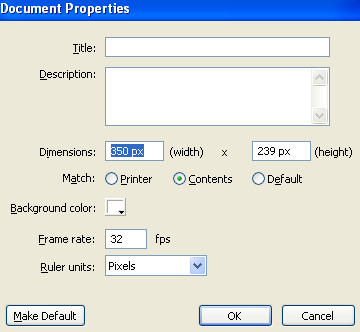
Step 2 Create a new flash file. Press Ctrl + J ( Document Properties ) to set the width of the file to 350 px, the height to 239 px (or the general size of the photos you have prepared). Set the background to white, Frame rate to 32, after setting it all, press OK.
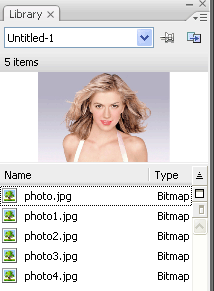
Step 3 Rename the current layer as photo 1 by double-clicking on the default name (Layer 1). Step 4 Go to File > Import > Import to Library. In the file explorer window, find up to 5 photos that you have prepared, hold Shift and select those photos, then click Open. If you are opening the Library ( Ctrl + L ) section on the Flash screen, you will see 5 photos that you just imported appear.
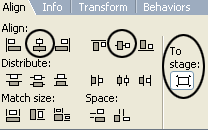
Step 5 Use the Selection Tool ( V ) and use the drag and drop technique to drag the first photo from the Library into the work area. Step 6 While the image is still selected, go to the Align Panel ( Ctrl + K ) and do the following: - Make sure the To Stage button of Align / Distribute is selected - Click the Align horizontal center button - Click on the Align vertical center button
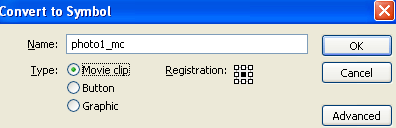
Step 7 Still select the image, press F8 ( Convert to Symbol ) to convert the image file into a Movie Clip.
Step 8 Click on frame 5, 10 and 15 and press F6, respectively Step 9 While you're still on frame 15, take the Selection Tool ( V ) and click once on the image. In the Properties Panel ( Ctrl + F3 ) below, in the Color menu select Advanced. Click the Settings button and make the adjustments as follows:
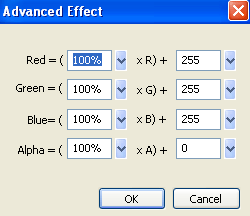
Repeat the process at frame 1 Step 10 Right-click anywhere between frame 1 and 5, between frame 10 and 15 on the timeline and choose Create Motion Tween from the menu that appears.
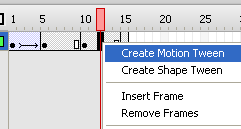
Step 11 Create a new layer above the layer photo 1 and name it photo 2 Step 12 Click on frame 12 of photo 2 and press F6 key. While you're still on frame 12, using the Selection Tool ( V ) drag the next image from the Library into the work area. Then repeat steps 6 and 7. Step 13 Click on frame 17 and 22 of layer photo 2 and press F6 one after another. While still on frame 22, repeat step 9. Do the same for frame 12. Step 14 Right-click anywhere between frame 12 and 17, between frame 17 and 22 on the timeline bar and choose Create Motion Tween. So we have done 2 effects for image 1 and image 2. Continue to do the same process with the rest of the images with each image is a layer and the same distance as above. Download the source file here.
FAQ
What does Macromedia Flash - Vivid Photo Effects explain?
Understanding Macromedia Flash requires more than a headline.
Who is most affected by Macromedia Flash?
The overview below breaks down the key facts, changes, and user impact.
What are the key takeaways from this topic?
Macromedia Flash Overview Step 1 First, you need to prepare the photos to use in this lesson, if you don't have photos available, you can download the images here: Step 2 Create a new flash file.
Related Articles
 Macromedia Flash - Photo Effects with Sound7 minutes read
 Macromedia Flash - an Attractive Photo Appearance Effect4 minutes read
 Macromedia Flash: Create Effects for Nature Photos4 minutes read
 Macromedia Flash - Effects of Lighting on Photos4 minutes read
 Macromedia Flash - Animation and Rotation Effects4 minutes read
 Macromedia Flash - Making Fireworks Effects4 minutes read
Reader Comments 0
Sign in with email or Google to join the discussion.