Table of Contents
What Is Nginx?
Nginx (pronounced "engine x") is a free, open source web server launched in 2004. It is easily configurable and has also found a niche as a proxy server.
Key Takeaways About Freenginx
- Nginx (pronounced "engine x") is a free, open source web server launched in 2004.
- It is easily configurable and has also found a niche as a proxy server.
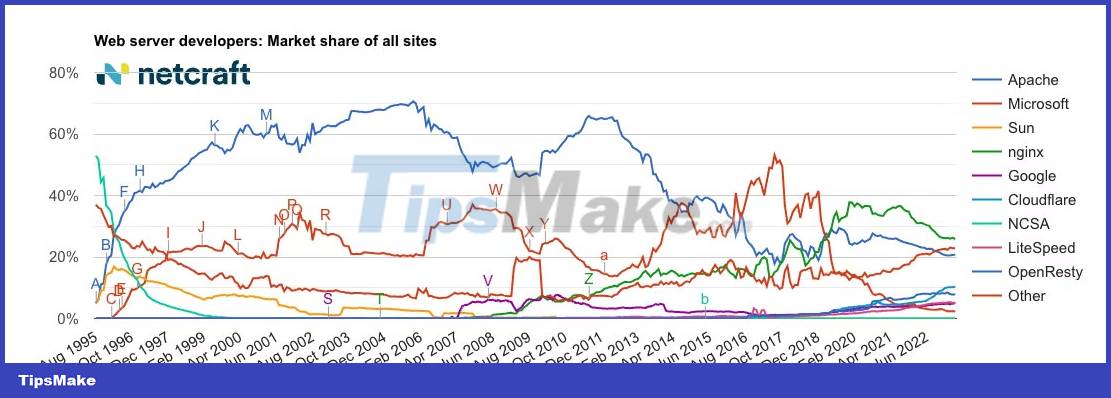
- According to Netcraft, Nginx's popularity has steadily increased, surpassing long-standing open source competitor Apache and Microsoft's proprietary IIS in 2019.
According to Netcraft, Nginx's popularity has steadily increased, surpassing long-standing open source competitor Apache and Microsoft's proprietary IIS in 2019.
What Is Freenginx?
On February 14, former Nginx developer Maxim Dounin announced Freenginx, a fork of Nginx. Maxim took this action to protest the decisions of the company that currently owns Nginx, F5. He wrote:
[I]no longer consider nginx a free and open source project developed and maintained for the benefit of the community.
The first version of Freenginx (1.25.4) launched on February 20, 2024, with several fixes to address vulnerabilities related to memory access. These are common security vulnerabilities that could allow malicious actors to attack websites.
Is Freenginx Better Than Nginx? Should I Start Using It?
After just one modification, Freenginx is almost no different from the original version. This is what happens with all branches. Over time, a branch will gradually diverge from its original software, while the remaining projects will follow different paths.
Freenginx's stated goal is to focus more on security-related and developer-led improvements rather than being driven by decisions from management above.
As the daughter branch matures, any migration will be less likely to be similar in nature. So now is the time to make a change if you like the direction Freenginx is going or if you want to support the developer's goals.
However, it is not necessary to change horses at this stage of the race. Nginx is not going anywhere and will always have the right to incorporate Freenginx changes into its codebase.
What Other Web Servers Are There?

Apache remains the primary alternative to Nginx, especially in open source ecosystems where it is installed by default or is easy to install. These two web servers currently dominate the market share and experience with either of them is valuable.
But this doesn't tell the whole story. Market share statistics from different sources are inconsistent, and trends can change quickly if a company responsible for hosting a large number of websites makes a change.
Smaller options include OpenResty - another Nginx variant with a suitable storage location for Lua applications - and Google's GWS. GWS is used exclusively by Google, but has a clear market share due to the number of sites Google generates.
FAQ
What is the main update about Freenginx?
Nginx (pronounced "engine x") is a free, open source web server launched in 2004.
Why does Freenginx matter?
It is easily configurable and has also found a niche as a proxy server.
What should readers know about Freenginx?
According to Netcraft, Nginx's popularity has steadily increased, surpassing long-standing open source competitor Apache and Microsoft's proprietary IIS in 2019.
Related Articles
 Branch Management in Git: Managing Branches in Git10 minutes read
 Learn About the Most Popular RDBMSs: Complete Overview10 minutes read
 How to Install a VPN on Windows Server 20194 minutes read
 Learn About the Architecture of MS SQL Server22 minutes read
 Create a Site-to-site VPN on Isa 2006 (Part 3)16 minutes read
 Office: Create a Site-to-site VPN on Isa 2006 (Part 5)22 minutes read
Reader Comments 0
Sign in with email or Google to join the discussion.