Table of Contents
This guide provides a clear, practical overview of instructions to set up the default application to open files, with useful context, important details, and straightforward takeaways for everyday readers.
Find the Default Apps Menu in Settings
The Windows 11 Settings application provides a convenient interface for you to choose or change which applications are responsible for opening which specific file types. First, open the Settings app by pressing Windows + i on your keyboard. Or, you can right-click the Start button and select ' Settings ' from the menu that appears.

In Settings, click ' Apps ' in the list on the left, then select ' Default Apps ' in the right pane.

Immediately, the Default Apps screen will open. Next, there are a few different ways you can change your default app settings. Find out below.
Choose default apps by file type
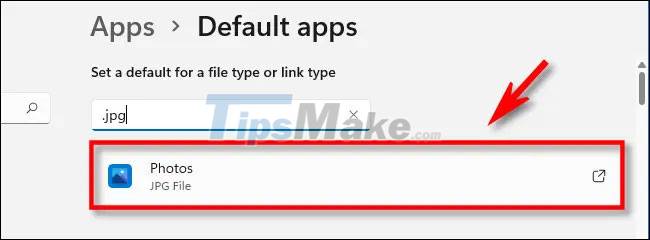
One of the simplest ways to change the default apps is to search by file type. In Settings > Apps > Default Apps , you'll see a text box labeled ' Enter a file type or link type '. Click that and enter the name of the file extension that you want to 'assign' to a particular application. For example, '.txt' for text files or '.jpg' for JPEG images.

If you have an extension that is not 'registered' you will see a button that says ' Choose a Default ', allowing you to set the default application for that file type. Click this button and follow the same steps as listed below.
In case you import a known file type, you will see the application with which the file extension is being associated appear directly below the text input box. To change this link, click the app name that appears.
A pop-up will ask ' How do you want to open [.] files from now on? '. Where [extension] is the type of file extension you are working with, such as .txt or .jpg. In the list of apps below, select the app you want to use, then click OK .

From now on, the file type you just modified will open only in the selected application by default.
Choose default by application
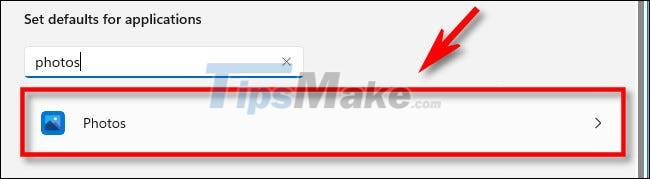
You can also change the file association by application. On the Default Apps screen, you will see a list of installed applications. Find the app for which you want to change the default, then click it. We will use Photos as an example.
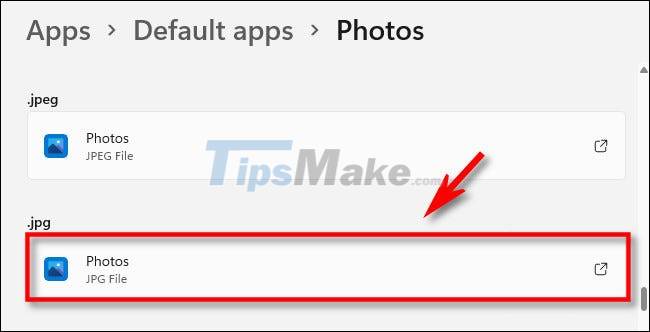
On the app's details screen, scroll down and select the type of file that you want to associate (open) with another app.
When the system asks with which program you want to open the file, browse through the list, select the application you want to use, then click ' OK '.

Change default apps using context menu
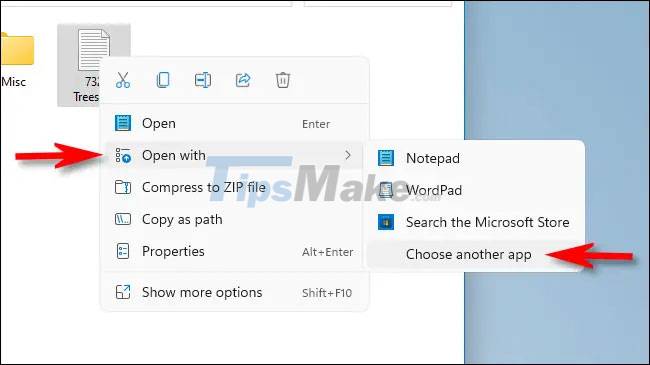
First, find a file for which you want to change the default application on the desktop or in File Explorer. Right click on the file and select ' Open With ', then click ' Choose Another App ' from the menu.
In the pop-up menu, select the application that you want to use to open this file type. Then, check the box next to ' Always use this app to open [.] files ' and click ' OK '.

From now on, whenever you double click on that file type, it will always be opened in the application you selected.
Key Takeaways
Use the information above as a practical reference for instructions to set up the default application to open files. Review each step carefully, confirm any requirements, and choose the option that best fits your situation.
FAQ
What does this guide explain about Instructions to Set up the Default Application to Open Files?
It explains the main concepts, practical considerations, and useful steps related to instructions to set up the default application to open files without requiring advanced knowledge.
Who can benefit from learning about Instructions to Set up the Default Application to Open Files?
This information is useful for readers who want a clear overview, practical guidance, and reliable steps related to instructions to set up the default application to open files.
What should I check before applying this information?
Review the requirements, confirm that your device, software, or situation matches the instructions, and back up important data before making major changes.
Related Articles
 How to Fix the Error Does Not Install the Default Windows 104 minutes read
 5 Ways to Open Applications in Windows 105 minutes read
 How to Reinstall the Removed Default Application on Windows 10?5 minutes read
 Steps to Set up Default Applications on Windows 116 minutes read
 How to Access Windowsapps Folder on Windows 10 and Windows 8?6 minutes read
 How to Open Files on Windows: Clear Instructions7 minutes read
Reader Comments 0
Sign in with email or Google to join the discussion.