Table of Contents
This updated guide examines Click: How to Remove Windows Genuine Advantage Notifications and organizes the essential facts, background, and practical takeaways in clear American English.
Method 1of 3:
Activating Windows
 Make sure that you'reconnected to the Internet. to activate your copy of Windows, you'll need to be connected to the Internet so that Microsoft can validate your key.
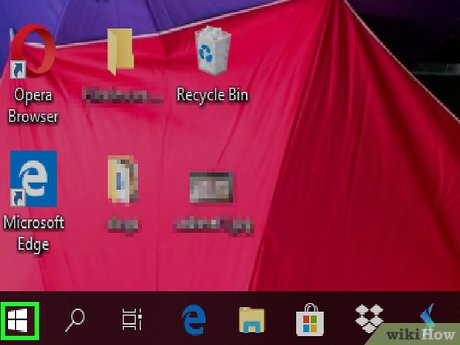 Open Start
 . Click the Windows logo in the bottom-left corner of the screen. The Start menu will pop up.
 Open Settings
 . Click the gear-shaped icon in the lower-left side of the Start menu.
 Click
Click Update & Security. This circular arrow-shaped icon is at the bottom of the Settings window.
 Click theActivationtab. You'll find it on the left side of the window.
 ClickChange product key. It's a link in the middle of the Activation page. Doing so opens a new window.
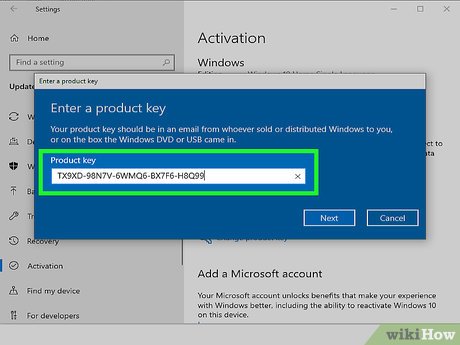 Enter your Windows 10 product key. Type the activation key that came with your copy of Windows 10 into the text box.
- You can usually find the product key on the CD box if you bought a hard copy, or in a confirmation email from Microsoft if you bought a Windows 10 product key online.
- If you bought a key for Windows 7, 8, or 8.1, you can use that key to register Windows 10.[1]
 ClickNext. It's in the lower-right corner of the window. This will prompt Microsoft to attempt to verify your copy of Windows.
 Follow any on-screen instructions. If your copy of Windows is legitimate, you should receive a notification that it has been accepted, though you may need to enter additional information if prompted.
Method 2of 3:
Removing the Activation Watermark from Windows 10
 Make sure that you're on an administrator account. You'll need to be on an account that has administrator privileges to make changes to your computer's registry.
 Open Start
 . Click the Windows logo in the bottom-left corner of the screen.
 Type inregedit. This will search your computer for the Registry Editor command.
 Clickregedit. It's a teal collection of blocks at the top of the Start window.
 ClickYeswhen prompted. Doing so will open the Registry Editor window.
 Go to the "Activation" key. To do so:
- Expand the HKEY_LOCAL_MACHINE folder by double-clicking it.
- Expand SOFTWARE
- Scroll down and expand Microsoft
- Scroll down and expand Windows NT
- Expand CurrentVersion
- Expand Software Protection Platform
- Click Activation
 Right-clickManual. It's a blue-and-white icon on the right side of the window. A drop-down menu will appear.
- If your mouse doesn't have a right-click button, click the right side of the mouse, or use two fingers to click the mouse.
- If your computer uses a trackpad instead of a mouse, use two fingers to tap the trackpad or press the bottom-right side of the trackpad.
 ClickModify. It's at the top of the drop-down menu. A window will appear.
 Change the value data. In the "Value data" text box, replace the "0" with a "1", then click OK .
- You may be prompted to confirm this choice. If so, click Yes or OK before proceeding.
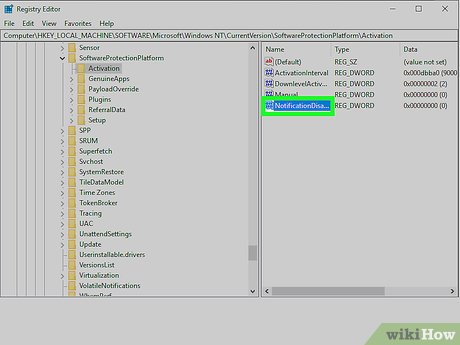 Right-clickNotificationDisabled. This item is also on the right side of the page.
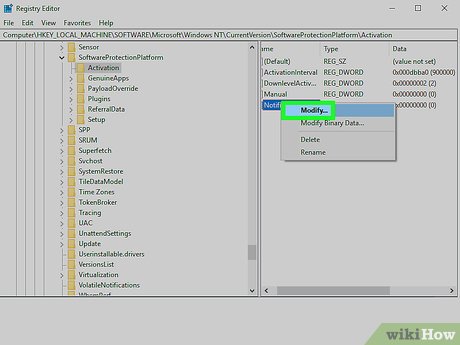 ClickModify.
 Change the value data to1. This will prevent the activation notification from appearing on your desktop.
 Restart your computer. Click Start
  , click Power
  , and click Restart in the pop-up menu. Your computer will shut down and then turn itself back on.
- Repeat this process if the notification reappears. While removing the watermark notification will work temporarily, you may need to disable it again in the future.
Method 3of 3:
Disabling Genuine Advantage in Windows 7
 Open Start
 . Click the Windows logo in the bottom-left corner of the screen.
 Click the search bar. It's at the bottom of the Start window.
 Type intask manager. This will search your computer for the Task Manager application.
 ClickTask Manager. It's at the top of the Start window.
 Open the Run window. Press⊞Win+Rat the same time to do so.
- If this doesn't work, re-open Start , type inrun, and click Run .
 Type insystem32.System32 is a folder that contains many of your computer's sensitive files.
 ClickOK. It's at the bottom of the Run window. This will open the system32 folder.
 Enable viewing for hidden files and file extensions. To do so:
- Click the View tab.
- Check the "Hidden items" box.
- Check the "File name extensions" box.
 Find the"WgaLogon.dll" file. The easiest way to do this is by typingwgainto the search bar that's in the upper-right side of the window and then waiting for the "WgaLogon.dll" file to appear.
 Rename the"WgaLogon.dll" file. Right-click the file, click Rename , and type.bakat the end of the file name and extension, then press↵Enter.
- The file should now read "WgaLogon.dll.bak" instead.
- You may be prompted to confirm this choice. If so, click Yes or OK .
 Create an empty copy of the"WgaLogon.dll" file. To do so:
- Right click on a blank space in the system32 window.
- Select New
- Click Text Document
- Type inWgaLogonas the file's name.
- Replace the.txtwith.dll
- Press↵Enter, then click Yes if prompted.
 Find the"WgaTray.exe" file in both system32 and Task Manager. Since you'll need to delete both entries within 5 seconds of each other, you'll want to find them now. To do so:
- system32 - You should see "WgaTray.exe" in the window if "wga" is still typed into the search bar.
- Task Manager - Click the Processes tab, scroll down until you find the "WgaTray.exe" option, and click it.
 Delete both"WgaTray.exe" files. Select the system32 "WgaTray.exe" file and press theDelkey, then switch to Task Manager and click End process or End task in the lower-right corner of the window.
 Restart your computer when finished. Once your computer finishes rebooting, your Genuine Advantage notifications should be gone.
- You may have to repeat this process at some point, since Genuine Advantage notifications often return with critical updates.
FAQ
What is Click: How to Remove Windows Genuine Advantage Notifications about?
It provides a structured overview of click, explains the main context, and highlights practical takeaways for readers.
Why does this topic matter?
Understanding the main concepts helps readers evaluate the issue, avoid common mistakes, and make better-informed decisions.
How should readers use this information?
Use the guidance as a practical starting point, confirm details that may have changed, and follow current product, safety, or security recommendations.
Related Articles
 Problems with Windows Genuine Advantage and Workarounds11 minutes read
 Disable, Remove Notification Icon Get Windows 104 minutes read
 How to Control and Customize Notifications in Windows 118 minutes read
 How to Turn Off Focus Assist Notifications on Windows 103 minutes read
 Remove Ccleaner's Annoying Messages in 2 Steps2 minutes read
 Here's How to Disable Notifications from Windows Phone Phones on2 minutes read
Reader Comments 0
Sign in with email or Google to join the discussion.