Table of Contents
This updated guide examines How to Make a Program Using Notepad and organizes the essential facts, background, and practical takeaways in clear American English.
Part 1
Observing Some General Tips
 Understand Notepad's limitations. You can technically write and run a program in Notepad using any coding language available, but you must save the program in the correct format for the program to run.
- All Notepad files save as text documents by default.
 Find and open Notepad. The easiest way to open Notepad is by clicking Start
  , typing innotepad, and clicking the blue Notepad icon at the top of the Start window.
 Determine your programming language. Notepad doesn't exclude any languages, but you'll need to use the same language throughout the document to remain consistent.
- If you don't know any programming languages, you can try one of the examples listed in this article.
 Press↵Enterafter you complete a line of code. As with most code editors, you'll always need to place new lines of code on a new Notepad line.
 Close any open brackets and parentheses. Whenever you open a bracket or parenthesis (e.g.,
{or[), you must close it with the opposite-facing counterpart to complete a line of code. Failing to do so will result in errors. Consider using a dedicated code-editing program. While you can certainly write entire programs in Notepad, it's definitely not the easiest way—Notepad doesn't contain any syntax highlighting or indentation options, making it difficult to use for writing larger pieces of code.
- Notepad++ is a great free option for coding.
Part 2
Creating a Program
 Open Notepad. This is how you will create and save any program regardless of the programming language that you use.
 Enter your program's code. Make sure that the language you use is consistent throughout the document.
 ClickFile. It's in the top-left corner of the Notepad window. A drop-down menu will appear.
 ClickSave As…. This option is near the top of the drop-down menu. Doing so opens the "Save" window.
 Select a save location. Click a folder (e.g., Desktop ) on the left side of the "Save" window to select that folder as your program's destination.
 Click the "Save as type" box. You'll find it near the bottom of the "Save" window. This prompts a drop-down menu.
 ClickAll Files. It's in the drop-down menu. This option allows you to save the Notepad file as any type of program.
 Enter a name for your program. Click the "File name" text field and enter your preferred name for your program.
 Add the program's extension to the name. Regardless of the program's name, you'll need to place a period and the programming language's extension tag after the name in order for the program to be saved correctly. Common programming languages and their extensions include the following:
- Batch (BAT) -.bat
- HTML -.htm
- Python -.py
- C++ -.cpp
- For example: to save a batch file as "watermelons", you would typewatermelons.batinto the "File name" field.
 ClickSave. It's in the bottom-right corner of the window. Doing so saves your program in your selected format. You can run it by double-clicking it, though you may need to select a program in which to open it after doing so.
Part 3
Creating a Basic BAT Program
 Open Notepad. You can create a program that opens another program on your computer using a batch (BAT) script.
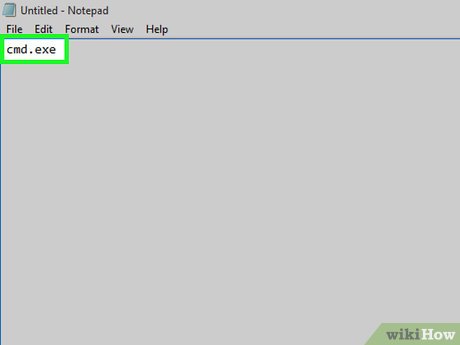 Enter the Command Prompt file's name. Typecmd.exeinto Notepad.
 Save your program. Make sure that you use the.batextension when saving.
 Double-click your BAT file. Doing so will open a new Command Prompt window.
Part 4
Creating a Basic HTML Program
 Open Notepad. Especially if you're designing a webpage, HTML is a great language to use.
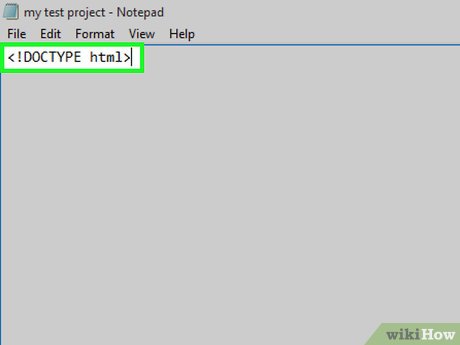 Indicate that you'll be using HTML. Type
into Notepad and press↵Enter. Add the HTML tag. Type
into Notepad and press↵Enter. Set up the body text section. Type
into Notepad and press↵Enter. This line indicates that the following part of the document will contain a section of information (in this case, text). Add a page heading. Type
into Notepad and press↵Enter, making sure to replace "Text" with whatever you want your page header to be.
Add a page heading. Type
into Notepad and press↵Enter, making sure to replace "Text" with whatever you want your page header to be.
- For example: to create a page with the heading "Hello!", you would type into Notepad.
 Add text to your page. Typeinto Notepad and press↵Enter. Make sure that you replace "text" with your preferred text.
- For example, you would type
How are you today?
into Notepad to display the phrase "How are you today?" below the heading.
- For example, you would type
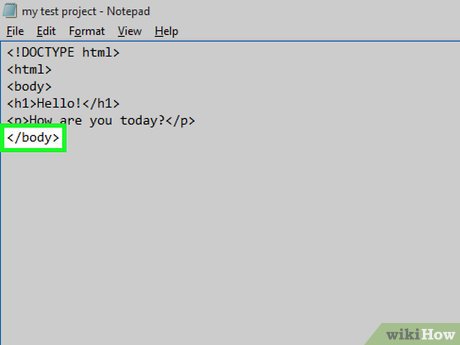 Close the body section. Type
into Notepad, then press↵Enter. Indicate the end of the HTML coding. Type
into Notepad. Review your program's code. It should look something like this:
-
How are you today?
 Save your program. Make sure that you use the.htmextension when saving.
 Double-click the HTML file. Doing so will usually open it in your default web browser, though you may have to select a program first. You should see your heading and its text displayed.
Part 5
Creating a Basic Python Program
 Open Notepad. Using the "print" command in Python, you can display any text that you want to.
 Enter the "print" command. Type
print("into Notepad. Make sure that there aren't any spaces when you do this. Add text to display. TypeHello!into Notepad.
 Close the "print" command. Type
")into Notepad to close the command. Review your code. It should look something like this:
print("Hello!")
 Save your program. Make sure that you use the.pyextension. You should now be able to open the program in your preferred Python editor.
Part 6
Creating a Basic C++ Program
 Open Notepad. You'll be using Notepad to create a basic C++ program that displays "Hello World!" when run.
 Add a title to your program. Type in
//followed by your program's title (e.g., "My first program"). Any text in a line that's typed after two slash marks will show up as plain text (e.g., not part of the program).- For example: to entitle your program "Program 1", you'd type
//Program 1into Notepad.
- For example: to entitle your program "Program 1", you'd type
 Enter the preprocessor command. Type
#includeinto Notepad, then press↵Enter. This command instructs C++ to run the following lines of code as a program. Declare the program's function. Type
int main ()into Notepad, then press↵Enter. Add an open bracket. Type
{into Notepad, then press↵Enter. Your program's main code will go between this open bracket and a closed bracket later. Enter your program's execution code. Type
std::cout<< "Hello World!";into Notepad, then press↵Enter. Add a closed bracket. Type
}into Notepad. This closes the program's execution phase. Review your program. It should look something like this:
//Program Title#includeint main (){
std::cout<< "Hello World!";}
9
- Save your program. Make sure that you use the.cppextension when doing so. Once you've saved the program, you should be able to run it in your preferred C++ compiler.
{"smallUrl":"https://www.wikihow.com/images/thumb/a/ae/Make-a-Program-Using-Notepad-Step-46.jpg/v4-460px-Make-a-Program-Using-Notepad-Step-46.jpg","bigUrl":"https://www.wikihow.com/images/thumb/a/ae/Make-a-Program-Using-Notepad-Step-46.jpg/v4-760px-Make-a-Program-Using-Notepad-Step-46.jpg","smallWidth":460,"smallHeight":345,"bigWidth":760,"bigHeight":570,"licensing":"
License: Fair Use (screenshot) n
"}
Tips
- C++ and HTML are two of the most commonly used programming languages in existence.
- You can use virtually any programming language to create most programs, though some languages are better-suited to specific functions (e.g., HTML is ideal for creating webpages).
Warnings
- Always check your code before saving it. Saving a broken program can cause issues with your default program compiler.
- Use the Command Prompt and Write in Batch Language
- Build a Simple Computer Game Using Batch Script
- Create a Simple CSS Stylesheet Using Notepad
- Make a Simple Mod of a Game
- Build a Simple Calculator Using Batch Script
1. Open Notepad. 2. Enter your program's code. 3. Click File , then click Save As... . 4. Click the "Save as type" drop-down box, then click All Files . 5. Type the program's extension (e.g., ".html") at the end of the name in the "File name" text box. 6. Click Save .
FAQ
What is How to Make a Program Using Notepad about?
It provides a structured overview of program, explains the main context, and highlights practical takeaways for readers.
Why does this topic matter?
Understanding the main concepts helps readers evaluate the issue, avoid common mistakes, and make better-informed decisions.
How should readers use this information?
Use the guidance as a practical starting point, confirm details that may have changed, and follow current product, safety, or security recommendations.
Related Articles
 Why Is Notepad Still a Great Note Taking Application?7 minutes read
 How to Use Notepad++5 minutes read
 What Is Notepad ++? Compare Notepad ++ and Regular Notepad4 minutes read
 These 'Hack' Tips Are Only Notepad Can Do22 minutes read
 Windows 11: Complete Guide: How to Activate and Experience the New4 minutes read
 If You've Overlooked Notepad Before, It's Time to Reconsider!8 minutes read
Reader Comments 0
Sign in with email or Google to join the discussion.