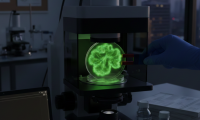
MagLOV: A Fluorescent Protein That Responds to Magnetic Fields
Engineered MagLOV proteins let researchers detect magnetic responses in living bacteria. The work demonstrates sensing and imaging methods, rather than remote-control treatments.

Browse more Explore Discover science news, research highlights and clear explainers that make important discoveries, ideas and developments easier to understand.
Engineered MagLOV proteins let researchers detect magnetic responses in living bacteria. The work demonstrates sensing and imaging methods, rather than remote-control treatments.
Saving possessions, checking phones, gossiping, procrastinating, and startling have different explanations. Separate useful evolutionary ideas from unsupported claims.
A survey of advances in genomics, medicine, physics, astronomy, and archaeology, with the limits of each milestone and the questions that remain unresolved.
Researchers grew ordered gallium-doped germanium films that become superconducting near 3.5 K. The result could help integrate semiconductor and superconducting components in quantum devices.
A quiet history does not make a volcano safe. Hayli Gubbi, El Chichón and Pinatubo show why monitoring, hazard maps and clear evacuation warnings matter before an eruption.
Chinese researchers demonstrated kerosene detonation in a ground-test engine model. The experiment addresses ignition in a compact combustor; it does not show an aircraft flying at Mach 9.
Geothermal plants use underground heat to drive generators. Compare dry steam, flash steam and binary-cycle systems, their advantages and limits, and how they differ from home heat pumps.
Ionocaloric refrigeration uses ions to control melting and freezing. Here is how the laboratory cycle works, its reported results and the barriers to commercial use.
An analysis of an ArcheAge beta test found less character progression and continuing social interaction before a wipe. Here is what it can—and cannot—tell us.
Cambridge researchers created stem-cell models that produce blood cells. The work helps study early development, while transplant applications remain experimental.
Planes need air for lift and engine combustion. See why thin air limits their altitude, how rockets reach orbit and what makes a spaceplane different.
A US–Brazil study linked age-related differences in political headline sharing to partisan bias. See the findings, their limits and checks to use before sharing.
Meet 20 influential physicists and astronomers, with clear explanations of their discoveries in motion, electricity, atoms, quantum theory, and the universe.
Paranthropus fossils have been found alongside early stone tools. Here is why that matters—and why the identity of the toolmakers remains uncertain.
A 2025 study found unusual potassium isotope ratios in rocks, suggesting some mantle material may preserve a chemical signature from before the Moon-forming impact.
Researchers found membrane-bound footprints left by dying cells. These structures help mark cell remains and carried influenza A virus in laboratory experiments.
Check the right disposal route for foam, toothpaste tubes, toys, cookware glass, and receipts, with local acceptance taking priority over recycling symbols.
Understand the silicon-22 mass experiment, what a nuclear magic number means, and how mirror-nucleus measurements test shell structure near the proton drip line.
Understand little-known weather terms that may affect your area this year with clear context, practical context and key details for confident evaluation.
How fusion neutrons could convert mercury-198 into gold-197, what the simulations estimate, and why that does not yet prove commercial gold production.