Table of Contents
AI fake-news detectors can flag suspicious claims, but their output should not be treated as a final verdict. A model may classify text from patterns learned during training, retrieve incomplete evidence, or misread a claim that depends on context. Reliable verification still requires checking the original claim against credible, current sources.
Detection is not the same as fact-checking
A basic detector predicts whether a piece of content resembles examples labeled “real” or “fake.” That can be useful for triage, but it is different from the work of identifying a precise claim, locating primary evidence, checking dates and context, and explaining why the evidence supports or contradicts it.
High performance on a benchmark also does not guarantee equal performance on breaking news, unfamiliar languages, satire, manipulated images, or topics not represented in the test data. A score must be interpreted alongside the dataset, label definitions, comparison methods, and error rates for different classes of content.
Why an AI detector can be wrong
- Training-data limitations: Labels may contain mistakes, inconsistent standards, regional gaps, or political and cultural biases.
- Changing information: A once-accurate answer can become outdated as new evidence appears.
- Weak evidence retrieval: A retrieval system may surface copied reports, low-quality sources, or pages that repeat the claim without proving it.
- Missing context: Cropped quotations, satire, opinion, and claims about a specific date can be misclassified when evaluated in isolation.
- Generated explanations: A fluent rationale may sound convincing even when the underlying sources do not support it.
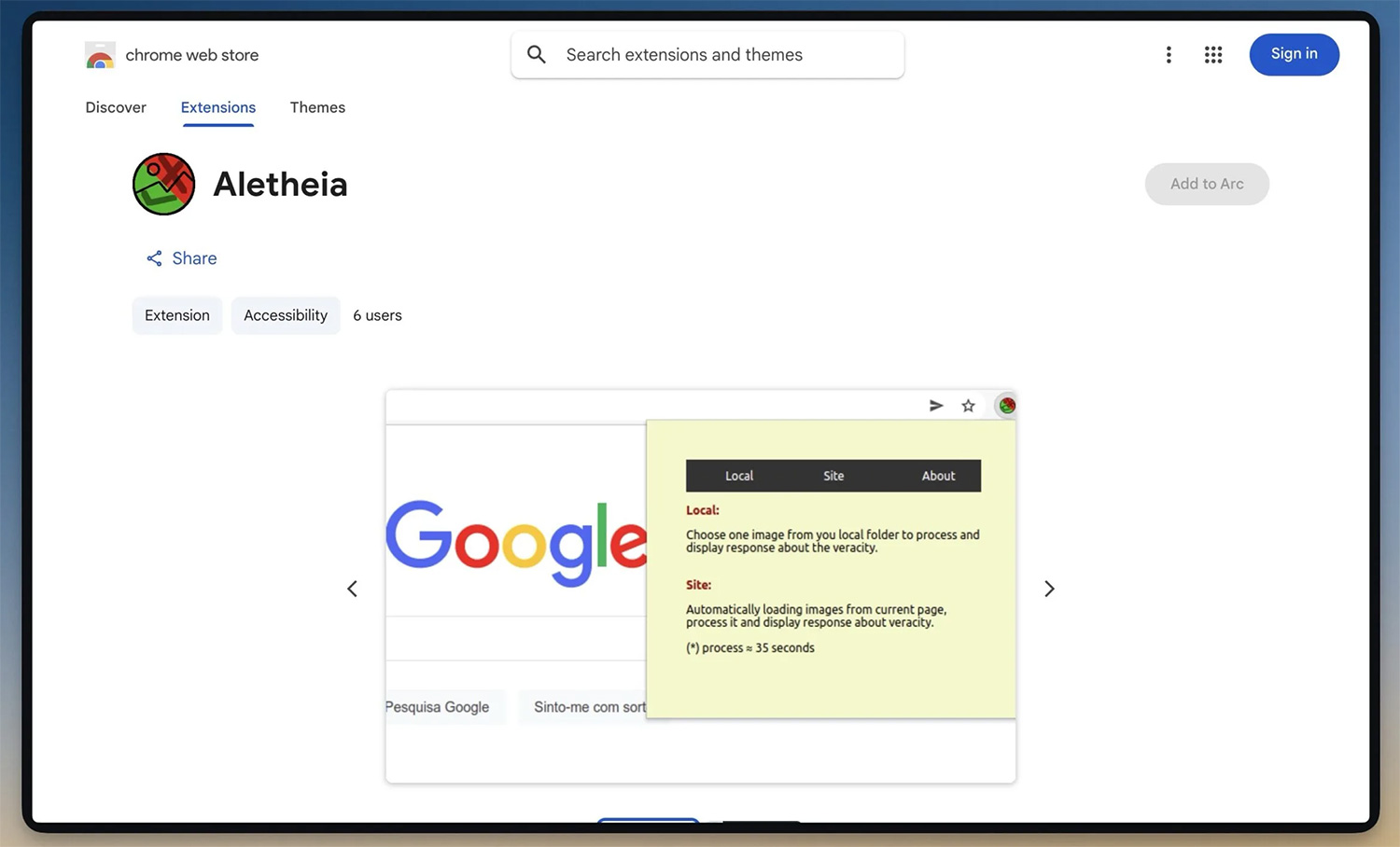
What Aletheia tries to improve
A 2026 research paper by Dorsaf Sallami and Esma Aïmeur at the University of Montreal introduced Aletheia, a prototype Chrome extension built around a retrieval-augmented large language model. The system extracts a claim, searches for web evidence, filters sources, classifies evidence as supporting, refuting, or unrelated, and returns a verdict with an explanation and confidence score.
The design also includes a discussion area and a feed of recent fact checks. The researchers evaluated the model on the LIAR and PolitiFact datasets and conducted a user study with 250 participants. They reported better detection performance than the baselines used in their experiments and positive usability results.
Those findings are promising, but they do not make the extension an independent authority on truth. The paper is a research report submitted to arXiv, and its results depend on the selected datasets, baselines, search results, source filtering, model configuration, and evaluation design. Readers can examine the Aletheia paper and methodology directly.
How to use AI fact-checking tools safely
- Reduce the story to a testable claim. Separate names, dates, numbers, and quoted statements instead of asking whether an entire article is “fake.”
- Open the cited evidence. Do not rely on the detector’s summary or confidence score.
- Prefer primary sources. Look for the original document, dataset, court filing, company announcement, research paper, or full recording.
- Check publication and event dates. Old material is frequently recirculated as if it were new.
- Compare independent sources. Multiple sites repeating the same wire story or press release are not independent confirmation.
- Look for what would disprove the claim. Confirmation bias affects people and automated systems alike.
The practical takeaway
AI is useful for finding possible evidence, breaking a claim into parts, and highlighting areas that deserve attention. It is much less reliable as a one-click judge of truth. Treat a detector’s label as a prompt to investigate, then base your conclusion on traceable evidence and transparent reasoning.
Related Articles
 Identify Fake News: How to Distinguish True Fake News4 minutes read
 Facebook, Google, Twitter Tightly Control Information Related to4 minutes read
 Instructions on How to Fake Ip on Android4 minutes read
 Even Deepfake Fraud Detection Tools Can Be Deceived4 minutes read
 WhatsApp Has a New Strategy to Prevent the Spread of Fake3 minutes read
 5 Simple and Effective Chrome Fake Ip Applications Today5 minutes read
Reader Comments 0
Sign in with email or Google to join the discussion.