Table of Contents
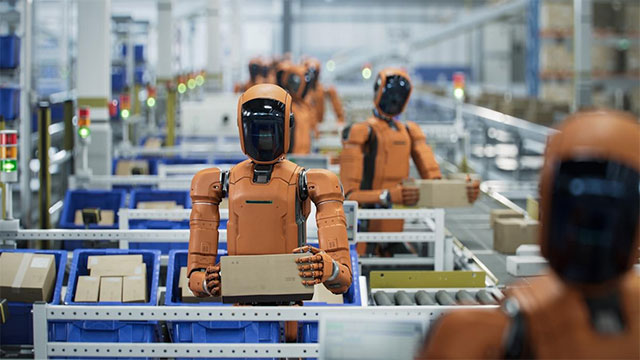
Xiaomi is testing humanoid robots on limited tasks at its electric-vehicle factory in Beijing. The trial is an experiment in whether a general-purpose robot can work in a production environment built for people; it does not mean humanoids have replaced workers or conventional industrial robots on the assembly line.
What Xiaomi reported from the trial
Company president Lu Weibing said two humanoid robots were tested during a roughly three-hour factory shift and completed about 90% of the work assigned to them. Reported tasks included handling and installing nuts—repetitive operations that require the robot to identify parts, position its hands, and interact with factory equipment.
That percentage needs context. It describes a small pilot with selected tasks, not 90% of all vehicle assembly and not a demonstrated ability to work an uninterrupted industrial shift. Xiaomi has not publicly provided enough detail to compare the robots’ speed, error rate, intervention requirements, or cost with human workers and fixed automation.
Humanoid robots are only one part of the factory
Xiaomi says its EV plant is highly automated, but most of that automation comes from established equipment such as fixed robot arms and material-handling systems. The body workshop uses hundreds of industrial robots for repeatable operations including welding, riveting, and adhesive bonding.
This distinction matters because a fixed robot usually completes one carefully engineered task faster and more reliably than a humanoid. The potential advantage of a human-shaped machine is flexibility: it may eventually use workstations, tools, and paths designed for people without rebuilding an entire production line.
Why factory work remains difficult
Real production environments expose the limits of current humanoid systems. Components can arrive at different angles, lighting changes, people move through the workspace, and a misplaced part can interrupt a routine. A useful factory robot must detect these changes, recover safely, and repeat the task for long periods with predictable quality.
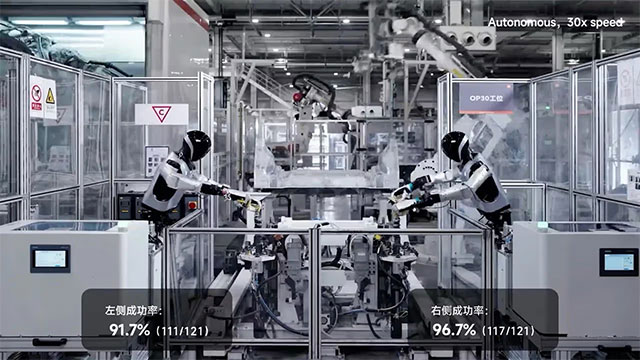
Computer vision, force sensing, and learned control can help a robot recognize and manipulate parts, but a successful demonstration does not by itself prove production readiness. Reliability, cycle time, safety certification, maintenance, energy use, and total operating cost all matter.
CyberOne and the identity of the factory robots
Some reports identify the trial machines as versions of Xiaomi’s CyberOne humanoid. Xiaomi first presented CyberOne as a research platform, but public descriptions of the factory trial do not establish that the robots are an unchanged commercial CyberOne model. It is safer to treat them as experimental Xiaomi humanoids unless the company publishes a specific model and configuration.
What the trial actually shows
The test shows that Xiaomi is collecting experience and training data for embodied AI in a real factory. It does not establish that humanoids are ready for broad deployment. An August 2026 Reuters investigation into China’s humanoid-robot industry reported that Xiaomi was training robots for tasks such as installing nuts, while conventional automation continued to handle the key work on active automotive lines.
Near-term uses are therefore likely to remain narrow: testing, material handling, inspection, and repetitive tasks where flexibility offers a practical benefit. Claims about replacing factory labor should wait for evidence from longer deployments with disclosed productivity and reliability data.
Related Articles
 Great Idea About a Robot That Can Find and Charge Electric3 minutes read
 Xiaomi Turned Out to Be More Money Than You Thought, Just4 minutes read
 Xiaomi's 'empty' Smartphone Factory: Features, Uses, and3 minutes read
 China Begins Mass Production of Humanoid Robots4 minutes read
 Nvidia and Foxconn Prepare to Use 'humanoid Robot Workers' to3 minutes read
 Buying a Xiaomi EV Has to Wait 7 Months: Complete Overview4 minutes read
Reader Comments 0
Sign in with email or Google to join the discussion.