Table of Contents
MATCH Function in Excel, Usage and Examples is easier to approach with a clear overview and reliable steps. This guide organizes the essential information, highlights practical details, and explains what to check along the way.
Key Takeaways
- Review instructions FOR USING MATCH FUNCTION IN EXCEL.
- Follow the recommended steps in order to avoid common mistakes with MATCH function in excel, usage and examples.
- Review compatibility, settings, or requirements before making changes.
INSTRUCTIONS FOR USING MATCH FUNCTION IN EXCEL
Syntax: MATCH(Lookup_value,Lookup_array,[Match_type]).
In there:
- Lookup_value: The value to look up, which can be a number, text, logical value, or a cell reference to a number, text, or logical value, required - Lookup_array: The array to look up, required - Match_type: The type of search. Optional.
Getting familiar with how to number in Excel quickly is also necessary, helping you work with Excel quickly, giving more accurate results. You can refer to this guide's article to learn how to number easily.
There are 3 types of searches:
1:Less than (Smaller than search value) 0: Exact match (Exact search value) -1:Greater than (Greater than search value).
When omitted, the MATCH function defaults to 1.
Example: Given a list of a group of students, find the class order of each student in the table below:
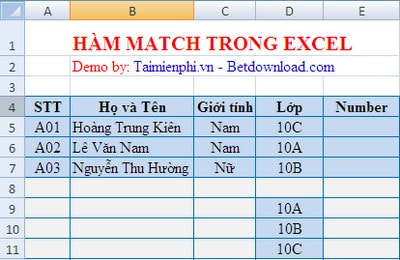
The formula in cell E5 is: =MATCH(D5,$D$9:$D$11,0).
We have the result:
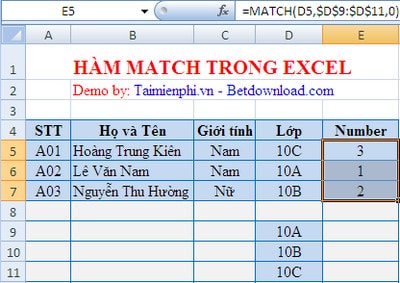
With a fairly simple syntax and usage, the MATCH function in Excel helps you search for an item in a list and returns the relative position of that item. This function is especially useful when you need to determine the location of data in a table, supporting quick information lookup.
You can combine the MATCH function with the INDEX function, which helps to get data by row or column based on the found position. This helps you improve the lookup efficiency. This is a popular way to create dynamic lookup formulas in Excel, helping you to handle data more accurately and flexibly.
Final Thoughts
The most reliable way to handle MATCH function in excel, usage and examples is to follow the process in order, verify each important setting, and test the result before moving on. Use the guidance above as a practical reference, then adjust the details for your device, software version, or specific goal.
FAQ
What should I know first about MATCH Function in Excel, Usage and Examples?
In this article, we will learn the syntax, usage and illustrative examples to effectively apply the MATCH function in work.
How do I get the best results with MATCH Function in Excel, Usage and Examples?
Use current software or equipment, follow the steps in order, review the recommended settings, and test one change at a time so you can identify what improves the result.
What should I do if MATCH Function in Excel, Usage and Examples doesn't work as expected?
Check compatibility, permissions, connectivity, and version-specific settings. Restart the relevant device or app, then repeat the process carefully before trying a more advanced fix.
Related Articles
 How to Use the MATCH Function in Excel6 minutes read
 How to Use the IRR Function in Excel5 minutes read
 How to Use the OFFSET Function in Excel7 minutes read
 How to Use the Match Function in Excel: Match Excel Function6 minutes read
 Excel Date Function - Usage and Examples6 minutes read
 How to Use the OR Function in Excel3 minutes read
Reader Comments 0
Sign in with email or Google to join the discussion.