Table of Contents
This guide explains how to use RANK Function in Excel, including its syntax, required arguments, practical examples, and common errors.

RANK function syntax and usage
Function syntax: = RANK (number, ref, [order]) .
Inside:
- RANK: is the name of the function used to return the rank of a number in a list of numbers.
- Number: is the number you want to find the rank.
- Ref: is an array or reference to a list of numbers. Non-numeric values in the array are ignored.
- Order: optional value.
- If Order is 0 or the user omits no fill, then the RANK function will sort in descending order (the largest number ranks 1).
- If Order is a value other than zero, then the RANK function will sort in ascending order.
Note:
- The RANK function arranges equal numbers of the same rank. However, the duplication will affect the ranking of subsequent numbers. For example, you have the sequence number: 1,2,2,3,4 and are arranged in ascending order, so the order of the number 1 in the series is 5.
- In some cases, users need to determine rankings that take into account (peer). You can use a combination of COUNT and RANK rows as the example below that the Software Tips will give below.
For example
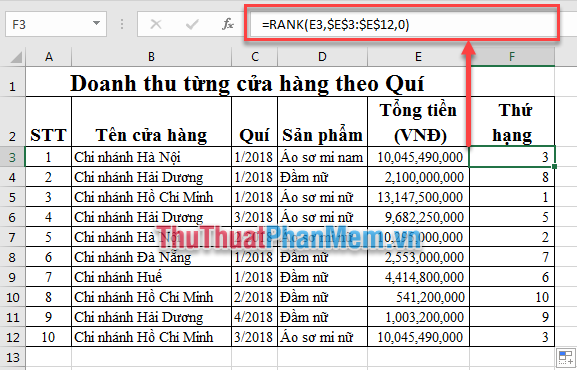
You have the sales table as the following image:

You need to rank the sales of your affiliates and your quarters in ascending rankings.
So in cell F3 you enter the formula: = RANK (E3, $ E $ 3: $ E $ 12,0) . And copy the formula for the remaining cells in column F. The result is as follows:
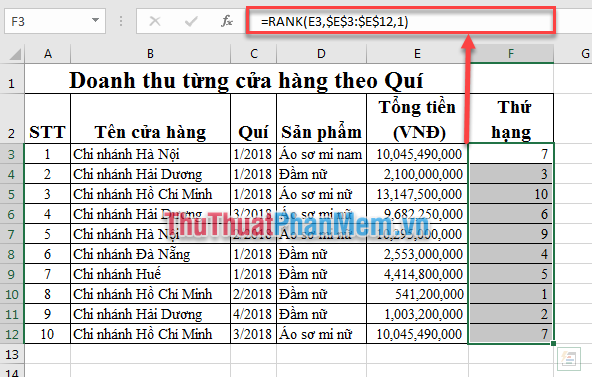
To rank in order from small to large, you change the above formula with:
So in cell F3 you enter the formula: = RANK (E3, $ E $ 3: $ E $ 12,1) .
Use a combination of rows COUNT and RANK to rank in descending and continuous order (including duplicate values). In cell F3, enter the formula: = RANK (E3, $ E $ 3: $ E $ 12) + COUNTIF ($ E $ 3: E3, E3) -1. Copy the formula for the cells in column F. The result is:

Above Software Tips showed you how to use the RANK function in Excel to look up the rank of a number in a series of numbers. Good luck!.
FAQ
What does the RANK function do in Excel?
The RANK function performs the calculation described in this guide. Use the correct arguments and compatible data types for reliable results.
How do I enter the RANK function correctly?
Start with an equals sign, enter RANK, add the required arguments inside parentheses, and confirm that cell references and separators are correct.
Why does the RANK function return an error?
Common causes include missing arguments, invalid data types, incorrect cell references, unsupported values, or regional separator settings.
Related Articles
 How to Rank on Excel with RANK Function: Excel Rank4 minutes read
 How to Use the IRR Function in Excel5 minutes read
 How to Use the OFFSET Function in Excel7 minutes read
 Excel Date Function - Usage and Examples6 minutes read
 How to Use the OR Function in Excel3 minutes read
 Function Address in Excel3 minutes read
Reader Comments 0
Sign in with email or Google to join the discussion.