Table of Contents
This updated guide examines How to Troubleshoot Flashing Screen Problems on Windows 10 and organizes the essential facts, background, and practical takeaways in clear American English.
- How to fix vertical screen stripes, horizontal stripes
- 9 damaging the fastest laptop screen!
- Why is the computer screen suddenly turned off?
Check Task Manager
To solve the flickering screen problem, you first need to determine if the driver has a problem or incompatible application that causes the problem.
To check, open Task Manager by pressingCtrl+Shift+Esc, right-click on Taskbar and select Task Manager or type task manager in the search box on the taskbar.

When Task Manager opens, watch the screen which part is blinking. If Task Manager blinks, the problem lies in the monitor driver. If it all flashes, but the Task Manager window does not, then the problem is due to incompatible applications.
Fix incompatible applications
If the problem is determined by an incompatible application, check if you are running Norton Antivirus, iCloud or IDT Audio. These applications may cause flashing screens in Windows 10. If you do not use these applications, consider the recently installed applications.
Another type of software that may affect the screen is desktop software such as a live wallpaper program. If so, disable or uninstall it.
If you suspect any application, try updating it to the latest version. If it still doesn't work, you need to uninstall the application.
Update the monitor driver
When upgrading from another Windows version to Windows 10, the graphics driver is not downloaded and updated automatically. Some third-party applications can help find and use the best drivers for the system like Driver Talent, Driver Booster and Driver Genius.
You can update the driver using Windows installation.
Step 1 . Open Device Manager by typing devmgmt.msc in the taskbar search box.
Step 2 . Click on the arrow next to Display adapters to expand the menu.
Step 3 . Right-click on your monitor adapter.
Step 4 . Select Update Driver .

Step 5. Select Search Automatically to find updated driver software.
Step 6 . If Windows finds a newer version of the monitor driver, it will automatically download and install.
Change the screen refresh rate
Step 1. Right-click an empty spot on the desktop and select Display settings .
Step 2 . Scroll down to the bottom and click on Advanced display settings .
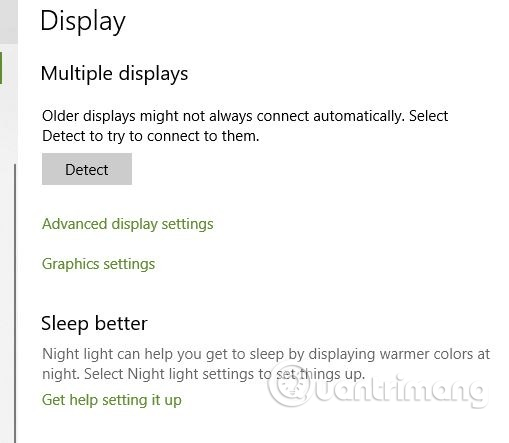
Step 3 . In the related settings, click Display adapter properties .

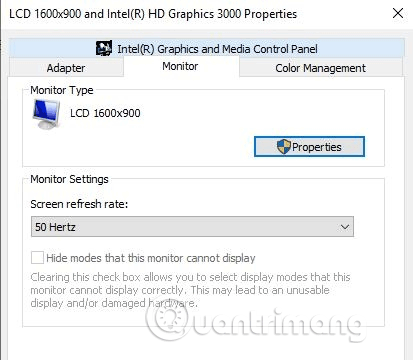
Step 4. Click on the Monitor tab and select a higher screen refresh rate, then click the OK button. If so, try 80Hz first.
Create a new user profile
Sometimes creating a new user profile on a computer can solve the problem. To create a new profile, follow the steps below:
Step 1. ClickWin+Ito open Settings.
Step 2 . Access Accounts .
Step 3 . Click on Family & other people on the left side of the window.
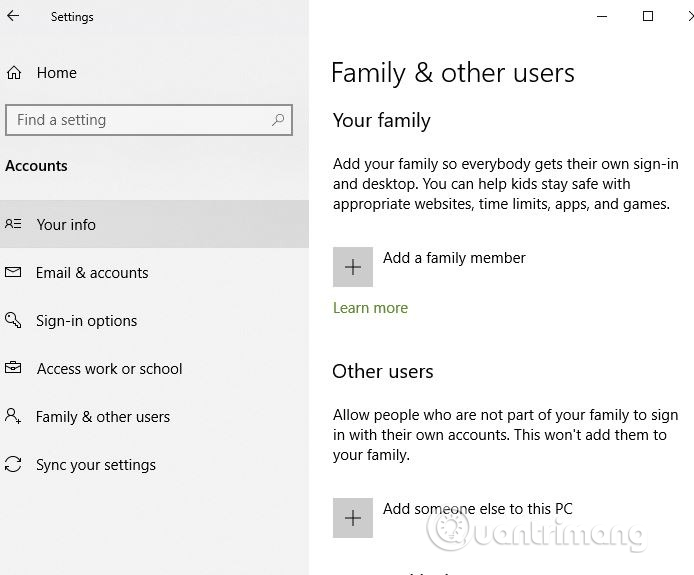
Step 4 . Choose Add someone else to this PC and follow the instructions.
Other solutions
The magnetic field can also cause the screen to blink. Move your laptop to another place, away from electronic devices and check if the screen blinks.
If so, it may be due to a screen error. Check by connecting the laptop to another monitor. If when connecting to another monitor without blinking, you need to replace the monitor or laptop.
Hope these solutions can help you fix the screen flickering problem.
I wish you all success!
FAQ
What is How to Troubleshoot Flashing Screen Problems on Windows 10 about?
It provides a structured overview of Fix flashing screen problems, explains the main context, and highlights practical takeaways for readers.
Why does this topic matter?
Understanding the main concepts helps readers evaluate the issue, avoid common mistakes, and make better-informed decisions.
How should readers use this information?
Use the guidance as a practical starting point, confirm details that may have changed, and follow current product, safety, or security recommendations.
Related Articles
 How to Fix Problems with Multi-monitor Setup in Windows6 minutes read
 How to Troubleshoot Windows with Event Viewer Log10 minutes read
 What Is the Error of the Air Conditioner Flashing Continuously?5 minutes read
 Troubleshoot Problems with Avast Free Antivirus in Windows 106 minutes read
 How to Fix Common Windows 10 Problems with Windbg11 minutes read
 How to Use the DirectX Diagnostic Tool to Troubleshoot Problems8 minutes read
Reader Comments 0
Sign in with email or Google to join the discussion.