Table of Contents
This guide explains how to time Off the Computer Very Quickly and Easily by the Command CMD, No, with clear steps, practical tips, and important checks before you begin.
With the timer by the following command you can perform on: Windows XP, Windows Vista, Windows 7, 8, 8.1 and Windows 10.
The steps are as follows:
First, press Windows + R to open the Run dialog box. After the Run dialog box appears, enter the following command:
shutdown -s -t 3600
Inside:
- shutdown : Turn off the computer
- s : shorthand for shutdown
- t : stands for time
- 3600 : The shutdown timer time is in seconds (3600 seconds = 1 hour).

Depending on how much time you want to schedule, convert hours or minutes to seconds to enter the command. For example, some common time frames have been changed to seconds:
- 5 minutes: shutdown -s -t 300
- 10 minutes: shutdown -s -t 600
- 15 minutes: shutdown -s -t 900
- 30 minutes: shutdown -s -t 1800
- 1 hour: shutdown -s -t 3600
- 2 hours: shutdown -s -t 7200
- 3 hours: shutdown -s -t 10800
- 4 hours: shutdown -s -t 14400
- 5 hours: shutdown -s -t 18000
- 12 hours: shutdown -s -t 43200
- 24 hours: shutdown -s -t 86400
After entering the command, click OK and a message will appear, as shown below is the message on windows 10:
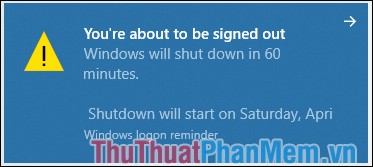
In addition to the shutdown timer function, you can also schedule the Restart of the computer by using the following command:
shutdown -r -t 3600
In case you want to cancel the shutdown timer, enter the command:
shutdown -a
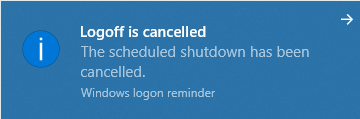
When the message Logoff is canceled as shown below, the timer has been successfully canceled.
Above Thuthuatphanmem. vn has instructed you to schedule a shutdown by a simple command in windows. Hope the article will be helpful to you. Good luck!
FAQ
What should I know about Time Off the Computer Very Quickly and Easily by the Command CMD, No?
Focus on the key features, requirements, limitations, and practical use cases explained in this guide.
How do I get the best results with Time Off the Computer Very Quickly and Easily by the Command CMD, No?
Follow the recommended steps, use current software or information, confirm compatibility, and review settings before major changes.
Are there any risks or limitations?
Potential limitations depend on compatibility, data quality, cost, privacy, support, and how the product or method is used.
Related Articles
 Take Screenshots Quickly, No Need to Install Additional Software5 minutes read
 How to Install DriverEasy and Quickly Update Your Computer Drivers5 minutes read
 How to Install and Uninstall RPM: Practical Guide4 minutes read
 How to Take Screenshots on a Windows 10 Computer8 minutes read
 How to Install Multiple Computer Software at the Same Time4 minutes read
 The Simplest Way to Install Additional Fonts for Computers4 minutes read
Reader Comments 0
Sign in with email or Google to join the discussion.