Table of Contents
Overview
This guide explains how to compress and decompress files of all formats on your computer in clear, practical terms. It covers the key concepts, recommended steps, common limitations, and useful checks so you can make a better-informed decision.
While using your computer or laptop, you will encounter the situation where you cannot share files via social networks such as Zalo, Messenger, Viber. due to the file size being too large. Compressing data can help you easily share files as well as share more easily. So how to compress files? In this guide, this guide will share with you the fastest and simplest way to compress and decompress files!
How to compress files on your computer
To be able to compress and decompress files on the computer, we need to have a supporting tool, which is Winrar software. Among the current decompression software, Winrar is considered the best file compression and decompression software at the present time.
First, download Winrar file compression software here.
After downloading and installing Winrar on your computer, we will compress the file according to the specific steps below:
Step 1: Highlight all the folders and files that need to be compressed (to keep things neat, you can put them all in a separate folder) and select Add to Archive to compress the file.
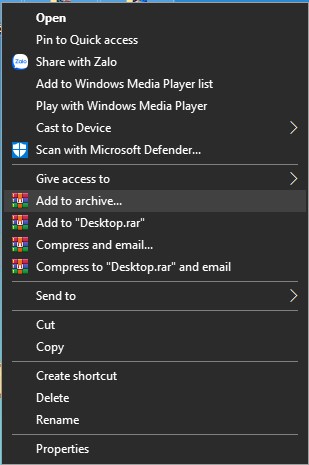
| In this step, you can also have more options like: Add to "filename. rar" to compress the file directly into a RAR file. Compress and email to compress files into rar, zip files and send emails containing the compressed files. Compress to "filename. rar" and email to compress the file into a folder and email it. |
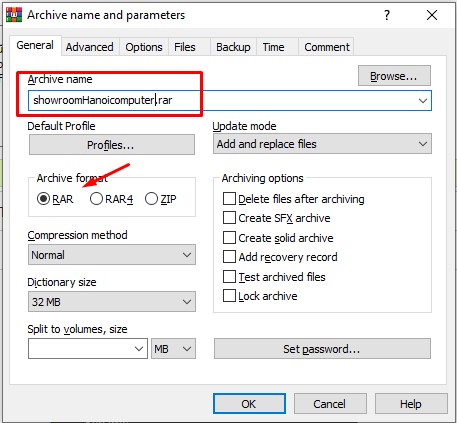
Step 2: In the General tab, in the Archive format section, you can choose to compress to a Rar or Zip file. Name the compressed file in the Archive name box.
Step 3: If you want to increase the security of the file, you can set a password when extracting by selecting Set password.
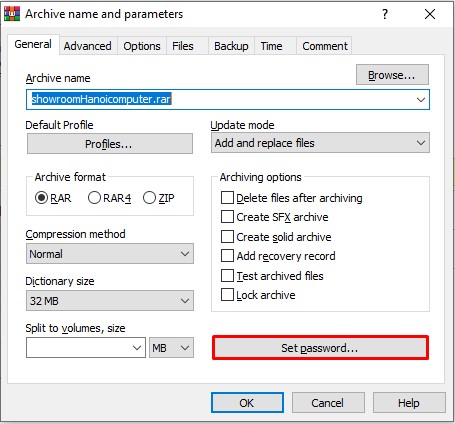
Step 4: Enter and re-enter the password you want, then press OK.
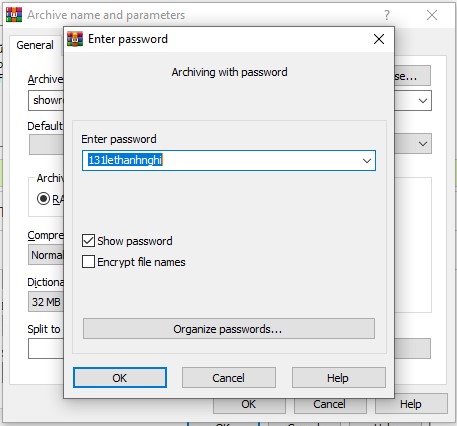
Step 5: After setting the password, click Ok to complete.
How to unzip compressed files using Winrar
With Winrar, decompressing files is as simple as compressing files. Decompressing files can also be done quickly with 2 mouse clicks.
First, right-click on the compressed RAR file. Then you can choose one of the following ways to unzip the file:
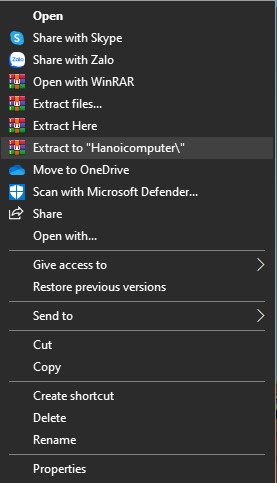
| Select Extract files to extract the file to the path you choose. Select Extract here to unzip the file right where you are working. This will unzip all the files inside and will not create a folder to contain the extracted files. Select Extract to + folder name to create a folder corresponding to the file name and extract everything in that folder. |
Above is a tutorial on how to compress and decompress files with Winrar quickly. If you need any further support, please comment below for this guide to answer and guide you!
Key Takeaways
Use the guidance above as a practical reference for compress and decompress files of all formats on. Check compatibility, follow the steps carefully, and verify important details with official documentation when software, security, accounts, health, or purchases are involved.
FAQ
How do I compress and decompress files of all formats on my computer?
Follow the steps in this guide in order, confirm each setting before continuing, and save, restart, or reconnect the device when the instructions require it.
What should I check before I begin?
Confirm the correct device, account access, software version, compatibility, and a current backup whenever the process could affect files, settings, or security.
What should I do if the process does not work?
Repeat the steps carefully, check for model or version differences, install available updates, and consult the manufacturer's official support documentation.
Related Articles
 How to Compress and Decompress Files and Folders on a Mac3 minutes read
 How to Compress and Decompress Files on Windows 104 minutes read
 How to Compress and Decompress Files in Node.js7 minutes read
 How to Compress and Decompress Files with Winrar?4 minutes read
 How to Compress and Decompress ZIP Files Quickly5 minutes read
 How to Decompress Files on Your Computer Quickly3 minutes read
Reader Comments 0
Sign in with email or Google to join the discussion.