Table of Contents
Fix Wi-Fi and Bluetooth Lost After Windows Goes to Sleep is easier to approach with a clear overview and reliable steps. This guide organizes the essential information, highlights practical details, and explains what to check along the way.
Key Takeaways
- Learn how to turn off link state power management in settings.
- Explore uninstall the latest bluetooth and Wi-Fi drivers.
- Understand reinstall an older version of the driver.
1. Turn Off Link State Power Management in Settings
Link State Power Management (LSPM) is a power saving feature that reduces power consumption when PCIe devices, such as network adapters, are not in use. However, this setting can also cause network devices to disappear when resuming from Sleep because Windows may not wake them up properly.
You can safely disable LSPM in Power Plan Settings with minimal impact on your power consumption. This helps you work around this issue. Here's how:
- Click Start, type Control Panel and open it from the search results.
- In Control Panel, open Power Options and click Change plan settings for your active plan.

- Next, click Change advanced power settings to open the Power Options dialog box.

- Expand Wireless Adapter Settings > Power Saving Mode. Then, set both On battery and Plug in to Maximum Performance.

- Next, expand PCI Express > Link State Power Management and set it to Off.

- Click Apply > OK, then restart your computer.
The Wi-Fi and Bluetooth adapters will still be available even after your laptop wakes from Sleep after restarting. The author has tested and confirmed that this solution works on an HP Pavilion gaming laptop.
2. Uninstall the Latest Bluetooth and Wi-Fi Drivers
The problem may be caused by a faulty driver update if your Wi-Fi and Bluetooth still disappear after entering Sleep mode. Rolling back to an older, more stable driver version may help fix the problem. Follow these steps: This helps you roll back to the old Bluetooth driver.
- Click Start, type Device Manager and open that driver.
- Expand the Bluetooth section.
- Right-select your Bluetooth device (e.g. Intel(R) Wireless Bluetooth(R) or Realtek Bluetooth) and select Uninstall device.
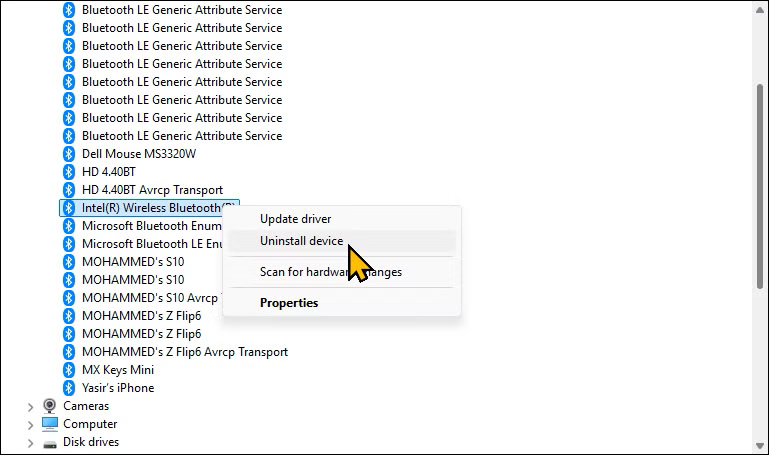
- In the confirmation dialog box, select Attempt to remove the driver for this device, and then click Uninstall.
Follow these steps: This helps you uninstall the Wi-Fi driver.
- In Device Manager, expand the Network adapters section.
- Right-select your Wi-Fi adapter and select Uninstall device.

- Select Attempt to remove the driver for this device, then click Uninstall. You can reinstall the older version of the driver after uninstalling both drivers.
Reinstall an Older Version of the Driver
Installing an older version of the driver may help if the latest driver is broken or doesn't work with your network adapter. You can download the previous driver from the manufacturer's website.
For instance, if your laptop uses an Intel Bluetooth and Wi-Fi adapter, open Intel's Download Center, select the Wireless category, and download an older version of the driver. Then, run the MSI installer or setup file and follow the on-screen instructions.
3. Perform a System Reset
A factory reset might help if the problem is caused by corrupt or missing system files. Windows 10 and 11 let you reset your PC without losing any data, but your apps and other settings will be deleted.
Now, before resetting, create a backup of your Windows computer. You can also export the list of installed applications on your computer to a text file using Windows Package Manager. Do the following: This helps you export the list of installed applications.
- Click search, type cmd and open Command Prompt.
- Then type the following command and press Enter to save the list to C:apps.txt: winget list >c:apps.txt.
Follow these respective instructions: This helps you reset your PC.
- Reset Windows 10 to its original state.
- How to reset Win 11, restore Windows 11 factory settings.
Windows will download the latest version of the operating system from the cloud (if you use Cloud install) and reset your computer. Install the latest driver and check if the problem is resolved after the reset.
4. Keep Your PC Running
As a quick fix, you can prevent your PC from going to Sleep to avoid losing Wi-Fi and Bluetooth connections. You can use PowerToy's Awake to keep your PC awake indefinitely while allowing you to automatically open Sleep when needed.
Start by downloading PowerToys from the Microsoft Store. Launch the app, expand Advanced Tools > Awake > Enable awake. Then, under Behaviour, set Mode to Keep awake unlimited.

5. Check for Hardware Problems
Identifying hardware problems can be difficult, especially if your Wi-Fi and Bluetooth devices work after a reboot. Try the following steps to identify hardware problems before taking your laptop to a service center.
An easy way to test for hardware related issues is to test your Wi-Fi and Bluetooth on another operating system. This is why it is always a good idea to carry a Linux Live USB around, as you can use the Try Ubuntu option to test the operating system without installing it first.
Create a bootable USB with the Ubuntu Linux distribution, boot into Ubuntu Live, then use the Try Ubuntu option. This helps you do this. Check if Wi-Fi and Bluetooth work in live mode. If they do, then it is not the hardware but the software that is causing the problem.
Perform Vibration Test
The shake test helps determine if a hardware problem is caused by a loose connection. Finally, wake up your laptop and check to see if the Wi-Fi connects. Put your laptop into sleep mode, then gently press around the bottom case, especially near the Wi-Fi adapter. This helps you do this. If it does, it may be due to a loose internal connection, and it's an easy fix if you're comfortable opening your laptop.
Contact your computer manufacturer for support if the problem persists despite these fixes. You may be eligible for a repair or replacement if your device is still under warranty.
Good luck!
See more articles below:
- Error of conflicting IP addresses when connecting to Wifi on iPhone, iPad, here is how to fix it.
- What is Wifi? How does Wifi work?
- How to view saved Wifi passwords on Windows 7/8/10.
Final Thoughts
The most reliable way to handle fix Wi-Fi and bluetooth lost after windows goes to sleep is to follow the process in order, verify each important setting, and test the result before moving on. Use the guidance above as a practical reference, then adjust the details for your device, software version, or specific goal.
FAQ
What should I know first about Fix Wi-Fi and Bluetooth Lost After Windows Goes to Sleep?
It could be due to a driver issue or incorrect power management settings if your Windows laptop's Wi-Fi and Bluetooth disappear after waking up from sleep but work fine after restarting.
How do I get the best results with Fix Wi-Fi and Bluetooth Lost After Windows Goes to Sleep?
Use current software or equipment, follow the steps in order, review the recommended settings, and test one change at a time so you can identify what improves the result.
What should I do if Fix Wi-Fi and Bluetooth Lost After Windows Goes to Sleep doesn't work as expected?
Check compatibility, permissions, connectivity, and version-specific settings. Restart the relevant device or app, then repeat the process carefully before trying a more advanced fix.
Related Articles
 How to Fix Lost Bluetooth Error on Windows 10 Settings Settings4 minutes read
 How to Find Lost Bluetooth Devices7 minutes read
 How to Set Up and Manage Bluetooth Devices in Windows: Practical Guide9 minutes read
 What You Need to Know About Sleep Needs by Age8 minutes read
 Steps to Fix Missing Bluetooth Button in Windows 10 Action9 minutes read
 15 Truths Completely Wrong About Sleep (part 1)6 minutes read
Reader Comments 0
Sign in with email or Google to join the discussion.