Table of Contents
This practical guide walks through 3 ways to fix slow iPhone keyboard, explains the main requirements, and highlights common issues that may appear along the way.
1. Reset keyboard dictionary
This can be helpful if you use the Autocorrect and Predictive features while typing.
Accordingly, the iPhone will automatically learn new words that you often use, then display future suggestions. All this data will be stored in the keyboard buffer, and for some reason it may cause the keyboard to be slow or unresponsive to the user actions. That is why you should reset keyboard dictionary on iPhone.
To do this, go to Settings - General - Reset - Reset Keyboard dictionary, and enter your password when prompted. Note, this only clears the keyboard cache and doesn't affect data on the iPhone.
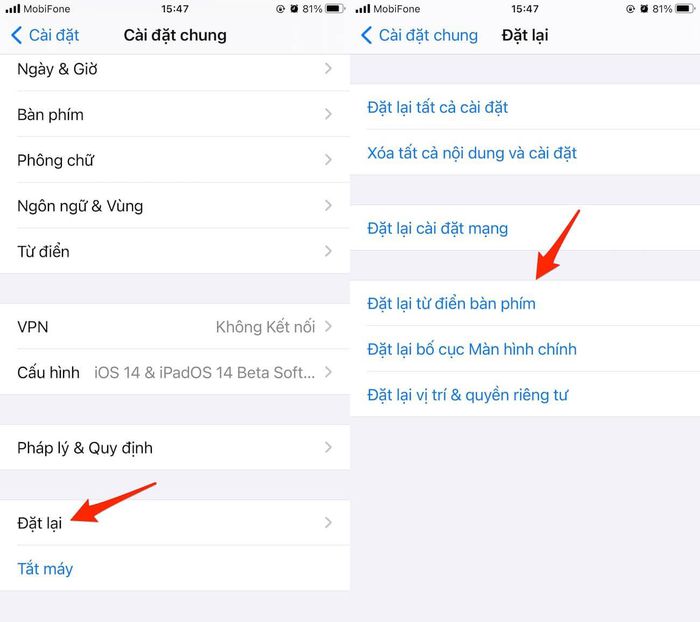
When finished, try opening any application and check if the keyboard is working properly or not, if not, users just need to move to the next solution.
Restart iPhone
Restarting the device is the easiest way to fix unknown problems.
First, press and hold the power button and the Home button at the same time until the Apple logo appears on the screen. For newer iPhone models (without a physical home button), users simply press and release the volume up button, press and release the volume down button, then hold the power button for a few seconds until the device is turned on. restart.
Alternatively, you can also restart your iPhone by going to Settings - General - Shut down. Then, users just need to press the power button for a few seconds to turn on the device again.
3. Update iOS
Before you do this, connect your iPhone to your computer and open iTunes (Windows) or Finder (macOS) software and make a full backup of your data, which will help minimize the risks. happening. Without a computer, users can back up data through iCloud.
Once that's done, go to Settings - General - Software Update - Download & Install (download and install). Note, the size of the update may vary depending on the device you are using.

In addition, users also need to ensure a few GB of free space on the iPhone (or iPad) for the device to operate stably.
If none of the above fixes the problem, try restoring your iPhone by going to Settings - General - Reset - Reset all content and settings. content and settings).
Note, this will wipe all the data on your iPhone, so make sure you have a backup on iCloud or iTunes.
Hopefully with the above tips, readers can solve the problem of slow keyboard at home instead of having to bring the device to a service center.
Key Takeaways
Use the information above as a practical reference for 3 ways to fix slow iPhone keyboard. Review each step carefully, confirm any requirements, and choose the option that best fits your situation.
FAQ
What does this guide explain about 3 Ways to Fix Slow iPhone Keyboard?
It explains the main concepts, practical considerations, and useful steps related to 3 ways to fix slow iPhone keyboard without requiring advanced knowledge.
Who can benefit from learning about 3 Ways to Fix Slow iPhone Keyboard?
This information is useful for readers who want a clear overview, practical guidance, and reliable steps related to 3 ways to fix slow iPhone keyboard.
What should I check before applying this information?
Review the requirements, confirm that your device, software, or situation matches the instructions, and back up important data before making major changes.
Related Articles
 minutes read
 Refresh the iPhone Keyboard with Next Keyboard3 minutes read
 How to Fix Slow Responsive Keyboard Errors on Windows 104 minutes read
 9 Ways to Fix Keyboard Typing Delay on Windows 10/118 minutes read
 How to Reset iPhone Keyboard2 minutes read
 iPhone Is Slow If Updated to iOS 11.2.2?3 minutes read
Reader Comments 0
Sign in with email or Google to join the discussion.