Table of Contents
This guide explains the PortableBaseLayer Partition in Windows 10 Disk Management, why it matters, how it works, and how to evaluate or use it in practical situations.
PortableBaseLayer also appears in the Optimize drives window as a virtual hard drive. You may be wondering exactly what is PortableBaseLayer. The answer will be In this guide.
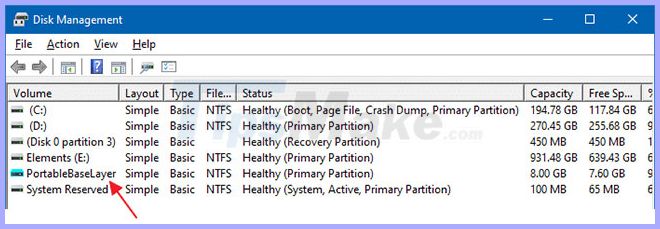 PortableBaseLayer with 8191MB capacity (8GB)
What is PortableBaseLayer appearing in Disk Management?
PortableBaseLayer is not a malicious drive. It is a mounted virtual drive (. vhdx) and used by the Windows Sandbox feature.
If you run a command mountvolfrom the Command Prompt, you can see the GUID volume of PortableBaseLayer and the associated file / directory ( WindowsContainersBaseImages ).
 GUID volume PortableBaseLayer and associated files / folders (WindowsContainersBaseImages)
Unexpected PortableBaseLayer will show up in the Disk Management or Optimize Drives list. And, in Windows Insider build 18912, some users have reported that the drive is not listed in Disk Management.
Is PortableBaseLayer related to Reserved Storage?
Is not! PortableBaseLayer has nothing to do with the Reserved Storage feature (also introduced in v1903).
Reserved Storage is a backup drive created to store Windows Update updates and temporary files, for a smooth installation experience. It has nothing to do with the Windows Sandbox or the PortableBaseLayer virtual drive.
Reserved Storage is automatically introduced on devices that come with 1903 pre-installed or on devices with a 'clean' 1903 installation.
 Reserved Storage is a backup drive created to store Windows Update updates and temporary files
You can learn more about Reserved Storage and how to disable it in the article: How to disable Reserved Storage on Windows 10.
FAQ
What should I know about the PortableBaseLayer Partition in Windows 10 Disk Management?
Focus on the key features, requirements, limitations, and practical use cases explained in this guide.
How do I get the best results with the PortableBaseLayer Partition in Windows 10 Disk Management?
Follow the recommended steps, use current software or information, confirm compatibility, and review settings before major changes.
Are there any risks or limitations?
Potential limitations depend on compatibility, data quality, cost, privacy, support, and how the product or method is used.
Related Articles
 Top 10 Free Windows Partition Management Software7 minutes read
 How to Fix Windows Cannot Be Installed to This Disk. the Selected Disk5 minutes read
 Partition to Create the Second Hard Drive on Windows8 minutes read
 How to Activate a New Hard Drive on Windows6 minutes read
 Click: How to Delete a Drive Partition on PC or Mac5 minutes read
 Disk Management Tool Windows 10 Is About to Have a Newer3 minutes read
Reader Comments 0
Sign in with email or Google to join the discussion.