Table of Contents
This guide explains a Firewall? Overview of Firewall, why it matters, how it works, and how to evaluate or use it in practical situations.
What is a firewall?
A firewall, also known as a firewall, is a technique that is integrated into the network to prevent unauthorized access, to protect internal information sources and prevent unwanted intrusion into the system. Firewal uses rules to control inbound and outbound traffic that acts as a barrier between secure and unsafe networks. It controls access to network resources through an active control model. That is, only traffic that conforms to the policy defined in the firewall is allowed to access the network, all other traffic will be denied.
Firewall is usually activated automatically, TipsMake. com will show you how to check if the computer has a firewall enabled.
Click Start (Windows ) → find Control Panel . Normally Control Panel will display as a summary, to display all the search functions you hover on ' View by ' and select ' Large icons '. Then you can easily see the icon of Firewall / Firewall.

Click on ' Windows Defender Firewall ' to check. If ' On ' is displayed, your computer has a firewall enabled.

Overview of Firewall
Any computer that uses the Internet needs a firewall, which helps to manage what is allowed into the network and what is allowed out of the network. Having such a 'guardian' to oversee everything happens is important for two reasons:
- Firstly , any computer with a network connection is usually permanently connected to the Internet.
- Secondly , each online computer has its own digital signature, called the Internet Protocol address (also known as an IP address): Without a firewall, it is no different than opening and waiting for someone. burglar into.
A properly configured Firewall will prevent this from happening and will effectively 'hide' the computer, allowing users to freely enjoy what the online world has to offer. A firewall is not the same as an antivirus program. Instead, it works in conjunction with these tools to ensure that the computer is protected from most common malicious attacks. Every firewall must have at least two network interfaces, one for the network it protects, and the other for the external network. A firewall can be a gateway or a link between two networks, usually a private network and a public network such as the Internet. The first firewalls are simple routers.
Firewall function
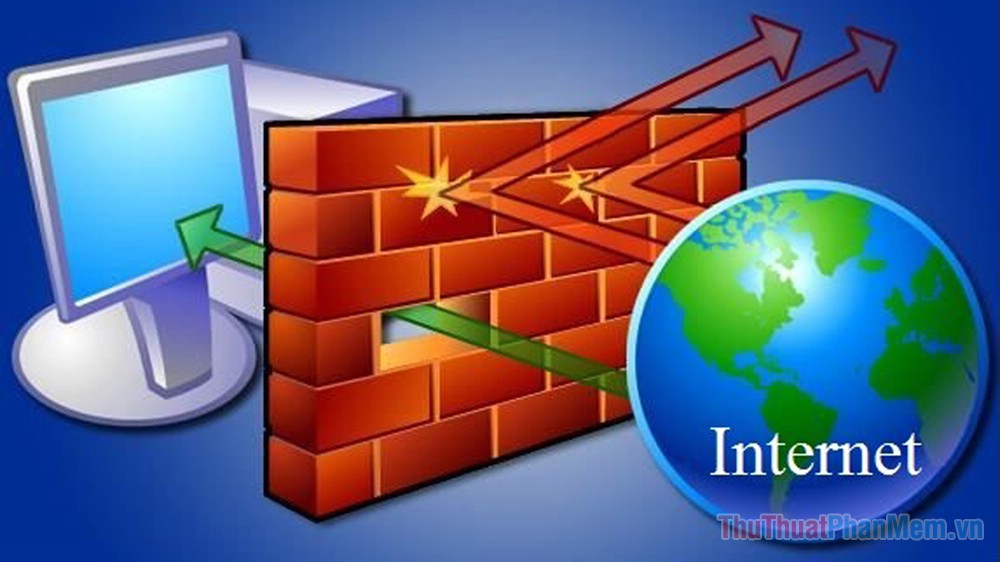
The main function of the Firewall is to control the flow of information between the Intranet and the Internet. Establish a mechanism for controlling the flow of information between an internal network (Intranet) and the Internet.
- Allow or prohibit outbound access services.
- Allowing or banning services from outside.
- Monitor network data flow between Internet and Intranet.
- Control access address, ban access address
- User control and user access.
- Control the content of information circulating on the network.
A firewall checks all information flows between two networks to see if it is up to standard. If it reaches, it is routed between networks, otherwise it fails. A firewall filter filters both incoming and outgoing traffic. It can also manage external access to internal network resources. It can be used to record all attempts to enter a private network and give quick alerts when an enemy or unauthorized person enters. Firewalls can filter packets based on their source, destination and port numbers. This is called address filtering. Firewalls can also filter special types of network traffic. This is called protocol filtering because decision making for forwarding or denying traffic depends on the protocol used.
Some firewalls have an interesting and advanced function, deceiving intruders that they have broken the security system. Basically, it detects an attack and takes over it, leading the attacker to follow it with a 'hall of mirrors' approach. If an attacker believes he or she has gained access to a part of the system and has further access, the attacker's activity can be recorded and monitored. If it is possible to keep the perpetrator for a while, the administrator can trace their tracks. For example, you can use the finger command to track an attacker or create a 'bait' file so that it takes a long time to transfer, and then track the file transfer to the attacker's location over an Internet connection.

Advantages and limitations of Firewall
Advantages
- Protect the system by attacks (inside, outside).
- Filter connections based on data content.
- Implement NAT.
- Combined with IDS / IPS system.
- Composition of defense solutions in depth.
Limit:
- Application layer attacks may be ignored.
- Connections: Dial-up, VPN can bypass firewall.
- Operation management is relatively complicated.
- There exist intrinsic weaknesses.
- Affect connection speed.
For users, the Windows Firewall may still be inadequate because it does not block outbound connections. So if any malware finds a way into the computer, there is no way to prevent its destructive activity. TipsMake. com recommends downloading additional free Firewall software and installing it to use in parallel with Windows Firewall.
With the above information, you probably understand a little about the firewall, its function and its advantages and disadvantages. If you find the article useful, please share your knowledge to everyone. Thank you for watching!
FAQ
What should I know about a Firewall? Overview of Firewall?
Focus on the key features, requirements, limitations, and practical use cases explained in this guide.
How do I get the best results with a Firewall? Overview of Firewall?
Follow the recommended steps, use current software or information, confirm compatibility, and review settings before major changes.
Are there any risks or limitations?
Potential limitations depend on compatibility, data quality, cost, privacy, support, and how the product or method is used.
Related Articles
 What Is a Firewall? General Knowledge About Firewall15 minutes read
 Review: Overview of the Tmg Firewall Troubleshooting Feature11 minutes read
 Overview of Windows Server 2008 Firewall with Advanced Security13 minutes read
 5 Reasons Why You Should Use a Firewall6 minutes read
 Overview of Windows Server 2008 Firewall with Advanced Security14 minutes read
 10 Free Firewall Software Is Most Worthwhile14 minutes read
Reader Comments 0
Sign in with email or Google to join the discussion.