Table of Contents
This updated guide examines How to View Network-based Applications on Windows 10 and organizes the essential facts, background, and practical takeaways in clear American English.
The following article will show you how to view the application has been using the Internet along with its Internet usage and general network.
- How to block Internet connection software, Windows 10 applications
- Monitor and save Internet capacity on Windows 10
- Check hidden connections to the Internet in Windows
Use Task Manager to see the current network usage
To check exactly which applications are using your network and the amount of data consumed to download and upload, you need to access Task Manager.
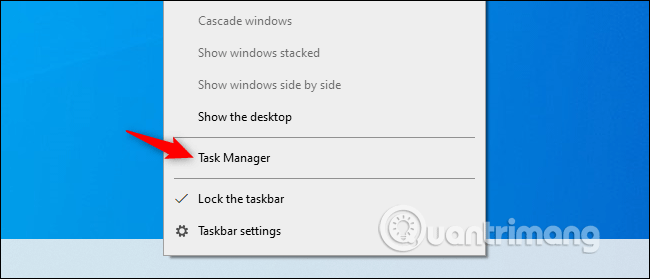
To open Task Manager, right-click the taskbar and select Task Manager or pressCtrl+Shift+Esc.
In the list of processes, click Network to sort the list of processes according to network usage. From this list, you will see applications that are using the network along with the bandwidth they are consuming.
If you don't see the Network, you need to click on More Details first.
Technically, this list is not complete, because if a process does not use a lot of network resources, Windows will round down to 0 Mbps (Megabit / sec). This is just a quick way to see which process is using a significant amount of bandwidth.

Use the Resource Monitor to see details of network usage
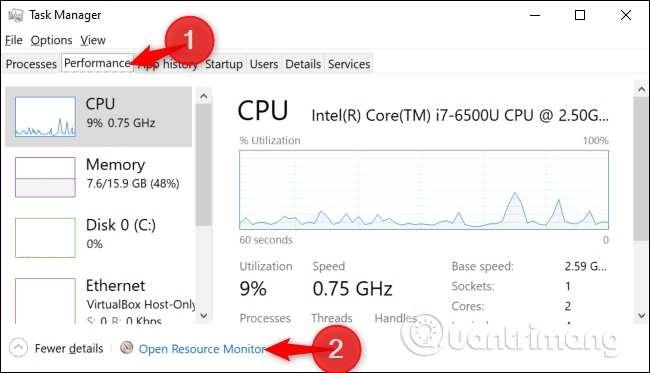
To get more detailed information, you should use the Resource Monitor application. You can launch it by searching the Resource Monitor in the Start menu or clicking the Performance tab in Task Manager, then clicking the Open Resource Monitor at the bottom of the window.
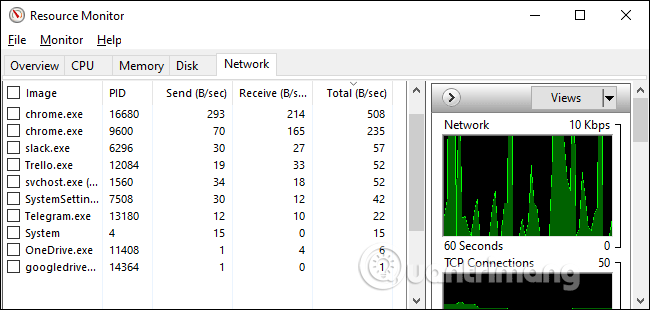
Click on the Network tab to see a list of processes that are downloading or uploading data over the network. You can also see the amount of data they're transmitting in bytes per second.
This way, you can also see processes that use a small amount of network bandwidth that is not displayed in Task Manager.
With both lists in the Task Manager and Resource Monitor, you can right-click an application and select Search Online to find more information about that process.
See network data usage over the past 30 days
Windows 10 keeps a list of applications that use the network and their usage in the past 30 days.
To find this information, go to Settings> Network & Internet> Data Usage , click on View usage per app at the top of the window. You can pressWin+Ito open the Settings application.
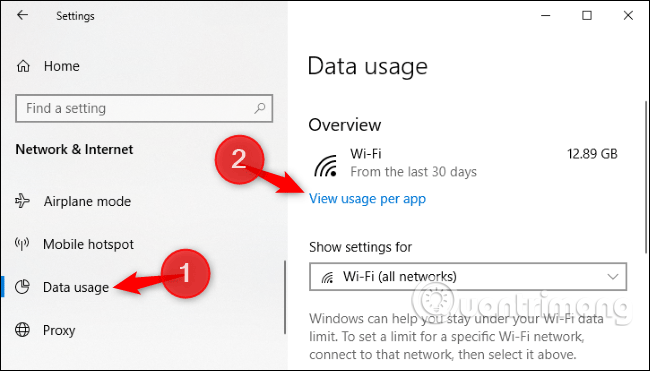
From here, you can scroll down and view applications that have used the network in the past 30 days.
If you are using a Wifi network, you will see applications that use the existing Wifi network or a list of applications that use the network on all connected Wi-Fi networks. Select the network you want to view from the Show usage from box.
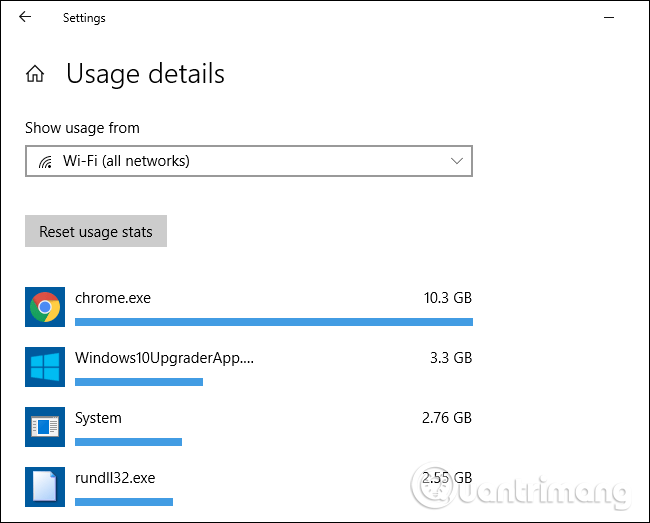
You will see that the culprit consumes the most network data at the top of the list. Below the list are applications that rarely connect to the Internet and do not use much data.
I wish you all success!
FAQ
What is How to View Network-based Applications on Windows 10 about?
It provides a structured overview of see network usage application, explains the main context, and highlights practical takeaways for readers.
Why does this topic matter?
Understanding the main concepts helps readers evaluate the issue, avoid common mistakes, and make better-informed decisions.
How should readers use this information?
Use the guidance as a practical starting point, confirm details that may have changed, and follow current product, safety, or security recommendations.
Related Articles
 How to Run GUI-Based Applications in Docker6 minutes read
 How to View MAC Address on Windows Using Command Prompt5 minutes read
 How to See Which Apps Are Using the Network on Windows 105 minutes read
 Frame View in SQL8 minutes read
 How to Arrange Network Connection on Windows 105 minutes read
 How to View Wifi Password, View WIFI Password on Windows 113 minutes read
Reader Comments 0
Sign in with email or Google to join the discussion.