Table of Contents
This guide explains how to get Numbers After Commas in Excel, with clear steps, practical tips, and important checks before you begin.

Use the TRUNC function to get the number before the comma
To get the part before the comma is very simple, you use the TRUNC function to truncate the part after the comma with the following syntax:
= TRUNC (number, [num_digits]).
Inside:
- TRUNC: is the name of the function used to round a number to an integer by removing its decimal part.
- Number: the original number.
- Num_digits: A number that identifies the precision of truncation. The default value for num_digits is 0 (zero).
Note that INT and TRUNC are also functions that take integers. However, the INT function rounds down to the nearest integer based on the value of the fractional part of that number. While the TRUNC function takes an integer part by removing its fractional part.
The INT and TRUNC functions differ only when the original number is negative. TRUNC (-10.25) = -10 while INT (-10.25) = -11.

Get the number after the comma
After you get the number before the comma (whole part) with the TRUNC function, you subtract the result of the TRUNC function and get the decimal.
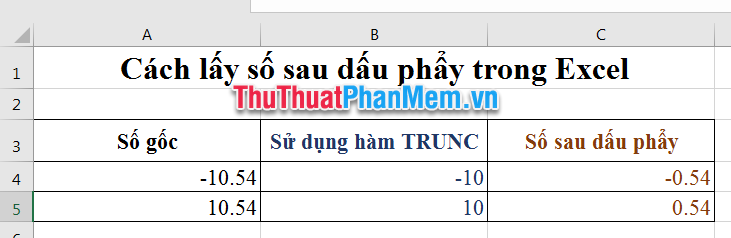
Combining the steps above, you can always use the following formula:
= rational numbers - TRUNC (rational numbers) .
In which rational numbers can be a position of cells containing data or a number to round. With the above formula, you get the same result:
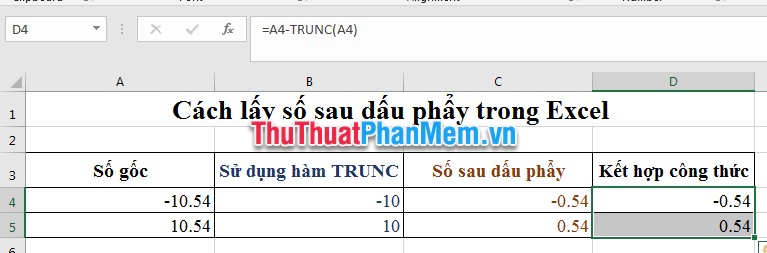
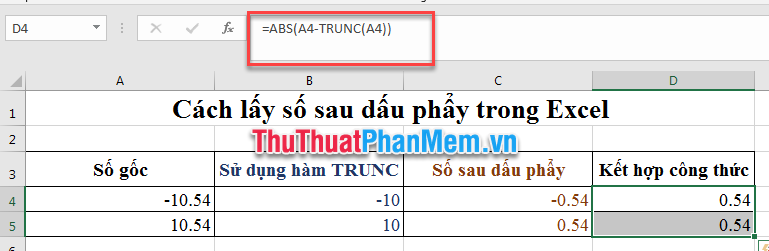
If you want the result to be a positive number, you use the ABS function to return the absolute value of the result by the formula = ABS (rational number - TRUNC (rational number)) .
Above Software Tips showed you how to take the number after the comma in Excel. Good luck!
FAQ
What should I know about Get Numbers After Commas?
Focus on the key features, requirements, limitations, and practical use cases explained in this guide.
How do I get the best results with Get Numbers After Commas?
Follow the recommended steps, use current software or information, confirm compatibility, and review settings before major changes.
Are there any risks or limitations?
Potential limitations depend on compatibility, data quality, cost, privacy, support, and how the product or method is used.
Related Articles
 Instructions for Rounding Decimal Numbers After Commas in Excel2 minutes read
 How to Convert Dots to Commas in Excel on Windows 72 minutes read
 How to Convert Commas into Dots in Excel3 minutes read
 Convert Commas to Dots in Excel2 minutes read
 How to Convert Commas to Dots in Excel - Convert Unit4 minutes read
 How to Replace Comma with Period in Excel4 minutes read
Reader Comments 0
Sign in with email or Google to join the discussion.