Table of Contents
This practical guide walks through how to defragment the Windows 10 hard drive, explains the main requirements, and highlights common issues that may appear along the way.
The process of finding fragments of data or files and reconstructing all of these fragmented data or files, then arranging them into a linked block is called defragmentation. This process increases data retrieval efficiency and access time, reduces file system fragmentation, and allows for faster and more efficient use of archives.
Hard drive gets fragmented after a long time and data gets fragmented when your computer saves data and stores them in multiple locations on the hard drive. This reduces the performance of the computer. To make your computer run efficiently and smoothly, you can use Windows 10's built-in tool to defragment all fragmented data or files.
Method 1: Use the Defragment tool available on Windows 10
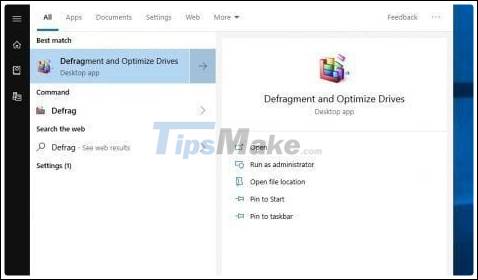
Step 1: Open Start and search for Defragment and Optimize Drives, then press Enter to open Optimize Drives.
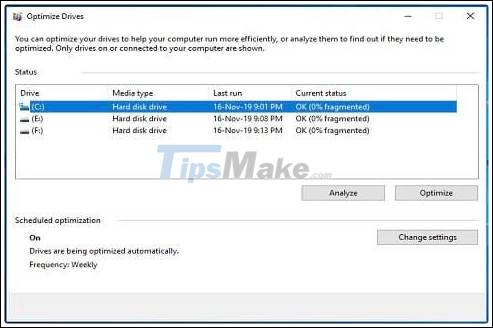
Step 2: Select the drive you want to optimize and click Analyze. If you have an SSD drive, this option is greyed out and unavailable.

Note: You always need to analyze the hard drive first to see the percentage of fragmented parts. If the fragmentation is less than 10%, then you do not need to optimize the hard drive as it is not suitable for defragmentation.

Step 3: Click the Optimize button to start defragmenting your hard drive.

Step 4: When the defragmentation is complete, click Close to close the window.
Method 2: Use Command Prompt
Step 1: Press the key combination Window + X or right-click the Start Menu.
Step 2: Click on Command Prompt.
Step 3: Select Yes to allow Command Prompt (Admin) to run as administrator.
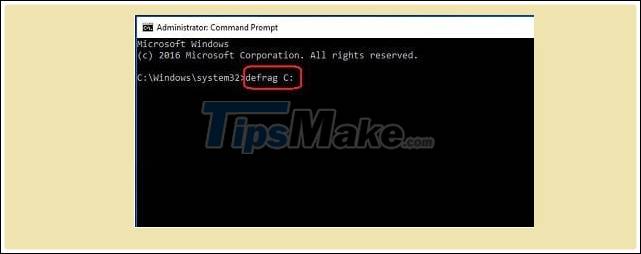
Step 4: Enter defrag C: command to start defragmenting your hard drive.
With the simple steps above, you are finished defragmenting the Windows 10 hard drive. When you do this, all the fragmented data or files move to a closer location and The free storage space of the hard drive is also pooled for faster use. As a result, future data or files will be stored in the defragmented storage space on your hard drive.
Key Takeaways
Use the information above as a practical reference for how to defragment the Windows 10 hard drive. Review each step carefully, confirm any requirements, and choose the option that best fits your situation.
FAQ
What does this guide explain about Defragment the Windows 10 Hard Drive?
It explains the main concepts, practical considerations, and useful steps related to defragment the Windows 10 hard drive without requiring advanced knowledge.
Who can benefit from learning about Defragment the Windows 10 Hard Drive?
This information is useful for readers who want a clear overview, practical guidance, and reliable steps related to defragment the Windows 10 hard drive.
What should I check before applying this information?
Review the requirements, confirm that your device, software, or situation matches the instructions, and back up important data before making major changes.
Related Articles
 When and How to Defragment Hard Drives on Windows 10?4 minutes read
 These Quality Hard Drive Defragmentation Software7 minutes read
 Why Doesn't Mac Hard Drive Need to Defragment?4 minutes read
 Defragment the Hard Drive with Disk Defragment2 minutes read
 Drive: How to Defragment a Windows Xp Computer5 minutes read
 Why You Really Shouldn't Defragment Your SSD: Key Reasons Explained7 minutes read
Reader Comments 0
Sign in with email or Google to join the discussion.