Table of Contents
This updated guide examines Frame: How to Close a Window in Java and organizes the essential facts, background, and practical takeaways in clear American English.
Method 1
Using javax.swing. JFrame
 Obtain an instance of a
JFrame, or create a new one.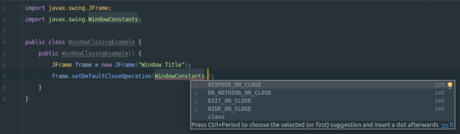 Set default close operation. Default close operation is set using the setter method inside the
JFrameclasssetDefaultCloseOperationthat determines what happens when the close button is clicked and takes the following parameters:WindowConstants. EXIT_ON_CLOSE- Closes the frame and terminates the execution of the program.WindowConstants. DISPOSE_ON_CLOSE- Closes the frame and does not necessarily terminate the execution of the program.WindowConstants. HIDE_ON_CLOSE- Makes the frame appear like it closed by setting its visibility property to false. The difference betweenHIDE_ON_CLOSEandDISPOSE_ON_CLOSEis that the latter releases all of the resources used by the frame and its components.WindowConstants. DO_NOTHING_ON_CLOSE- Does nothing when the close button is pressed. Useful if you wish to, for example, display a confirmation dialog before the window is closed. You can do that by adding aWindowListenerto the frame and overridingwindowClosingmethod. Example of the custom close operation:frame.setDefaultCloseOperation(WindowConstants.DO_NOTHING_ON_CLOSE);frame.addWindowListener(newWindowAdapter(){@OverridepublicvoidwindowClosing(WindowEvente){// Ask for confirmation before terminating the program.intoption=JOptionPane.showConfirmDialog(frame,"Are you sure you want to close the application?","Close Confirmation",JOptionPane.YES_NO_OPTION,JOptionPane.QUESTION_MESSAGE);if(option==JOptionPane.YES_OPTION){System.exit(0);}}});
Method 2
Using java.awt. Frame
 Obtain an instance of a
Frame, or create a new one. Add window listener. Call
addWindowListenermethod on the instance. The required argument isWindowListener. You can either implement every method of theWindowListenerinterface or override only the methods you need fromWindowAdapterclass. Handle window closing event. Implement
windowClosingmethod fromWindowListenerinterface or override it fromWindowAdapterclass. There are two ways of closing a window:- Dispose the window after the close button is clicked:
- Call
disposemethod insidewindowClosingmethod.
frame.addWindowListener(newWindowAdapter(){@OverridepublicvoidwindowClosing(WindowEvente){// Dispose the window after the close button is clicked.dispose();}}); - Call
- Terminate the program after the close button is clicked:
- Call
System.exitmethod insidewindowClosingmethod.
frame.addWindowListener(newWindowAdapter(){@OverridepublicvoidwindowClosing(WindowEvente){// Terminate the program after the close button is clicked.System.exit(0);}}); - Call
- Dispose the window after the close button is clicked:
FAQ
What is Frame: How to Close a Window in Java about?
It provides a structured overview of frame, explains the main context, and highlights practical takeaways for readers.
Why does this topic matter?
Understanding the main concepts helps readers evaluate the issue, avoid common mistakes, and make better-informed decisions.
How should readers use this information?
Use the guidance as a practical starting point, confirm details that may have changed, and follow current product, safety, or security recommendations.






Reader Comments 0
Sign in with email or Google to join the discussion.