Table of Contents
This updated guide explains how to Close Windows through clear steps, practical examples, and important checks that help prevent common errors.
Method 1 of 4:
Microsoft Windows
-
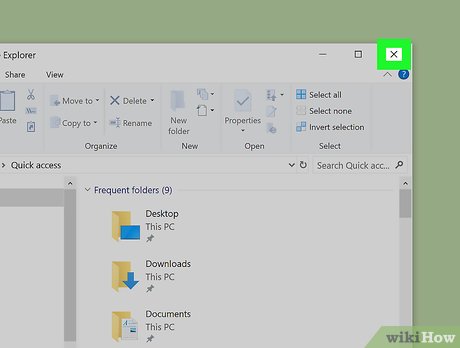 Click the X at the top-right corner of a window to close it. Nearly all Windows apps have an X at the top-right corner. Apps like these can typically be closed easily by clicking the X .
- If the window contains an open document, you may be prompted to save or dismiss it before the window will close.
- If the window has expanded to full-screen size and you don't see the X , press F11 to bring it back to normal size first.
-
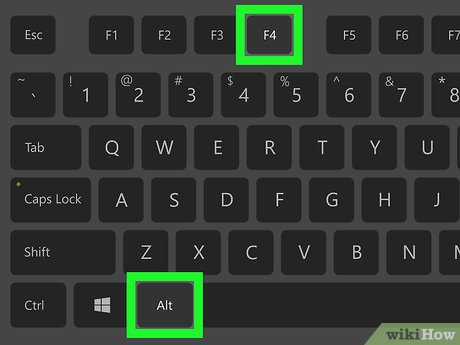 Press Alt+F4 to close a window. This keyboard shortcut will close the currently-active window just like clicking the X . If the window you're using doesn't have the X at the top-right corner, this combination of keys should do the trick.
 -
 Press Ctrl+F4 to close an active document. This command can be used in an app that supports multiple active documents at once, such as Microsoft Word. The app itself will not close, but the open file will.
 -
 Click Ctrl+W to close a web browser tab. If you're using a browser like Chrome or Edge, this keyboard shortcut will close the active browsing tab without closing the browser application.
 -
 Press ⊞ Win+↓ to minimize the active window. Pressing the Windows Key and the down-arrow key at the same time will not close the window, but it will remove it from your view so you can work on other things.
- To restore a minimized window, click it on the taskbar, which is usually at the bottom of the screen.
- To minimize all open Windows at once, press ⊞ Win+M.[1]XResearch source
Method 2 of 4:
macOS
-
 Click the red circle at the top-left corner of a window to close it. If the window you're closing contains an open document, you may be prompted to save or dismiss that document before the window will close.
- If you aren't able to use the mouse or prefer a keyboard shortcut, you can also press ⌘ Cmd+Q on the keyboard to close the active window.[2]XResearch source
-
 Press ⌘ Cmd+W to close the active window. This keyboard shortcut works in the same way as clicking the red circle at the top-left corner.
- If you're using an app with tabs, such as a web browser, this shortcut will close the active tab only. To close all open tabs in the window, keep pressing ⌘ Cmd+W until all are closed.
- To close all open Windows at once, press ⌘ Cmd+⌥ Option+W.
-
 Press ⌘ Cmd+M to minimize the active window. Minimizing a window doesn't completely close it, but it does remove it from the screen until you need to bring it back into view. You can re-open the minimized window by clicking its icon at on the far-right side of the Dock.
- To minimize all open Windows at once, press ⌘ Cmd+⌥ Option+M.
-
 Press Fn+F11 to hide all open Windows. Pressing this key will return you to your Mac's desktop immediately. When you're ready to re-open the Windows you've hidden, just press Fn+F11.
 -
 Press ⌘ Cmd+H to hide the active window. This command makes it look like the window is no longer open even though you're not closing the app. When you're ready to go back to the hidden window, click its application icon to re-open it.
- To hide all Windows at once, press ⌘ Cmd+⌥ Option+H.
Method 3 of 4:
Android
-
 Open your recent apps. The steps to do this vary by Android:[3]XResearch source
- If you're using a Samsung Galaxy, you can usually do this by pressing the Recent Apps button to the left of your Home button at the bottom of the screen.
- If your Android has a button with a square (or overlapping squares) at the bottom of the screen, tapping it should bring up your recent apps.
- If neither of these options work, try swiping up from the bottom of the home screen (but not so far that the app drawer opens).[4]XResearch source
-
 Swipe to the app you may need to close. You can move to the next step once the app you may need to close is at the center of the screen.
 -
 Swipe up on an app to close it. Depending on your Android, you may also be able to close apps by tapping the X at the top-right corner.
- You can tap Close All on some Androids to close all open apps at once.
Method 4 of 4:
iPhone or iPad
-
 Swipe up from the bottom of the home screen. If your iPhone or iPad doesn't have a physical Home button at the bottom-center part of the screen, this action will display your open apps.[5]XResearch source
- If you're using an iPhone or iPad with a physical Home button at the bottom-center part of the screen, press the button twice (quickly) to bring up the list of open apps instead.
-
 Swipe left or right to find the app you may need to close. Move to the next step once the app you may need to close appears at the center of the screen.
 -
 Swipe up on the app to close it. The window is now closed.
FAQ
What is the easiest way to Close Windows?
Start with the requirements in this guide, then follow each step in order. Check the result after every major change so problems are easier to identify.
Can beginners follow these instructions?
Yes. The process is organized into practical steps, and you can repeat any step before moving forward.
What should I check if the method does not work?
Confirm your software or device version, permissions, settings, file format, and internet connection when the task depends on online services.
Related Articles
 How to Close Apps in Windows 83 minutes read
 8 Ways to Close Applications and Programs on Windows9 minutes read
 How to Close All Open Windows of an App in Mac Os4 minutes read
 How to Close the Application on Android5 minutes read
 Turn on // Off the Prompt 'Do You Want to Close All Tabs?' in3 minutes read
 How to Close Windows in Windows 85 minutes read
Reader Comments 0
Sign in with email or Google to join the discussion.