Table of Contents
This updated guide examines How to Compare Two Dates in Java and organizes the essential facts, background, and practical takeaways in clear American English.
Method 1
Using compareTo
 Use compareTo. Date implements Comparable and so two dates can be compared directly with the compareTo method. If the dates are for the same point in time, the method returns zero. If the date being compared is before the date argument, a value less than zero is returned. If the date being compared is after the date argument, a value greater than zero is returned. If the dates are equal, a value of 0 is returned.[1]XResearch source
 Create the date objects. You will need to create each date object before you can start comparing them. One way to do this is to use the SimpleDateFormat class. It allows for easy entry of date values into date objects.
SimpleDateFormatsdf=newSimpleDateFormat("yyyy-MM-dd");//For declaring values in new date objects. use same date format when creating datesDatedate1=sdf.parse("1995-02-23");//date1 is February 23, 1995Datedate2=sdf.parse("2001-10-31");//date2 is October 31, 2001Datedate3=sdf.parse("1995-02-23");//date3 is February 23, 1995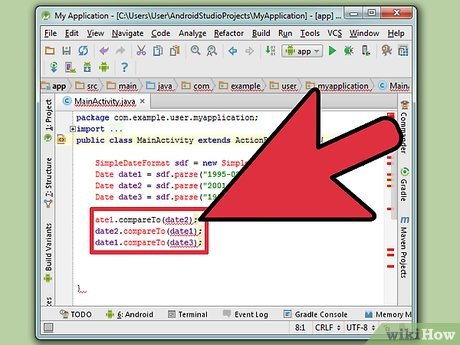 Compare the date objects. The code below will show you each case -- less than, equal, and greater than.
date1.compareTo(date2);//date1< date2, returns less than 0date2.compareTo(date1);//date2 > date1, returns greater than 0date1.compareTo(date3);//date1 = date3, so will print 0 to console
Method 2
Using Equals, After, and Before
 Use equals, after and before. Dates can be compared with the equals, after and before methods. If two dates are for the same point in time, the equals method will return true. The examples will use previously created dates from the compareTo method.[2]XResearch source
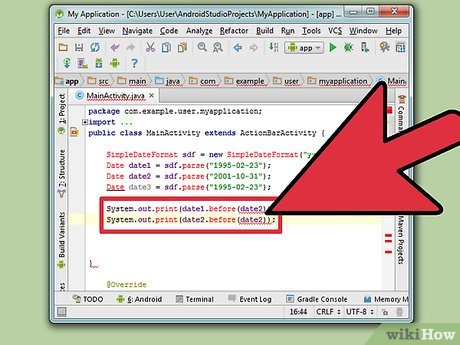 Compare using the before method. The code below shows a true and false case. If date1 is before date2, before returns true. If it is not, before returns false.
System.out.print(date1.before(date2));//prints trueSystem.out.print(date2.before(date2));//prints false
 Compare using the after method. The code below shows a true and false case. If date2 is after date1, after returns true. If it is not, after returns false.
System.out.print(date2.after(date1));//prints trueSystem.out.print(date1.after(date2));//prints false
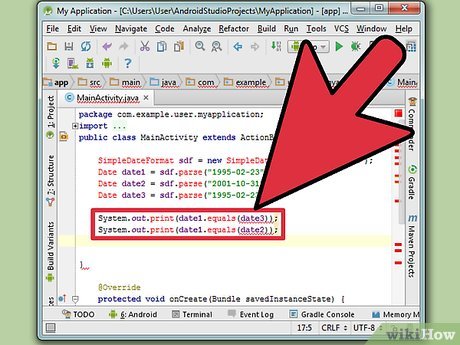 Compare using the equals method. The code below shows a true and false case. If the dates are equal, equals returns true. If they are not, equals returns false.
System.out.print(date1.equals(date3));//prints trueSystem.out.print(date1.equals(date2));//prints false
Method 3
Using the Calendar Class
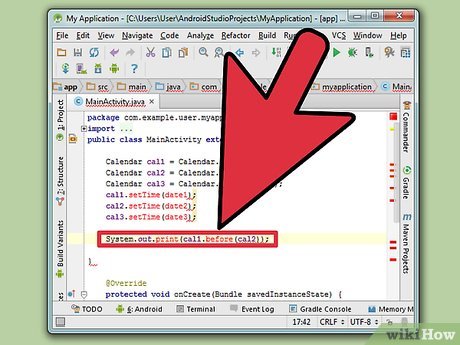 Use the calendar. The calendar class also has compareTo, equals, after and before methods that work in the same way as described above for the date class. So if the date information is being held in a calendar, there is no need to extract the date just to perform a comparison.[3]XResearch source
 Create instances of Calendar. To use the Calendar methods, you will need a few Calendar instances. Luckily, you can just grab the times from the already created Date instances.
Calendarcal1=Calendar.getInstance();//declares cal1Calendarcal2=Calendar.getInstance();//declares cal2Calendarcal3=Calendar.getInstance();//declares cal3cal1.setTime(date1);//applies date to cal1cal2.setTime(date2);cal3.setTime(date3);
 Compare cal1 and cal2 using before. The code below should print true since cal1 is before cal2.
System.out.print(cal1.before(cal2));//will print true
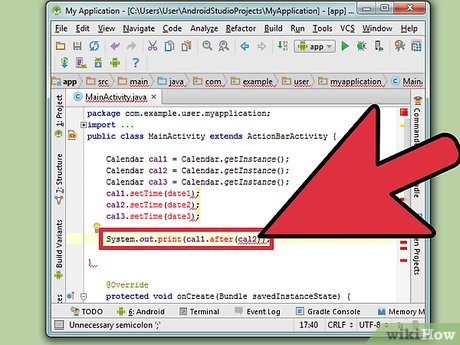 Compare cal1 and cal2 using after. The below code should print false since cal1 is before cal2.
System.out.print(cal1.after(cal2));//prints false
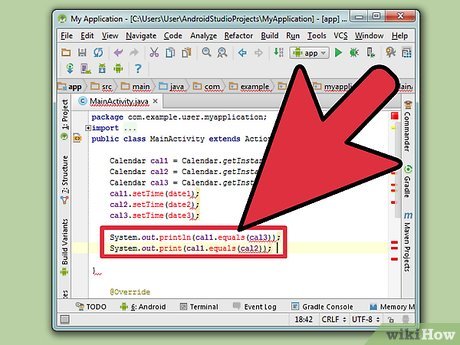 Compare cal1 and cal2 using equals. The below code will show an example of both a true and false case. The condition depends on the calendar instances being compared. The code should print "true," then "false" on the next line.
System.out.println(cal1.equals(cal3));//prints true: cal1 == cal3System.out.print(cal1.equals(cal2));//prints false: cal1!= cal2
Method 4
Using getTime
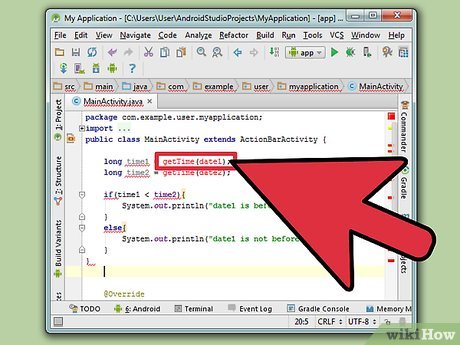 Use getTime. It is also possible to directly compare the point of time of two dates, although any of the previous approaches are likely to be more readable and so preferable. This will be a comparison of two primitive data types, so it can be done with "<", ">", and "==".
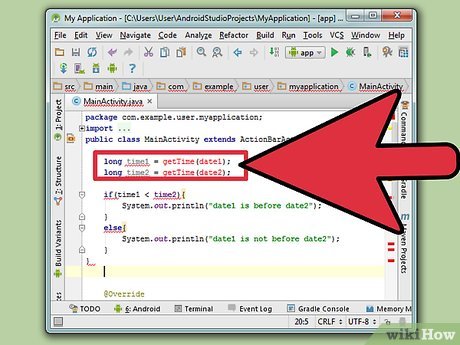 Create the long time objects. Before you can compare the dates, you must create long integers with the data from the previously created Date objects. Luckily, the getTime() method will do most of the work for you.
longtime1=getTime(date1);//declares primitive time1 from date1longtime2=getTime(date2);//declares primitive time2 from date2
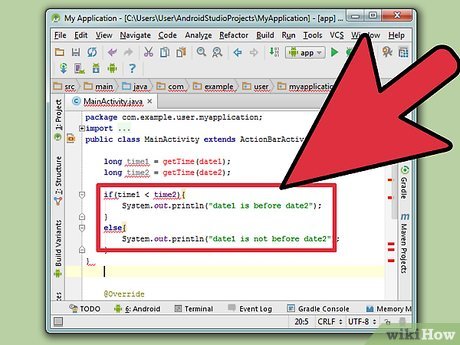 Do a less than comparison. Use the less than symbol (<) to compare these two integer values. Since time1 is less than time 2, the first message should print. The else statement is included for proper syntax.
if(time1
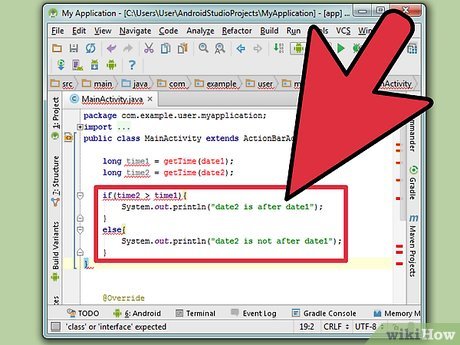 Do a greater than comparison. Use the greater than symbol (>) to compare these two integer values. Since time1 is greater than time 2, the first message should print. The else statement is included for proper syntax.
if(time2>time1){System.out.println("date2 is after date1");//will print since time2 > time1}else{System.out.println("date2 is not after date1");}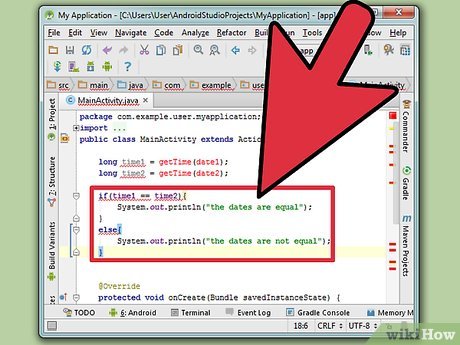 Do an equals comparison. Use the symbol to check for equality (==) to compare these two integer values for equality. Since time1 is equal to time3, the first message should print. If the program gets to the else statement, that means the times are not equal.[4]XResearch source
if(time1==time2){System.out.println("the dates are equal");}else{System.out.println("the dates are not equal");//will print since time1!= time2}
FAQ
What is How to Compare Two Dates in Java about?
It provides a structured overview of date, explains the main context, and highlights practical takeaways for readers.
Why does this topic matter?
Understanding the main concepts helps readers evaluate the issue, avoid common mistakes, and make better-informed decisions.
How should readers use this information?
Use the guidance as a practical starting point, confirm details that may have changed, and follow current product, safety, or security recommendations.
Related Articles
 How to Compare Two Dates in Java8 minutes read
 What Is the Difference Between Go and Java? Complete Guide4 minutes read
 What Is Java? Why Choose Java?11 minutes read
 Basic Java Syntax: A Practical Guide10 minutes read
 What Is JAVA File? How to Open, Edit and Convert JAVA Files6 minutes read
 EQuiz - Multiple Choice Quiz About JAVA4 minutes read
Reader Comments 0
Sign in with email or Google to join the discussion.