Table of Contents
Many people are always excited to try out new browsers, and when one promises to be 5 times faster than the default Android browser and 2 times faster than Chrome, it becomes even more exciting.
Browsers are more than just gateways to our favorite websites; they're the central operating systems for our digital identities, managing everything from communication and entertainment to banking and health records.
Many people are always excited to try out new browsers, and when one promises to be 5 times faster than the default Android browser and 2 times faster than Chrome, it becomes even more exciting.
That's the claim of the Dolphin browser! But is that claim accurate?
Dolphin's Bold Claim: 2x Faster Than Chrome
Is Dolphin's promise accurate?
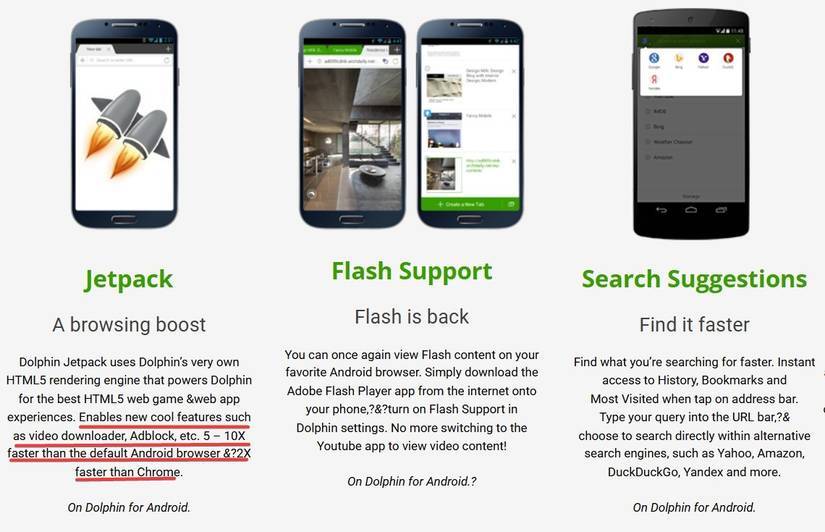
Dolphin is a mobile browser that doesn't have an official desktop version yet, and it's positioned around speed. Here's the official claim: 5-10x faster than the stock Android browser and 2x faster than Chrome. That's not a subtle claim, especially on mobile devices with limited battery and memory. It would be amazing if it actually doubled the speed of Chrome.
Google Chrome is deeply integrated into the Android ecosystem. It's powered by Google 's engine-level improvements and is regularly optimized for Android updates. You can only assume that for Dolphin to be twice as good, it would need more than a few UI tweaks and an ad blocker.
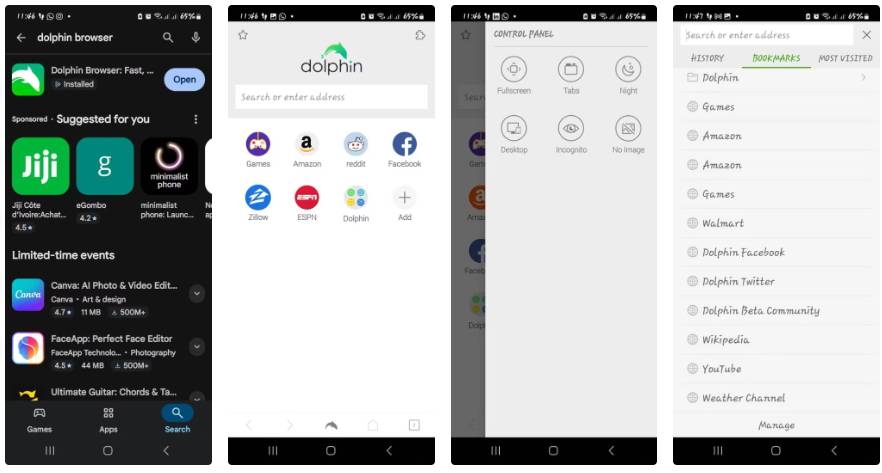
Of course, this browser isn't all about speed. It includes tabbed browsing, tools and extensions, its own web app store, and a switcher that lets you switch between desktop and mobile views. If you added speed to that feature set, it could be the only mobile browser you could use instead of Chrome.
Testing Dolphin and Chrome in the real world
Benchmarks and Resource Usage: The Big Picture
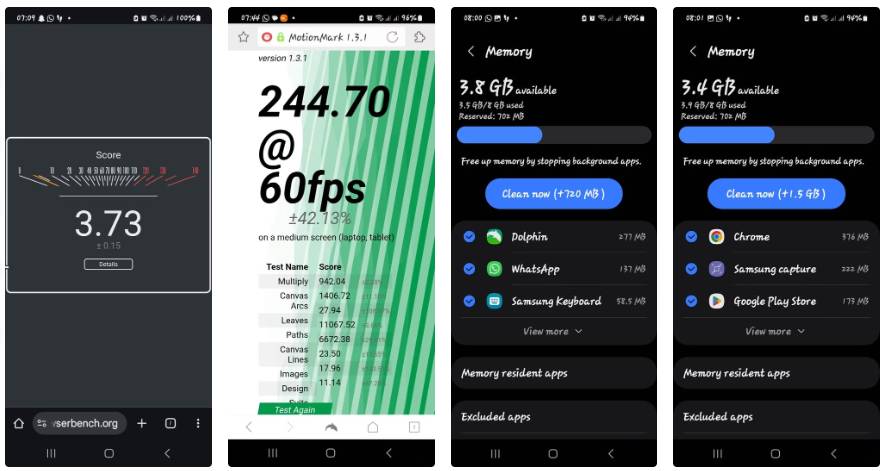
The best way to verify Dolphin's claims is to run industry-standard web browsing tests. I ran three BrowserBench tests on my Samsung Galaxy A72 using both Chrome and Dolphin. These tests simulate page loading, script execution, and graphics rendering—your everyday web browsing routine. They determine how quickly the browser responds when you click, scroll, or stream.
The first test we ran was the Speedometer 3.0 test, which measures responsiveness. While Chrome scored 3.73, Dolphin was slightly better at 3.77. This suggests that basic interactions like typing or switching tabs will be roughly the same on both browsers.
Next, we ran the JetStream 2 test to evaluate how both browsers execute JavaScript and WebAssembly. Here, Dolphin scored 225.78 points, higher than Chrome's 218.49 points. This is a small difference, suggesting Dolphin is slightly faster at processing scripts. However, it's still not twice as fast.
In the MotionMark test, which measures how well a browser handles graphics, Dolphin outperformed Chrome with a score of 244.70 compared to Chrome's 215.77. This suggests that you'll experience smoother animations and transitions in Dolphin. Finally, with just one tab running, RAM usage was tested and Dolphin again came out on top, using 277MB of RAM compared to Chrome's 376MB. This lower RAM footprint suggests that Dolphin will likely be faster on devices with less memory, although in real-world use, it's a bit faster, not a whole lot faster.
What makes Dolphin feel faster?
Inside: Performance tweaks and feel
Both browsers have nearly identical benchmark scores, suggesting that Dolphin isn't noticeably faster, even if it sometimes feels that way. The speed difference is likely due to minor optimizations rather than necessarily raw processing power.
Dolphin runs on a leaner architecture that allows it to launch quickly and use less memory, creating the illusion of speed, especially on mid-range phones. This is unlike Chrome, which has many background services tied to the Google ecosystem.
Dolphin also has built-in ad blocking and caching to reduce loading times when browsing media content or ad-heavy websites. Some pages that take a long time to load in Chrome load almost instantly in Dolphin, although the rendering engine isn't much faster.
This speed advantage won't be as noticeable on sites that rely heavily on modern JavaScript frameworks. It's efficient and lightweight, but it won't necessarily outperform Chrome on complex, code-intensive tasks. It just strips away the bloat that slows Chrome down. You can switch to other lightweight browsers if speed is a priority.
Comments after testing and using Dolphin
The claims of 2x speed seem to be more hype than reality. But many people continue to enjoy the Dolphin mobile browser experience all day long. It provides a smooth experience in some cases. Dolphin has the advantage of being lightweight, memory efficient, and has a built-in ad blocker, especially on low- to mid-range phones where RAM is important.
Dolphin still isn't quite as fast as Google Chrome, however. It's a little faster, but not significantly more powerful or capable of handling everyday tasks. There's still a place for it, especially if you want a productive browser that doesn't get bogged down by background apps like Chrome.
FAQ
What should you know about dolphin browser claims to be 2x faster than Chrome?
In practical terms, many people are always excited to try out new browsers, and when one promises to be 5 times faster than the default Android browser and 2 times faster than Chrome, it becomes even more exciting.
Why does dolphin browser claims to be 2x faster than Chrome matter?
The article highlights that dolphin's Bold Claim: 2x Faster Than Chrome Is Dolphin's promise accurate.
What is the main takeaway?
The main takeaway is that here's the official claim: 5-10x faster than the stock Android browser and 2x faster than Chrome.
Related Articles
 Google Claims Chrome Is Now Faster Than Ever3 minutes read
 Google Claims the New Occlusion Feature Makes Chrome on3 minutes read
 Microsoft Claims Edge Overcomes Chrome and Firefox, Becoming the World's Best Browser3 minutes read
 Dolphin Anty Explained6 minutes read
 Google Chrome Is Now 23% Faster, Have You Tried It?3 minutes read
 Microsoft Claims Edge Browser Performs Better Than Chrome on Windows3 minutes read
Reader Comments 0
Sign in with email or Google to join the discussion.