Table of Contents
Leased Line is easier to understand when the core ideas are explained in practical terms. This guide covers what it means, how it works, why it matters, and the main details you should know.
Key Takeaways
- Understand what is leased line.
- Explore architecture of leased line.
- Understand current leased line classification.
What Is Leased Line?
Leased line, also known as leased line, is a form of private network connection between network nodes using a private data transmission channel. You will find many protocols for communication for Leased line, such as HDLC, ATM, PPP,.
Leased lines are copper or fiber optic cables that directly connect two network points together, using CSU, DSU terminals. Commonly used connection standards are G703, HDSL and a few others.
Architecture of Leased Line
Leased lines are connected directly to the premises or can also be done through fiber optic cables. In the case of leased lines transmitted through fiber optic cables, they will work by sending light pulses where the data is transmitted at the speed of light.
Current Leased Line Classification
Current leased lines are divided into 3 types:
● Fibre leased lines: Involves the transmission of light from a fiber optic leased line to a fiber optic cable to establish a symmetrical data connection. Only a few leased lines use fiber optic cables for the entire routing process, while most leased lines use fiber optic cables for the majority of the parts. Fiber leased lines offer excellent speeds compared to other types.
● DSL leased lines: This type of leased line provides low bandwidth leased lines. Compared to symmetrical and non-competitive leased lines, DSL connections are asymmetrical and competitive. You can choose SDSL, an asymmetrical alternative to DSL that provides faster upload speeds.
● MPLS leased lines: MPLS leased lines (MPSL) is a technology that encapsulates data and transmits it from X to Y. You can put labels on it and then decide to transmit data depending on those labels.
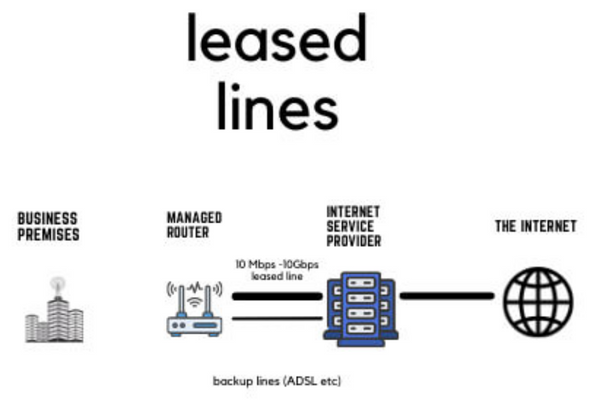
What is leased line?
How Does Leased Line Work?
A Leased Line creates a direct connection between two points (such as two offices or between an office and a data center) without being affected by the traffic of other users. This ensures that bandwidth is always dedicated to the organization using it, helping to reduce latency and increase data transmission speeds.
They differ from traditional telecommunication technologies, which use and reuse circuits by switching. They establish a continuous tunnel between two communication points, allowing data to flow continuously.
Internet Protocols Used with Leased Line
There are 3 Internet protocols that leased lines use: PPP, HDLC, LAPB. These protocols have different characteristics, serving different needs, users will choose depending on actual usage needs.
HDLC Protocol
HDLC (High-Level Data Link Control) is a bit-oriented WAN protocol, commonly used to control high-level data links. HDLC is widely used in point-to-point or multipoint configurations. This Internet protocol is only used with Cisco routers, which means that both ends of the connection must be Cisco routers to use HDLC.
PPP Protocol
This is a byte-oriented protocol. This connector protocol can still be used if one end of the leased line is a Cisco device and the other end is a third device. The advantage of this protocol is that it is compatible with all routers of different manufacturers. PPP is also widely used because it allows other network protocols to run through it.
LAPB Protocol
LAPB is a layer two communication protocol, with characteristics similar to the X.25 network protocol. LAPB has full procedures, transmission control, development and error correction, but this protocol is still rarely used.
Benefits of Using Leased Line
High Connection Speed
Leased Line provides fixed bandwidth, not shared with others, ensuring equal (symmetrical) download and upload speeds throughout the operation time. Connection speeds can reach from 2Mbps to 10Gbps, helping businesses handle large volumes of data without experiencing congestion during peak hours.
Stable Upload and Download Speed
The download and upload speed of the leased line is always guaranteed to be stable throughout the operation. The higher the speed, the faster the connection is. Therefore, leased line is very suitable for businesses and organizations that need to process large amounts of data.
Ensuring Security and Privacy
By using a separate line, Leased Line helps protect your business information and data from external threats. This connection is not shared with anyone else, thus minimizing the risk of external attacks.
Some Limitations
Besides the above advantages, Leased line still has some limitations such as:
● Line rental price is higher than other types of Internet connections.
● To be able to use a leased line, businesses need a network system that meets the requirements for speed and reliability.
What Is the Difference Between Leased Line and Broadband?
Leased Line and Broadband are two popular types of Internet connection services, but they have different features and applications.
In Terms of Definition
● Leased Line: Is a dedicated network connection, providing fixed and high-speed bandwidth, not shared with other users. This service is often used for large businesses or organizations with large and stable data transmission needs.
● Broadband: Is a high-speed Internet service but often shares bandwidth with many other users. This is a popular choice for households and small businesses, suitable for common online activities such as surfing the web, watching videos, and playing games.
In Terms of Speed and Bandwidth
● Leased Line: Provides balanced upload and download speeds, with bandwidth that can reach from 2Mbps to 10Gbps or more. In particular, this bandwidth is not affected by the traffic of other users.
● Broadband: Speeds are often uneven; download speeds are usually higher than upload speeds. Bandwidth may be reduced during peak hours due to multiple users sharing.
In Terms of Security
● Leased Line: Designed to ensure privacy and security, as it is a separate connection for only one customer. This makes it an ideal choice for businesses that need to protect sensitive information.
● Broadband: Although there are security measures, due to its shared nature, the level of security is not as high as Leased Line. Data can be more vulnerable to attacks when transmitted over a shared network.
In Terms of Cost
● Leased Line: Usually costs more due to the quality of service and committed bandwidth. However, for large businesses, this is a necessary investment to ensure work performance.
● Broadband: Costs much less than Leased Line, making it a popular choice for homes and small businesses. However, this cost can vary depending on the service provider and subscription plan.
In Terms of Application
● Leased Line: Suitable for applications that require stable connections such as VoIP, video conference, or hosting servers. It also supports services such as VPN for businesses.
● Broadband: Suitable for daily online activities such as surfing the web, watching online videos, playing online games, but doesn't guarantee performance for applications that require continuous high bandwidth.
Conclude
Leased Line is a service that brings many benefits to businesses that need to transmit data internationally. Although the price is higher than normal services, it provides fast and secure transmission speed. Hopefully the above information helps you better understand what Leased Line is and choose the right network service.
Final Thoughts
The most reliable way to handle leased line is to follow the process in order, verify each important setting, and test the result before moving on. Use the guidance above as a practical reference, then adjust the details for your device, software version, or specific goal.
FAQ
What is Leased Line?
Businesses need a strong information system, requiring good quality to be able to keep up with the development of the 4.0 revolution.
Why is Leased Line important?
Understanding leased line helps you evaluate its purpose, requirements, limitations, and practical impact before you use it or make a related decision.
Who should understand Leased Line?
It is useful for beginners who need a clear overview and for experienced users who want to confirm terminology, requirements, or best practices.
Related Articles
 Some Tricks or LINE Users Should Know7 minutes read
 How to Add or Delete Friends on LINE?4 minutes read
 Benefits of Internet Marketing5 minutes read
 Search for Malware on Windows Computers with the Command Line7 minutes read
 2 Simple Ways to Create a LINE Account on Your Phone2 minutes read
 How to Log Out of LINE Account on Android?2 minutes read
Reader Comments 0
Sign in with email or Google to join the discussion.