Table of Contents
This guide explains how to use NETWORKDAYS Function in Excel, including its syntax, required arguments, practical examples, and common errors.

Description: The function returns the number of intact working days calculated between two specific dates. Working days do not include weekends and holidays specified.
Syntax: NETWORKDAYS (start_date, end_date, [holidays])
Inside:
- start_date: Start date to calculate the number of working days, is a required parameter.
- end_date: The end date to calculate the number of working days, which is a required parameter.
- holidays: Holidays need to be excluded from the working day, these days are usually not on a fixed list, is an optional parameter.
Attention:
- Excel stores the date as a serial number to facilitate the calculation process.
- If any function argument is invalid -> the function returns the #VALUE! Error value
For example:
Calculate the total number of business days for the following values:
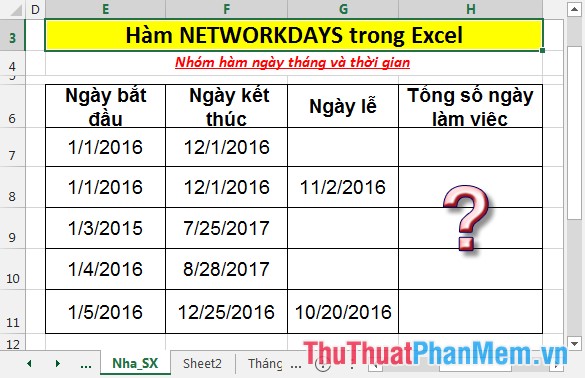
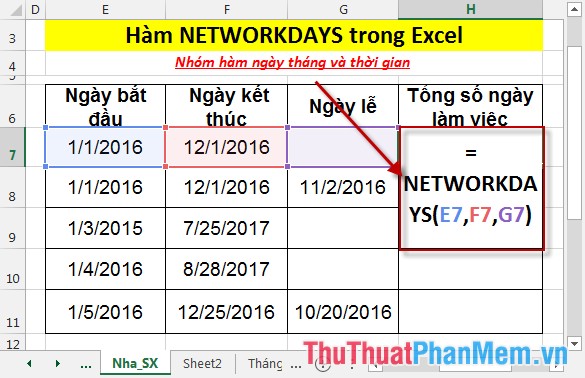
- In the cell to calculate the total number of working days, enter the formula: = NETWORKDAYS (E7, F7, G7).
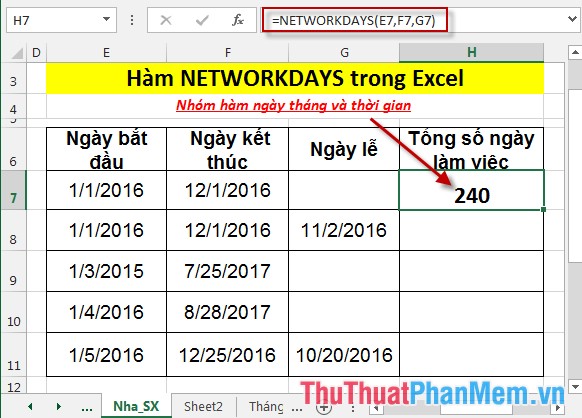
- Press Enter -> total working days is:
- Similarly copying the formula for the remaining prices results:

Here, with the same start and end dates, but since February 11, 2016 is off-company leave, the number of working days is reduced by 1.
Above are instructions and some specific examples when working with NETWORKDAYS function in Excel.
Good luck!
FAQ
What does the NETWORKDAYS function do in Excel?
The NETWORKDAYS function performs the calculation described in this guide. Use the correct arguments and compatible data types for reliable results.
How do I enter the NETWORKDAYS function correctly?
Start with an equals sign, enter NETWORKDAYS, add the required arguments inside parentheses, and confirm that cell references and separators are correct.
Why does the NETWORKDAYS function return an error?
Common causes include missing arguments, invalid data types, incorrect cell references, unsupported values, or regional separator settings.






Reader Comments 0
Sign in with email or Google to join the discussion.