Table of Contents
This updated guide examines How to Take a Screenshot on a Dell and organizes the essential facts, background, and practical takeaways in clear American English.
Method 1of 3:
Using Windows 8 and 10
 Navigate to a page on which you wish to take a screenshot. Anything that's on your screen (other than your mouse cursor) will be captured when you take your screenshot, taskbar included.
- For example, you might open a Facebook conversation you had with a friend.
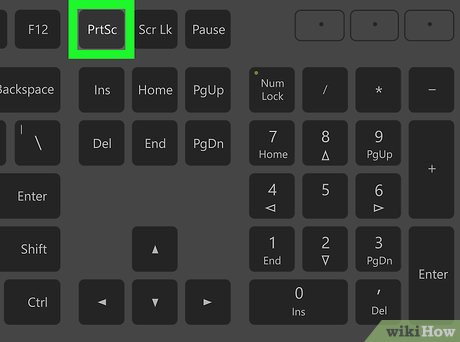 Locate the⎙PrtScrkey. The "Print Screen" key is typically found in the upper-right side of Dell keyboards. Unlike other computer manufacturers' keyboards, the "Print Screen" key usually doesn't have anything else written on it.
- The "Print Screen" key may be written a number of different ways, but "PrtSc" and "Prnt Scr" are the two most common variations.
 Locate the⊞Winkey. This key, which has the Windows logo on it, is typically in the bottom-left corner of any Windows computer.
 Press⊞Winand⎙PrtScrsimultaneously. Your screen should dim briefly, indicating that your screenshot was taken.
- If the screen doesn't dim, try holding down⊞Winand firmly pressing down on the⎙PrtScrkey.
 Open the Start menu. To do so, either press the⊞Winkey or click the Windows logo in the bottom-left corner of the screen. The Start menu will open with your mouse cursor in the "Search" field.
 Typescreenshotsinto Start. You'll see a folder entitled "Screenshots" appear at the top of the Start window.
 Click the Screenshots folder. Doing so will open it; you'll be able to find your screenshot inside.
- The Screenshots folder is created in your Pictures folder after you take your first screenshot.
Method 2of 3:
Using Windows XP, Vista, and 7
 Navigate to a page on which you wish to take a screenshot. Anything that's on your screen (other than your mouse cursor) will be captured when you take your screenshot, taskbar included.
- For example, you might open a Facebook conversation you had with a friend.
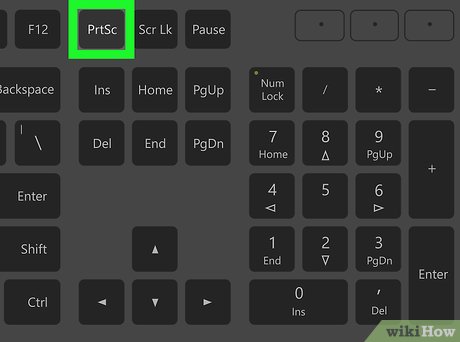 Locate the⎙PrtScrkey. The "Print Screen" key is typically found in the upper-right side of Dell keyboards. Unlike other computer manufacturers' keyboards, the "Print Screen" key usually doesn't have anything else written on it.
- The "Print Screen" key may be written a number of different ways, but "PrtSc" and "Prnt Scr" are the two most common variations.
 Press⎙PrtScr. Doing so will copy an image of your screen onto your computer's clipboard, from which you can paste it into an application that will allow you to save it as a picture.
- Some Dell keyboards have "PrtSc" written in a different color than the regular key color (e.g., white). If so, you'll need to pressFnin the left corner of the keyboard while pressing⎙PrtScr.
 Open the Start menu. You can do this by clicking either the Windows icon (Windows Vista and 7) or Start (Windows XP) in the bottom-left corner of the screen, or you can press the⊞Winkey.
 Typepaintinto the Start menu. You should see the Paint application pop up at the top of the Start menu's window.
- For Windows XP, click All Programs and then select the Accessories tab.
 Click the Paint icon. It resembles a cup full of brushes (Windows XP and Vista) or a painting palette (Windows 7).
 Hold downCtrland pressV. This will paste your screenshotted image into Paint.
 ClickFile. It's in the top-left corner of the Paint window.
 ClickSave. This will prompt a window wherein you can name your file.
 Type in a name, then clickSave. Doing so will save your screenshot to your computer's default save location, which is usually the Documents folder.
- You can change the save location by clicking on a folder in the left-hand sidebar.
Method 3of 3:
Using the Snipping Tool
 Open the Start menu. To do so, either press the⊞Winkey, or click the Windows logo in the bottom-left corner of the screen.
- The Snipping Tool is not available for Windows XP.
 Typesnipping toolinto Start. This will pull up the Snipping Tool icon at the top of the Start window.
 Click the Snipping Tool's icon. It resembles a pair of scissors. Doing so will open the Snipping Tool app.
 ClickModeor▼. This will prompt a drop-down menu with the following screenshot shape options:
- Free-form Snip – This lets you draw any shape with your mouse. The inside area of the shape will be captured for the screenshot.
- Rectangular Snip –This is the default shape, and lets you draw a box of any proportions to use as the screenshot.
- Window Snip – This takes a screenshot of a specific window, much like holding Alt and pressing Print Screen. You will be able to select which window you want to use.
- Full-screen Snip – This takes a screenshot of the entire screen, but doesn't show the Snipping Tool window.
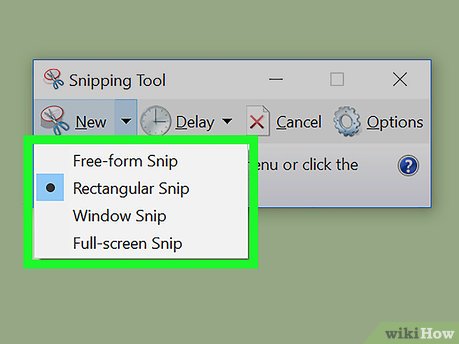 Click a shape. It will be applied to your screenshot template.
 Change the border. By default, all snips will have a red border around them. You can change this by clicking the Options button. This will open a new window, allowing you to disable the border or change the color.
 ClickNew. It's on the left side of the Snipping Tool bar. Your screen will dim, and your mouse's cursor will turn into a crosshair.
 Click and drag your mouse across the screen. As you do so, a rectangle will appear and encompass your selected area.
- If you selected Full-screen Snip , clicking New will take the screenshot.
 Release the mouse button. This will take a screenshot of anything within the rectangular area.
 ClickFile. It's in the top-left corner of the screenshot's page.
 ClickSave as. This option is near the middle of the drop-down field.
 Type in a name, then clickSave. Doing so will save your screenshot to your computer's default visual media save location, which is typically the Pictures folder.
- You can change the save location by clicking on a folder in the left-hand sidebar.
FAQ
What is How to Take a Screenshot on a Dell about?
It provides a structured overview of screen, explains the main context, and highlights practical takeaways for readers.
Why does this topic matter?
Understanding the main concepts helps readers evaluate the issue, avoid common mistakes, and make better-informed decisions.
How should readers use this information?
Use the guidance as a practical starting point, confirm details that may have changed, and follow current product, safety, or security recommendations.
Related Articles
 How to Take a Screenshot of Dell Laptop3 minutes read
 How to Screenshot Dell Laptop for All Windows Generations from XP to 106 minutes read
 Dell Laptop Screen Capture: Complete Guide10 minutes read
 How to Take Screenshots of Dell Computers You Need to Know7 minutes read
 How to Take a Screenshot on a Dell Computer: Clear Instructions8 minutes read
 How to Take a Screenshot on Windows 118 minutes read
Reader Comments 0
Sign in with email or Google to join the discussion.