Table of Contents
This guide provides a practical overview of Exponential Functions in Excel - Usage and Examples, including its main features, benefits, limitations, and important considerations.
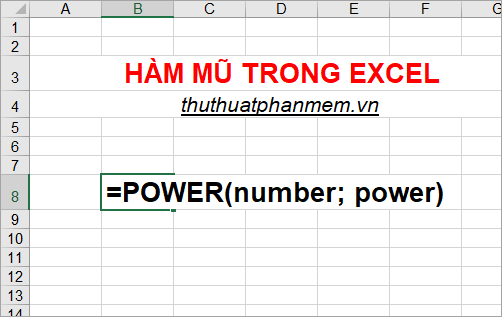
Power function is exponential in Excel, below will be usage and specific examples of exponential functions in Excel.
Description
The Power function (exponential function) helps you calculate power in Excel and return the result as the power of a number.
- You can use the '^' operator instead of the Power function to calculate powers in Excel.
Syntax
= POWER (number; power)
Inside:
number is a required argument, this is the base number it can be any real number.
power (required argument) is the exponent you want to raise the base power to.
For example
Here is an example of the POWER function with base and exponent numbers:

So, all you know is that the POWER function is an exponential function in Excel, you can calculate power in Excel for multiple records quickly with this POWER function. The article shared to you the description, syntax and examples of how to use the POWER function in Excel. Hope this article will help you. Good luck!
FAQ
What should I know about Exponential Functions in Excel - Usage and Examples?
Focus on the key features, requirements, limitations, and practical use cases explained in this guide.
How do I get the best results with Exponential Functions in Excel - Usage and Examples?
Follow the recommended steps, use current software or information, confirm compatibility, and review settings before major changes.
Are there any risks or limitations?
Potential limitations depend on compatibility, data quality, cost, privacy, support, and how the product or method is used.
Related Articles
 How to Use the IRR Function in Excel5 minutes read
 Comparison Functions in Excel - How to Use Comparison Functions and5 minutes read
 Excel Date Function - Usage and Examples6 minutes read
 Function Address in Excel3 minutes read
 How to Use the PMT Function in Excel4 minutes read
 5 Real-world Examples Demonstrating the Effectiveness of the MAP Function in Excel9 minutes read
Reader Comments 0
Sign in with email or Google to join the discussion.