Table of Contents
This guide provides a practical overview of Function Address, including its main features, benefits, limitations, and important considerations.

Syntax and usage of ADDRESS function
Syntax: = ADDRESS (row_num, column_num, [abs_num], [a1], [sheet_text]) .
Inside:
- row_num: Number of rows to get the address, required parameters.
- column_num : The column number of the cell to get the address, required parameters.
- abs_num: Specifies the return reference type, which is an optional parameter with the following values:
+ 1 or ignore: Absolute address.
+ 2: Absolute products; relative column.
+ 3: Relative row; absolute column.
+ 4: Relative address.
- a1: The logical value specifying the reference type A1 or R1C1, which is an optional parameter. The following values are available:
+ TRUE or skip: Columns are numbered according to the alphabet, row by number. For example B2, C8..
+ FALSE: Both rows and columns are labeled in the form of R1C1. Example R1C2.
- sheet_text : The text value that specifies the sheet name to refer to, which is an optional parameter. If the Sheet argument is omitted, the formula will interpret the current sheet.
Usage: The Address function returns the position (address) of a cell in the worksheet with the given number of rows and columns. You consider some illustrative examples to be able to better understand the application of this function.
Illustration
You refer to some examples and description of formulas in the following table:
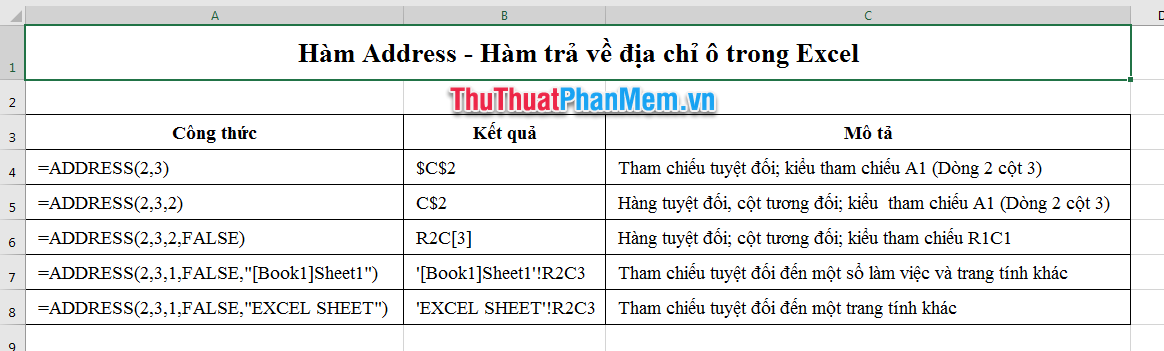
Note:
- A1 reference style (row 1 and column A): absolute reference is expressed by the dollar symbol preceding the column or row position.
- R1C1 reference style (row 1 and column 1): absolute reference is indicated by square brackets [] in the row or column number.
- If you want to reference a workbook, and other worksheets, put the name of the workbook in square brackets. For example "[Book2] Sheet3" means the working window is named Book2 and the worksheet in that window is Sheet3.
Hope this article will be helpful for readers. Good luck!
FAQ
What should I know about Function Address?
Focus on the key features, requirements, limitations, and practical use cases explained in this guide.
How do I get the best results with Function Address?
Follow the recommended steps, use current software or information, confirm compatibility, and review settings before major changes.
Are there any risks or limitations?
Potential limitations depend on compatibility, data quality, cost, privacy, support, and how the product or method is used.
Related Articles
 How to Use Address Function in Excel: Excel. MS Excel9 minutes read
 How to Use the IRR Function in Excel5 minutes read
 How to Use the OR Function in Excel3 minutes read
 How to Use the OFFSET Function in Excel7 minutes read
 How to Use the MATCH Function in Excel6 minutes read
 Excel Date Function - Usage and Examples6 minutes read
Reader Comments 0
Sign in with email or Google to join the discussion.