Table of Contents
This updated guide examines Compare Internet Speed of DNS 1.1.1.1 with Other Popular DNS and organizes the essential facts, background, and practical takeaways in clear American English.
You can visit DNSPerf.com to see a table comparing DNS query speed 1.1.1.1 compared to other popular DNS. DNS is specific to each location, so your results may be different from the results of DNSPerf.
- Introducing DNS Resolver 1.1.1.1
- Learn about DNS Hijacking and how to prevent it!
- How to change DNS to surf faster
 (Click on image to see full size)
to compare Internet speed, the article will check with some popular DNS services at position 06109. First, do the DNS 1.1.1.1 and Quad9 services, using the IP address 1.1.1.1. of CloudFlare as the primary address and 1.0.0.1 as the secondary address along with the main DNS 9.9.9.9 of Quad and DNS 149.112.112.112 sub, the DNS cache of the router still works. Then, we set the DNS router cache feature to zero and run DNS Benchmark.
From the above test, we can see that the 1.1.1.1 address has a slower response time than the 1.0.0.1 secondary IP address, possibly because it is under pressure from early users. So you should set the 1.0.0.1 address as the primary address and 1.1.1.1 as the secondary address. One thing to note is that the Quad9's 8.8.8.8 address is faster than the 1.1.1.1 address in some runs on this test.
Finally, note that the 1.1.1.1 address registered on the MegaPath Networks network and 1.0.0.1 address is registered on the Cloudflare network. In general, from the above test, we can see that Quad9 and CloudFlare 1.1.1.1 have equal performance.
For home use, OpenDNS is another service that users need to consider. It uses 208.67.222.222 address as its primary address and 208.67.220.220 as a secondary address. There is also Norton ConnectSafe with many different levels of protection.
Typically, users do not use the IP address instead of the URL name but on the website https://1.1.1.1 you can use both with the TLS HTTPS security key.
The primary and secondary IP addresses of DNS services used during comparison checks
The following list covers 5 services used for comparison in this review.
Cloudflare 1.1.1.1 - speed and privacy, providing DNS over HTTPS
- 1.1.1.1
- 1.0.0.1
Google Public DNS - speed, provides DNS over HTTPS
- 8.8.8.8
- 8.8.4.4
See also: Use Google Public DNS to speed up Internet connection
Quad9 - privacy, speed, malware filtering, providing DNSSEC
- 9.9.9.9
- 149,112,112,112
Note, although the Quad9 provides completely separate secondary DNS based on IPV6 2620: fe:: fe address, but DNS Benchmark does not support IPV6 so at this test it has Quad9 sub-DNS IP 149.112.112.112.
- How to transfer IPv4 addresses to IPv6
- How to change DNS Quad9 to block malicious domain
OpenDNS - suitable for home use (part of Cisco), providing DNSCrypt
- 208.67.222.222
- 208.67.220.220
See also: OpenDNS - Speed up web browsing and more
Norton ConnectSafe - suitable for home use, does not provide DNS over HTTPS, DNSSEC or DNSCrypt
- 199.85.126.20
- 199.85.127.20
Comparison test results
This comparison test was done with the DNS Benchmark tool at position 06109 on the Cox Communication Internet with Cloudflare, Google, Quad9, OpenDNS and Norton ConnectSafe services. Below is a screenshot of the test results in 5 times.
Result 1: Click on the image to enlarge and see.

Second result:

3rd result:
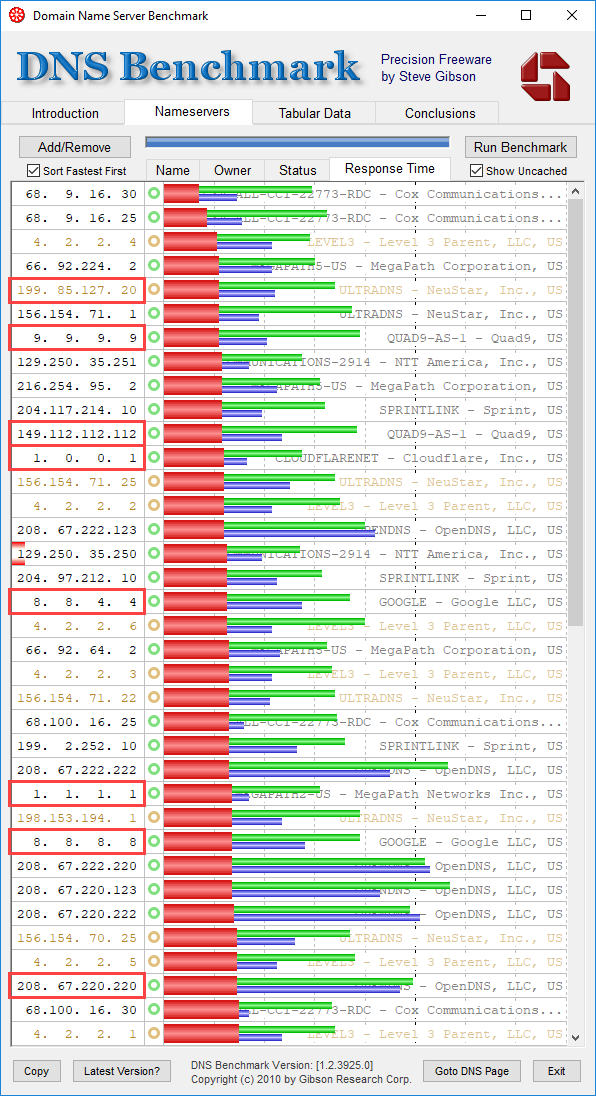
4th result:
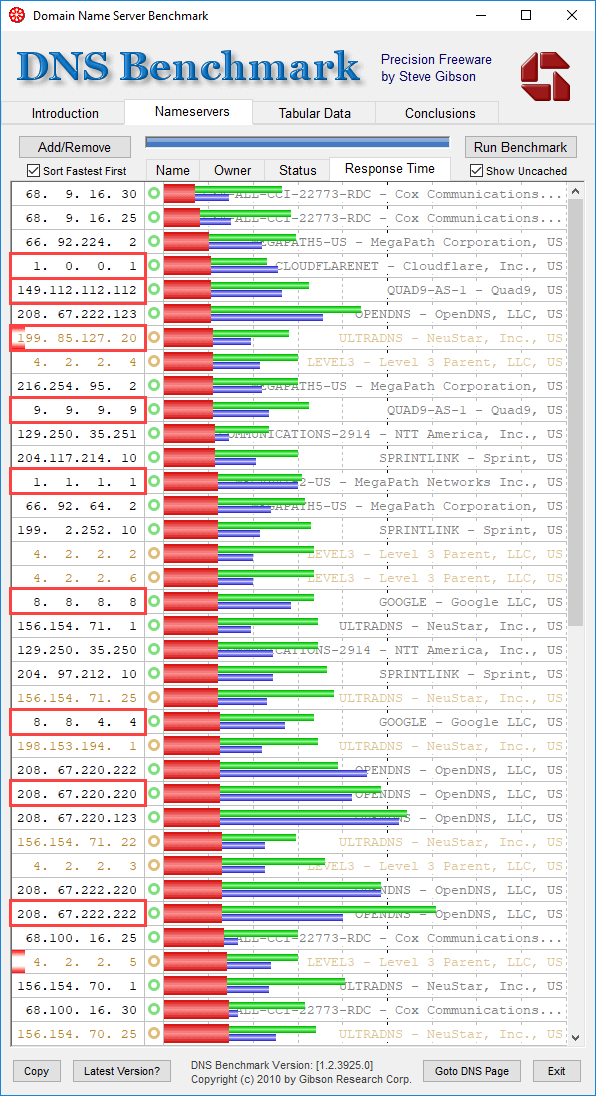
The 5 th result:
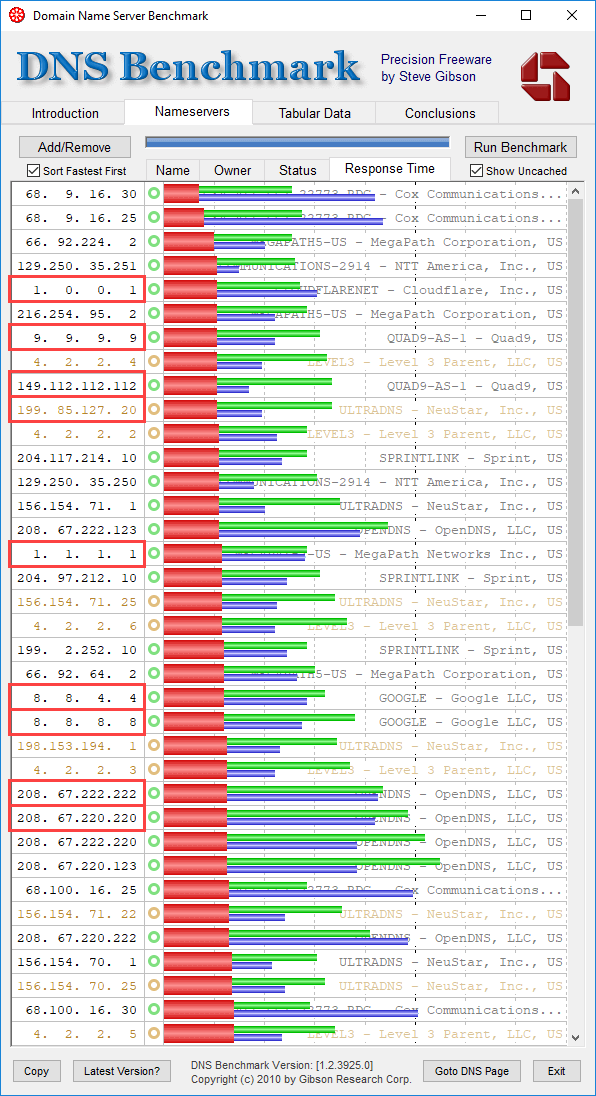
Evaluation after performing the test
Based on the test results, we can see that all of these services are very fast. When turning on the router's DNS cache and surfing many different websites, we find some services faster than other page load time services. That's why you need to take more tests and make sure there are no other systems on the same router network and perform each service check at different times of the day.
Note, the main DNS result is the same as the secondary DNS may be a bad sign, indicating that it uses the same infrastructure. In other words, you can even get the same line and if a DNS decreases, access to both will decrease.
:
- The best top 10 Public DNS Server you should know now
- How to change DNS to access Facebook faster, error free
- Improve network security with DNS Server
FAQ
What is Compare Internet Speed of DNS 1.1.1.1 with Other Popular DNS about?
It provides a structured overview of compare internet speed, explains the main context, and highlights practical takeaways for readers.
Why does this topic matter?
Understanding the main concepts helps readers evaluate the issue, avoid common mistakes, and make better-informed decisions.
How should readers use this information?
Use the guidance as a practical starting point, confirm details that may have changed, and follow current product, safety, or security recommendations.
Related Articles
 8 Ways to Check the Network Speed Extremely Accurately, You7 minutes read
 How to Speed up Internet Win 10 Thoroughly4 minutes read
 How to Check If Your ISP Is Throttling Your Internet Speed9 minutes read
 10 Cities with the Fastest Internet Speeds in the World4 minutes read
 How to Double Your Internet Speed10 minutes read
 How to Check Internet Speed with the Command Line in Linux3 minutes read
Reader Comments 0
Sign in with email or Google to join the discussion.