Table of Contents
The Easiest Ways to Find Large Files on Windows is easier to approach with a clear overview and reliable steps. This guide organizes the essential information, highlights practical details, and explains what to check along the way.
Key Takeaways
- Follow the steps to use PC manager to find large files with just one click.
- Follow the steps to find large files by size or type on windows.
- Follow the recommended steps in order to avoid common mistakes with the easiest ways to find large files on windows.
How to Use PC Manager to Find Large Files with Just One Click
You will find many dedicated storage tools that can help you find large files on your Windows PC. However, most of them are complicated to use. You can try the PC Manager application if you are looking for a quick and hassle-free solution.
PC Manager is a free app from Microsoft that allows you to view all the large files on your computer with just one click. Since it doesn't come pre-installed on Windows computers, you'll first need to download it from the Microsoft Store.
- Download PC Manager (Free)
Note: PC Manager is not available in all countries. You won't see the install button in the Microsoft Store if you're in an unsupported region.
Follow these steps to find large files: after installing the PC Manager application.
- Open the PC Manager application on your computer.
- Open the Storage tab and select Large Files.
- In the window that opens, PC Manager will display all large files along with the total storage space they take up.
- By default, the app classifies files larger than 10 MB as 'large.' However, you can click the Size drop-down menu in the upper-right corner and choose from options like 50 MB, 100 MB, or even 1 GB.
- Use the filters at the top of the window to narrow down large files by type, such as documents, images, videos, ZIP files, and more.
- Select the files you want to move or delete by checking the boxes next to them.
- Finally, click the Move button if you want to move the files to another folder. Alternatively, click the Permanently delete button to completely delete the files.
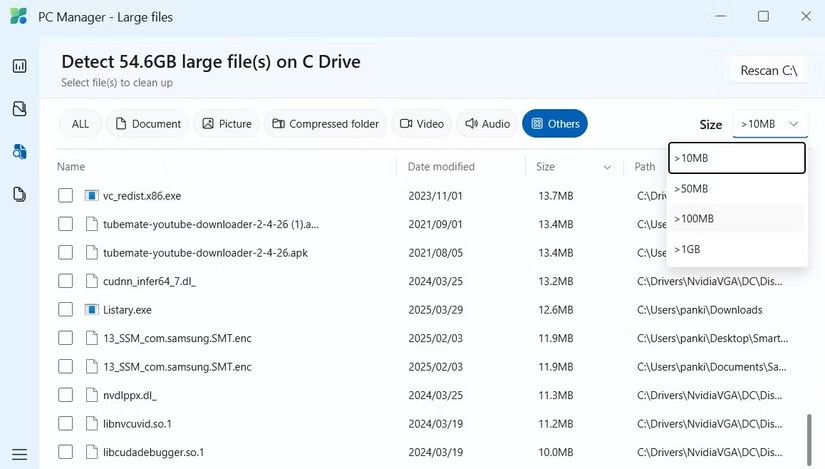
Warning: The Permanently Delete option in PC Manager will completely delete the files, meaning you won't be able to restore them from the Recycle Bin. So make sure to exercise caution when using this option.
And just like that, you have successfully deleted all the large files on your PC. This method is ideal for most users because it is quick and easy to perform.
PC Manager also offers other useful storage management features, such as finding duplicate files in Windows, organizing downloaded files, and more. In addition, it can help boost your PC's performance, manage protection settings, and provide quick access to frequently used tools.
How to Find Large Files by Size or Type on Windows
You can also use File Explorer to do the job while PC Manager allows you to locate large files by size. This has a few advantages. First, you don't need to download any additional apps. Second, File Explorer gives you more control over sorting and filtering files.
For instance, you can use File Explorer to find only large EXE files. Similarly, instead of sifting through all large video files, you can create a list of only large MOV files. Additionally, File Explorer allows you to search within specific folders, which means you have more flexibility.
Here's how you can use File Explorer to find large files on Windows:
- Press Windows + E to open File Explorer.
- Navigate to This PC to search your entire computer, or select a specific folder or drive where you want to search for large files.
- In the search bar at the top, type size:gigantic and press Enter to see all files larger than 128 MB. You can also use other size filters, such as size:large (1-16 MB) or size:huge (16-128 MB). Type size:>300MB in the search box to find files larger than 300 MB. This helps you be even more precise.
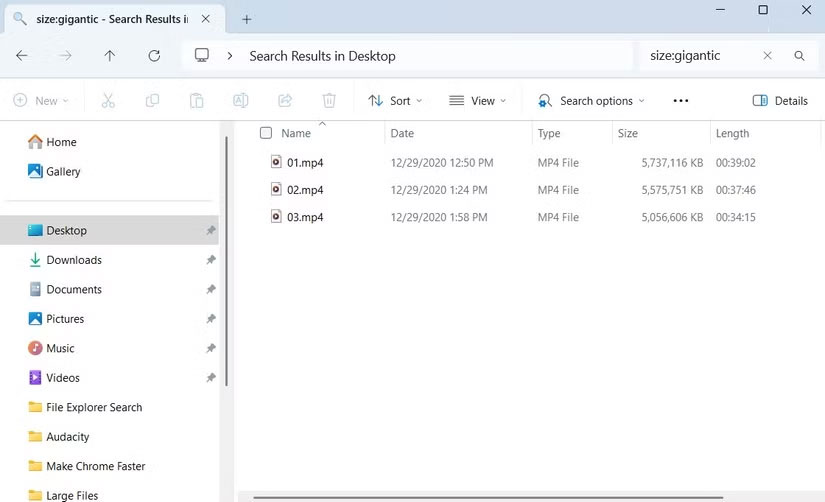
You can click View > Details to see the files along with their sizes after entering your search query. You can then sort the results by clicking the Size column at the top of the window.
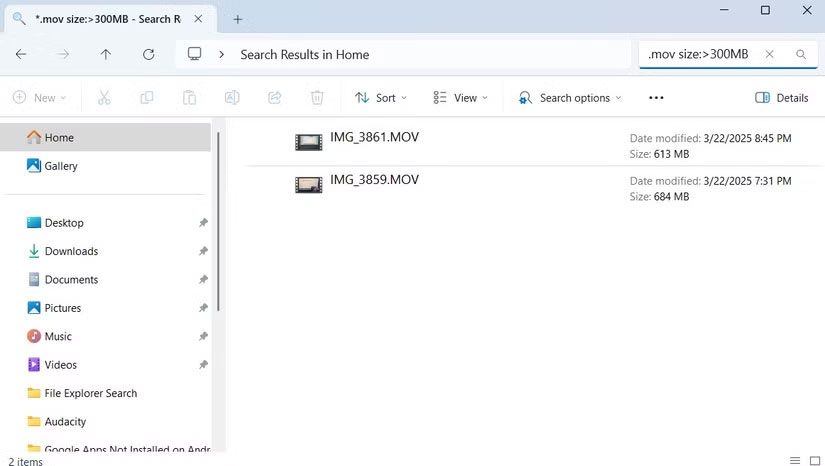
Another benefit of using File Explorer is that you can combine search filters to get more precise results. For instance, you can type *.mov size:>300MB into the search bar to find MOV files larger than 300MB. Similarly, you can use *.exe size:>100MB to find EXE files larger than 100MB.
Of course, this will require you to get used to File Explorer's various search tricks, but it will definitely give you more flexibility than you would with PC Manager.
As you continue to use your Windows PC, you will eventually run into storage limitations. Identifying and deleting large unused files is your best option if you don't want to uninstall an app or program.
Whether you use PC Manager's one-click utility or File Explorer's detailed search options, finding large files on your computer won't take long. So choose the solution that works best for you and free up space on your PC.
Final Thoughts
The most reliable way to handle the easiest ways to find large files on windows is to follow the process in order, verify each important setting, and test the result before moving on. Use the guidance above as a practical reference, then adjust the details for your device, software version, or specific goal.
FAQ
What should I know first about The Easiest Ways to Find Large Files on Windows?
No matter how much internal storage your PC has, you'll eventually run into storage problems.
How do I get the best results with The Easiest Ways to Find Large Files on Windows?
Use current software or equipment, follow the steps in order, review the recommended settings, and test one change at a time so you can identify what improves the result.
What should I do if The Easiest Ways to Find Large Files on Windows doesn't work as expected?
Check compatibility, permissions, connectivity, and version-specific settings. Restart the relevant device or app, then repeat the process carefully before trying a more advanced fix.
Related Articles
 Find Large Files in Windows 10: How to Find Large Files on3 minutes read
 How to Find Files / Folders Taking up a Large Capacity on6 minutes read
 4 Fastest Ways to Copy Files in Windows4 minutes read
 9 Ways to Attach Large Files to Emails11 minutes read
 10 Ways to Split Files, Cut Large Files into Several Small Files8 minutes read
 How to Find Large Files on Linux: Step-by-Step Guide4 minutes read
Reader Comments 0
Sign in with email or Google to join the discussion.