Table of Contents
This guide provides a practical overview of ROUND, ROUNDDOWN, ROUNDUP Functions - Functions for Rounding Decimal, including its main features, benefits, limitations, and important considerations.
1. ROUND function
Description: The function performs rounding to a specified number of digits.
Syntax: ROUND (number, num_digits) .
Inside:
- number: The value to be rounded, is a required parameter.
- num_digits : Number of digits to round, a required parameter.
Attention:
- If num_digits value> 0 the function performs rounding to the specified number of decimal places.
- If num_digits value = 0, the function rounds to the nearest integer.
- If num_digits value
- Where you want to round to a specific multiple using MROUND .
2. ROUNDDOWN function
Description : The function performs rounding down (approaching 0 or the number before it).
Syntax : R OUNDDOWN (number, num_digits) .
Inside:
- number : The value you want to round.
- num_digits : Number of digits to round.
Attention:
- The Rounddown method is like the Round function, except it always tends to be rounded down.
- If num_digits value> 0, the function is rounded down.
- If num_digits value = 0, the function rounds down to the nearest integer.
- If num_digits value
3. ROUNDUP function
Description: The function rounds a number in the direction of getting close to the number behind it or rounding away from the number 0.
Syntax: ROUNDUP (number, NUM_DIGITS) .
Inside:
- number : The value you want to round.
- num_digits : Number of digits to round.
Attention:
- The Roundup method is like the Round function, but it is only different from the rounding function.
- If value number = 0 the function performs rounding to the nearest integer.
- If number
- Where num_digits
4. Example of use with the above 3 functions
For the same values, experiment with rounding functions with different numbers of digits:
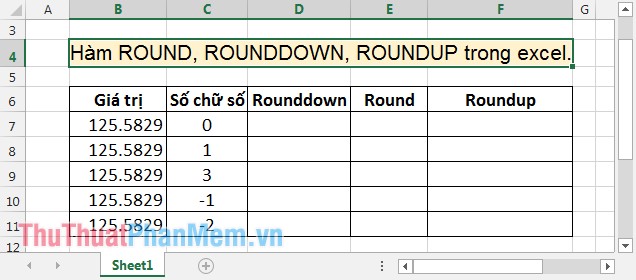
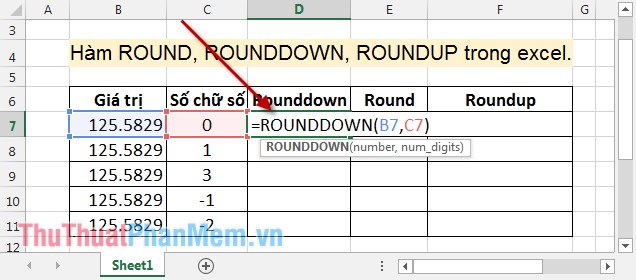
In the cell where you need to calculate ROUNDDOWN, enter the formula: = ROUNDDOWN (B7, C7) .
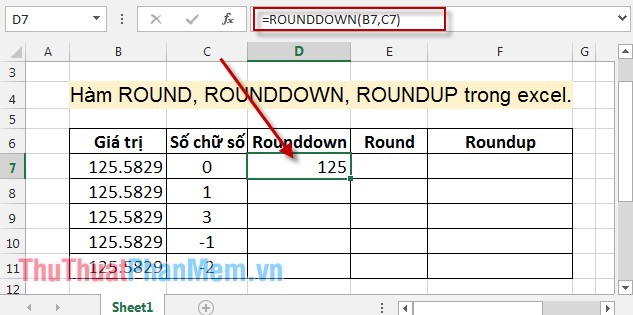
Press Enter to get the results:
Similarly enter the formula with the Round function and the result is:

With ROUNDUP function:

Similarly copy the formula for the remaining cells -> the result is:

Based on the above result table you can compare the values of 3 functions with the same rounding value and the same number of digits to round. When the number of digits has a negative value, the values of 3 functions are completely different.
The above is a detailed guide on syntax and usage of rounding functions.
Good luck!
FAQ
What should I know about ROUND, ROUNDDOWN, ROUNDUP Functions - Functions for Rounding Decimal?
Focus on the key features, requirements, limitations, and practical use cases explained in this guide.
How do I get the best results with ROUND, ROUNDDOWN, ROUNDUP Functions - Functions for Rounding Decimal?
Follow the recommended steps, use current software or information, confirm compatibility, and review settings before major changes.
Are there any risks or limitations?
Potential limitations depend on compatibility, data quality, cost, privacy, support, and how the product or method is used.
Related Articles
 Compare ROUND, ROUNDUP and ROUNDDOWN Rounding Functions in Excel8 minutes read
 How to Use the Rounding Function in Excel Simply and Effectively7 minutes read
 Rounddown Function: Syntax and Usage for Rounding Numbers Down in Excel3 minutes read
 How to Round Numbers in Excel Using the ROUND, ROUNDUP, ROUNDDOWN Function6 minutes read
 How to Round Numbers Using the Roundup Function in Excel4 minutes read
 Ways to Round Numbers in Excel: Round Function Excel Number6 minutes read
Reader Comments 0
Sign in with email or Google to join the discussion.