Table of Contents
This article provides a clear overview of ISNA Function in Excel, with the main facts, useful context, and practical details organized for easy reading.
this guide will guide the syntax and usage of the ISNA () function in Excel.
Description
The ISNA () function helps you identify if the value is #N/A (the value is not available).
The ISNA () function returns TRUE if the cell contains #N/A values. Returns FALSE if the cell does not contain the value #N/A.
This function is often used in conjunction with VLOOKUP () and IF () functions.
Syntax
= ISNA (value)
With value as the value of the cell, the expression you need to check.
For Example
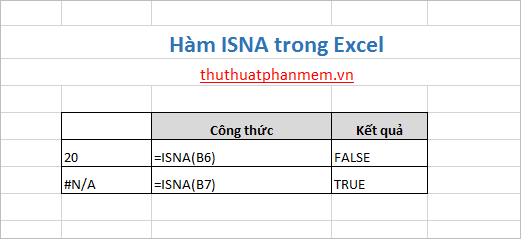
Simple example is as follows: You have cell B6 with a value of 35, cell B7 has the value #N/A, so when testing cell B6 and cell B7 with the ISNA function will have different results:
You can use the value as an expression, for example VLOOKUP expression as the example below:
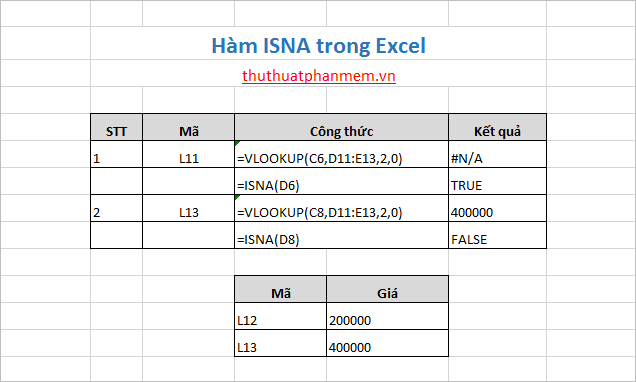
Explain the above example:
1. The VLOOKUP () function did not find the value of L11 in the Price Code table, so the result is #N/A so the ISNA () function will return TRUE.
2. VLOOKUP () finds the value of L13 in the Price Code table so the result returned will be the value corresponding to the L13 code. So the ISNA () function will return the FALSE value because its value is different from #N/A.
In addition to combining with VLOOUP function, you can combine with IF function to get more complete results.
FAQ
What is the main focus of ISNA Function in Excel?
The article explains the most important facts, context, and practical details related to ISNA Function in Excel.
Who may find this information useful?
It is useful for readers who want a clear overview, practical context, and a better understanding of the subject.
What should readers verify before taking action?
Check current product versions, official requirements, regional availability, and any details that may have changed since the original publication.
Related Articles
 How to Use the ISNA Function in Excel2 minutes read
 The Index Function in Excel: Formulas and Usage9 minutes read
 How to use the VALUE function in Excel - A function to4 minutes read
 Basic Excel Functions That Anyone Must Know20 minutes read
 How to Use Hlookup Function on Excel: Excel Hlookup Function4 minutes read
 How to Use the SUM Function to Calculate Totals in Excel8 minutes read
Reader Comments 0
Sign in with email or Google to join the discussion.