Table of Contents
How to Remove Updates from Windows Recovery Environment (Winre) is easier to understand when the core ideas are paired with practical examples. The sections below explain the topic clearly, highlight useful steps, and point out details that can prevent common errors.
Now, the only way to solve the problem is to boot the system from Windows Installer Media and uninstall the problematic update with the DISM tool in Command Prompt.
How to uninstall updates in the WinRE and DISM tools.
If the update installation fails, it may cause Windows to fail to boot. In this case, you can delete the offline update, by following the steps below:
Step 1. Boot the system from the Windows installation media.
Step 2. In the screen below, press the SHIFT + F10 keys to launch the Command prompt (or click Next> Repair My Computer> Troubleshoot> Command Prompt ).

Step 3. At the command prompt, find a list of all drives on the system with this command:
wmic logicaldisk get name

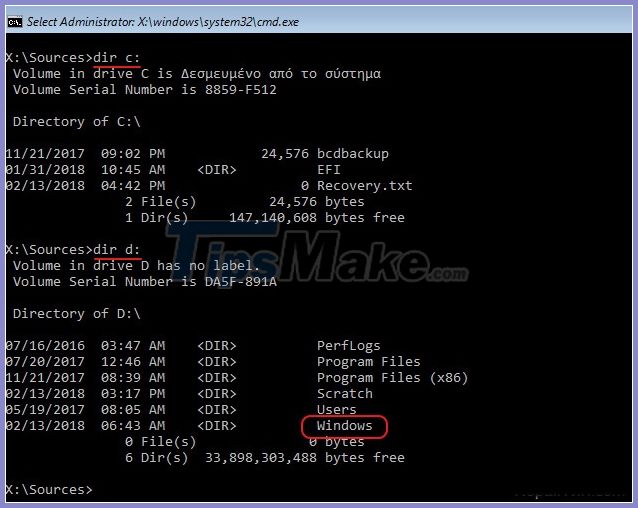
Step 4. Then find out which drive contains the "Windows" folder, by typing this command:
dir Tên ổ đĩa:
As an example,, to see the contents of C: drive , type:
dir C:
If you cannot see the "Windows" folder on C: drive, continue to move on to the next drive (As an example,, " dir D: ", " dir E: ", etc.), until you see the folder "Windows".
As you can see in the screenshot below, the Windows folder (in this case) is located in drive D:.
Step 5. When you find a drive containing "Windows" (drive D in this example), enter the following command to get a list of installed updates:
dism.exe /Image:D: /get-packages /format:table
Tip : If you don't know the KB name of the update that caused the startup problem, issue the following command to view the installation date of all packages.
dism.exe /Image:D: /get-packages /format:list

Step 6. In the "Package Identity" column , find out the Package Identity of the update you want to delete.
Example: "Package_for_KB4058702 ~ 31bf3856ad364e35 ~ amd64 ~~ 16299.188.1.0"
Step 7. Then enter the following command to remove the problematic update package:
dism /image:D: /Remove-Package /PackageName:PackageName
As an example,, to delete "Package_for_KB4025376 ~ 31bf3856ad364e35 ~ amd64 ~~ 10.0.1.0 ", enter the following command:
dism /image:D: /Remove-Package /PackageName:Package_for_KB4025376~31bf3856ad364e35~amd64~~10.0.1.0

Step 8. When the deletion process is complete, enter exit to close the Command prompt, then close all windows and turn off the computer.
Step 9. Finally, delete Windows Installer Media and start Windows as usual.
Good luck!
FAQ
How to uninstall updates in the WinRE and DISM tools?
If the update installation fails, it may cause Windows to fail to boot. In this case, you can delete the offline update, by following the steps below:
What is How to Remove Updates from Windows Recovery Environment (Winre)?
Now, the only way to solve the problem is to boot the system from Windows Installer Media and uninstall the problematic update with the DISM tool in Command Prompt.
Why is How to Remove Updates from Windows Recovery Environment (Winre) important?
A clear understanding of How to Remove Updates from Windows Recovery Environment (Winre) helps you make informed decisions, avoid common mistakes, and use the relevant tools or techniques more effectively.
Related Articles
 What Is Windows Recovery Environment? How Does Winre Work?8 minutes read
 Enable / Disable Windows Recovery Environment (WinRE) in3 minutes read
 Microsoft Security Update Breaks Windows Recovery Environment4 minutes read
 Windows' 'Rescue' Feature Becomes a Door for Hackers to Steal Data4 minutes read
 Restore: How to Uninstall All Windows Updates5 minutes read
 Rescue the System with These 5 Bootable Windows Pe Recovery Disks6 minutes read
Reader Comments 0
Sign in with email or Google to join the discussion.