Table of Contents
This guide explains how to determine the Type of Account in Windows 10, with clear steps, practical tips, and important checks before you begin.
This guide will show you how to quickly determine if a user on a PC has an admin or standard account in Windows 10.
Determine the type of account in User Accounts
1. Open the Control Panel (icon view) and click on the User Accounts icon .
2. Look below the username in the box with your account picture.
- If you see Administrator under your username, then your account is an admin account.
- If you do not see Administrator under your username, then your account is a standard user account.
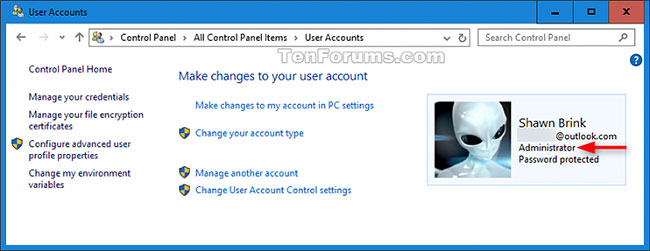 Determine the type of account in User Accounts
Determine the type of user account in User Accounts
You must be logged in as an administrator to perform this option.
1. Open the Control Panel (icon view) and click on the User Accounts icon .
2. Click the Manage another account link .
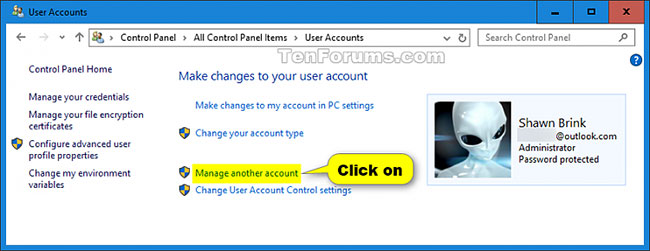 Click the Manage another account link
3. View the username in each box, which comes with that user's account picture.
- If you see Administrator under the username, then that account is an admin account.
- If you do not see Administrator under the username, then that account is a standard user account.
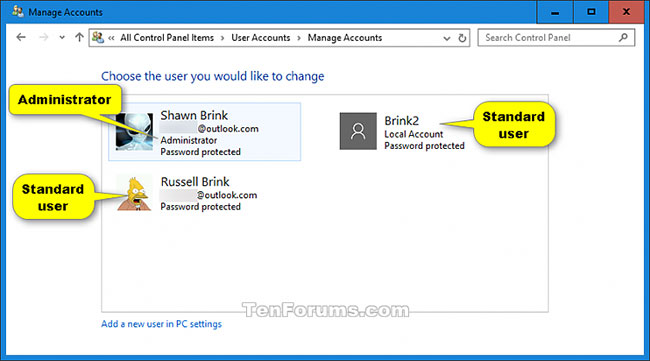 See the username in each box, associated with that user's account picture
Determine the type of user account in Local Users and Groups
Local Users and Groups is only available in Windows 10 Pro, Enterprise and Education editions.
1. Press the Win+ keys Rto open the Run dialog, enter lusrmgr. msc into Run and click OK to open Local Users and Groups .
2. Click Groups in the left pane and double click Administrators in the middle.
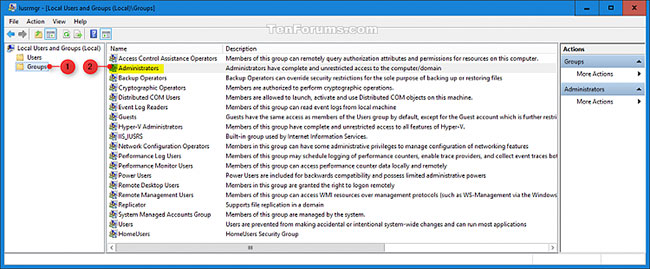 Double click on Administrators in the middle
3. Look at the username listed under Members.
- If the username is listed as a member of the Administrators group, then the account is admin.
- If the username is not listed as a member of the Administrators group, then the account is a standard user.
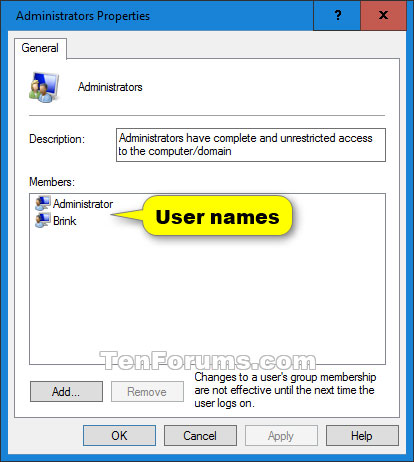 Look at the username listed under Members
Determine the user's account type in the Command Prompt
1. Open Command Prompt.
2. Copy and paste the command net localgroup administratorsinto the Command Prompt , then press Enter.
3. Look at the username listed under Members.
- If the username is listed as a member of the Administrators group, then the account is admin.
- If the username is not listed as a member of the Administrators group, then the account is a standard user.
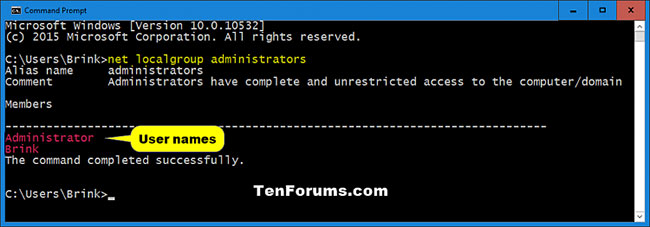 Determine the user's account type in the Command Prompt
Determine the type of user account in Settings
1. Open Settings and click on the Accounts icon .
2. Perform step 3 (Your info ) or step 4 ( Family & other users ) for which page in Accounts you want to check.
3. Determine the type of account on the "Your info" page for current users:
A) Click Your info on the left.
B) Look down below the account picture on the right.
- If you see Administrator under the username, then that account is an admin account.
- If you do not see Administrator under the username, then that account is a standard user account.
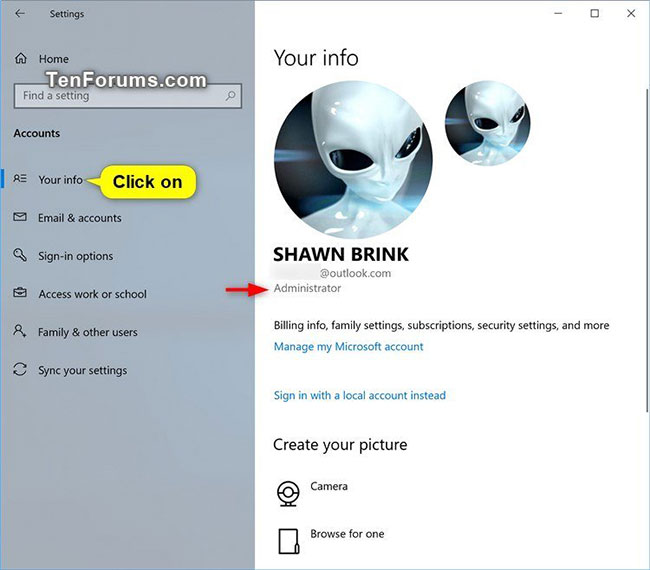 Determine the type of account on the "Your info" page for current users
4. Determine the account type on the " Family & other users " page for other users :
A) Click Family & other users on the left.
B) Look at each user listed under Other users on the right.
- If you see Administrator under the username, then that account is an admin account.
- If you do not see Administrator under the username, then that account is a standard user account.
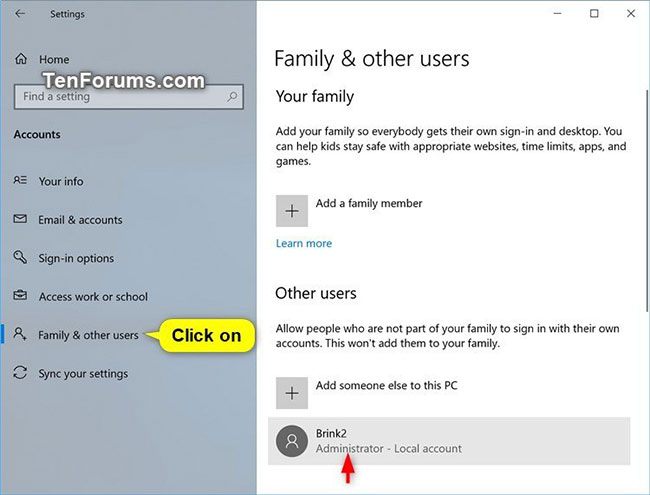 Determine the account type on the "Family & other users" page for other users
FAQ
What should I know about Determine the Type of Account in Windows 10?
Focus on the key features, requirements, limitations, and practical use cases explained in this guide.
How do I get the best results with Determine the Type of Account in Windows 10?
Follow the recommended steps, use current software or information, confirm compatibility, and review settings before major changes.
Are there any risks or limitations?
Potential limitations depend on compatibility, data quality, cost, privacy, support, and how the product or method is used.
Related Articles
 Type: How to Create and Manage a Hidden Account in Windows 74 minutes read
 10 Effective and Safe Usage Tips for Microsoft Accounts13 minutes read
 How to Type Vni in Windows3 minutes read
 How to Change the Account Name, Account Name in Windows 105 minutes read
 4 Ways to Quickly Check the Partition Type on Windows 115 minutes read
 How to Configure Your PC to a Local Area Network8 minutes read
Reader Comments 0
Sign in with email or Google to join the discussion.