Table of Contents
This updated guide examines How to Change Your IP Address (Windows) and organizes the essential facts, background, and practical takeaways in clear American English.
Method 1of 2:
Public IP
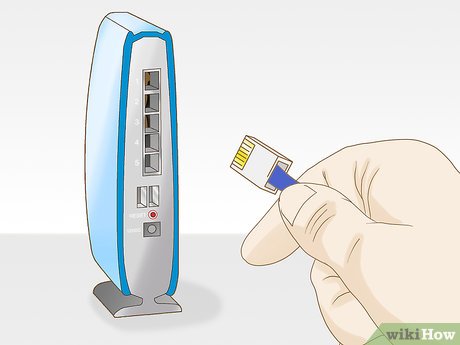 Unplug your router and modem. Most service providers assign dynamic IPs, which change from time to time. By disconnecting your modem for a long period of time, you are likely to get a new address assigned to you when you turn it back on.
- You may want to check your current IP address before doing this.
- Simply unplugging the router and modem from the wall will work.
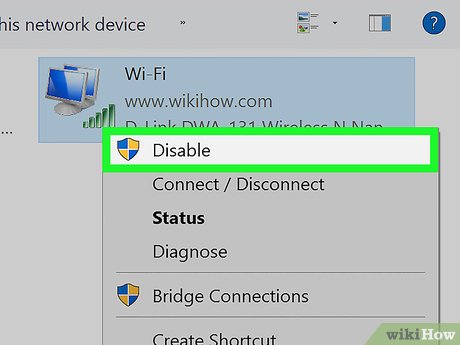 Disable your computer's Wi-Fi. This will prevent it from reconnecting to the router when you plug it back in. To disable Wi-Fi:
- Click
 in the bottom-right corner of the screen.
 - Click Wi-Fi in the pop-up window.
- Click
 Wait for five minutes. Some ISPs will assign a new IP address in as little as five minutes; if doing this doesn't work, however, you may need to leave your router unplugged overnight (or for around eight hours).
 Plug your router back in. As long as you have a different device (e.g., a phone, a gaming console, or another computer) connected to Wi-Fi, the router and the second device will claim the old IP address.
 Re-enable Wi-Fi on your computer. Doing so after the other devices have had a chance to establish their connections will most likely change your computer's public IP address.
- You may want to check your IP address again to make sure it has changed.
 Contact your ISP. In some rare cases, you may have a static IP address assigned by your internet service provider. to get this changed, you will need to contact their technical support directly. Oftentimes, this can only be changed once.[1]
 Use a proxy network. This will display a different IP address for your connection; often, it will be an address from a different part of the country or world. Reliable proxies and VPNs often require monthly subscriptions.
Method 2of 2:
Private IP
Renewing the Address
 Open Start
 . It's in the bottom-left corner of the screen. If you're trying to change your IP address to fix a connection issue, renewing it is an easier process than manually changing the address.
 Typecommand promptinto Start. This will search your computer for the Command Prompt app.
 Right-click
 Command Prompt. It should be at the top of the Start window.
 ClickRun as administrator. This option is at the bottom of the drop-down menu.
- If you aren't an administrator on your current computer, you won't have this option and thus won't be able to renew your computer's IP address.
 ClickYeswhen prompted. Doing so opens Command Prompt.
 Type inipconfig /releaseand press↵Enter. This command "forgets" your current IP address.
 Type inipconfig /renewand press↵Enter. This refreshes your IP address. Doing this in and of itself will likely solve some connection issues, though it won't always change your computer's actual IP address.
Changing the Address
 Open the Settings app. Click the Start
 button and select the Settings
 gear.
gear.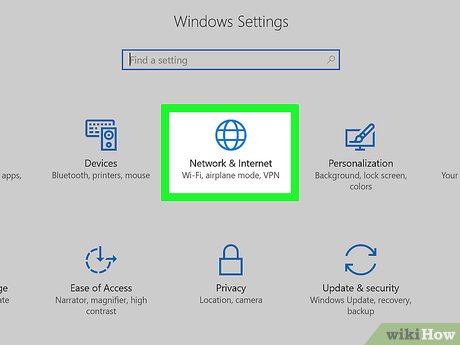 Select theNetwork & Internetcategory.
 Ensure theStatussection is selected. This is the first tab on the left pane.
 Click the "Change connection properties" link.
 ClickEditunder "IP assignment". Scroll down to access this section.
 Switch to a manual IP assignment. Click the dropdown menu from the dialog that appears and choose the "Manual" option.
 Toggle on
 IPv4. Several text boxes will appear.
 Fill in the text boxes. Here's what they mean:
- IP address - Usually, your device's IP address will be "192.168.1. X" (or a similar set of numbers), wherein "X" is specific to your device. Change the "X" value to a number between 1 and 100. Make sure you don't use the same IP address as another device on your network (e.g., your phone).
- Subnet prefix length - This depends on your IP address, but will usually be "255.255.255. X".
- Gateway - This is your router's IP address.
- Preferred DNS - Your preferred DNS address (for example: "208.67.222.222" for the OpenDNS server, or "8.8.8.8" for Google's server).
- Alternate DNS - A secondary DNS address (for example: "208.67.220.220" for the OpenDNS server, or "8.8.4.4" for Google's server).
 ClickSave. Your new network settings will be saved and applied.
FAQ
What is How to Change Your IP Address (Windows) about?
It provides a structured overview of address, explains the main context, and highlights practical takeaways for readers.
Why does this topic matter?
Understanding the main concepts helps readers evaluate the issue, avoid common mistakes, and make better-informed decisions.
How should readers use this information?
Use the guidance as a practical starting point, confirm details that may have changed, and follow current product, safety, or security recommendations.
Related Articles
 How to Change MAC Address on Windows: Clear Instructions7 minutes read
 Change IP Address: How to Change the IP Address for the Phone9 minutes read
 3 Ways to Change the Mac Address on Windows 7/8 / 108 minutes read
 How to Change the Mac Address on Windows 10, 8, 75 minutes read
 How to Change Mac Addresses on Windows, Linux and Mac Os X6 minutes read
 3 Ways to Change IP Address in Windows 10: Features, Uses, and15 minutes read
Reader Comments 0
Sign in with email or Google to join the discussion.