Table of Contents
Gemini 4 Argon is Google's AI model for extended, multi-step work, including software engineering and enterprise tasks. Choosing it involves more than comparing benchmark scores: access, token costs, and the amount of review your workflow needs all matter.
What Argon is designed to do
Google positions Argon for workflows that require sustained reasoning across several stages, such as understanding a codebase, proposing changes, running tests, and revising the result. That is a broader task than generating a single function or answering one question.
Its main areas of emphasis include coding, professional knowledge work, multimodal reasoning, and defensive cybersecurity. These are intended use cases, rather than a guarantee that every output will be correct.
How to access Gemini 4 Argon
In its October 13, 2026 rollout announcements, Google made Argon available through the paid Gemini API and Google AI Studio. Google AI Pro and Ultra subscribers can access it in the Gemini app; Antigravity access is available to Ultra subscribers. Check the account and model selector you will actually use before buying a subscription for a specific feature.
The Gemini app update also adds a way to switch from chat to tasks, and brings Antigravity's coding interface into the macOS app. See Google's app announcement for the rollout details.
API pricing: introductory rates have an end date
Google lists an introductory rate of $2 per million input tokens and $10 per million output tokens through November 30, 2026. Its developer documentation lists rates of $4 and $20 respectively afterward. Check the model documentation before budgeting or deploying an application.
Input tokens are the material sent to the model; output tokens are what it generates. Estimate both sides of a workflow, including repeated calls and long responses. A low per-token price alone does not establish the lowest cost for a completed task.
How to judge performance for your work
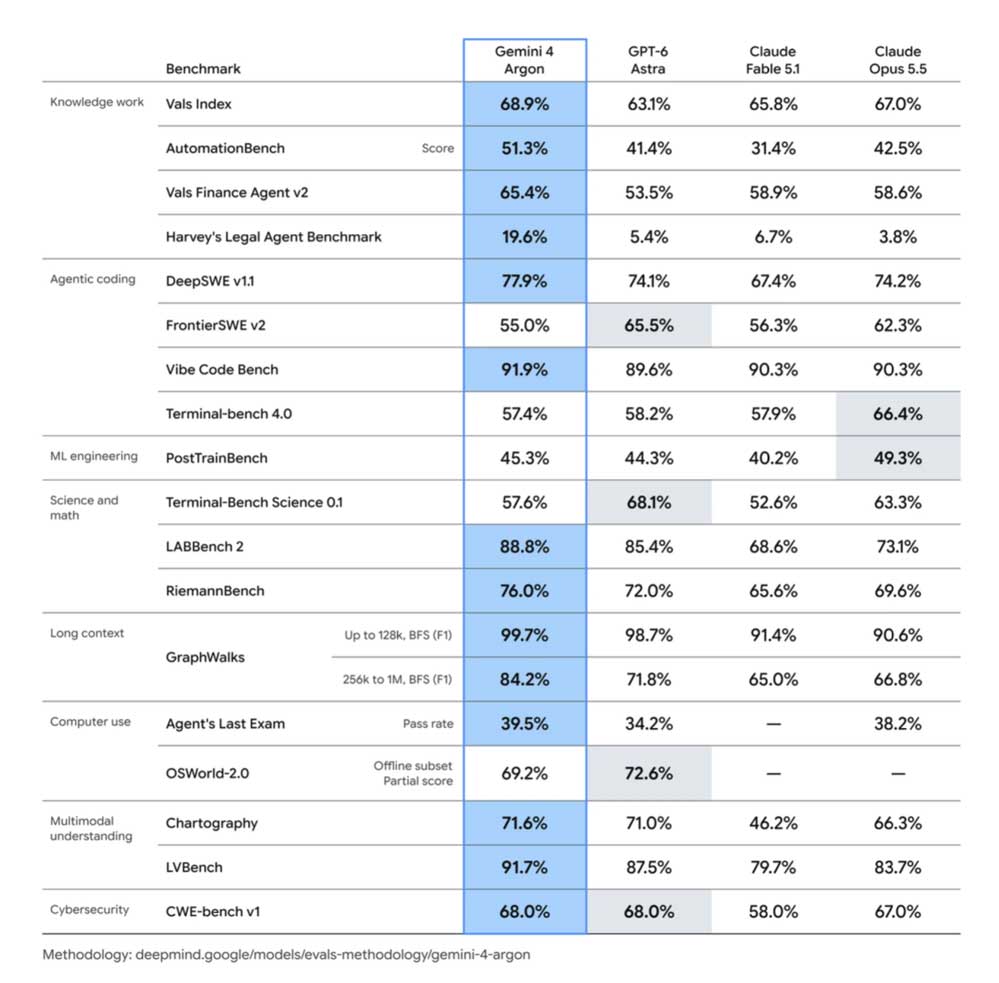
Benchmark rankings are snapshots of performance on particular test sets. Results from different evaluators may measure different skills, use different tools, or run under different conditions. Manufacturer-reported scores should be read with their test methodology and compared with independent evaluations where available.
Rather than treating Argon as the best model for every task, test it against representative examples from your own workflow:
- Coding: does the change pass relevant tests and handle existing behavior correctly?
- Research and document work: can you trace important claims back to the supplied material?
- Long tasks: does it follow the original requirements through the final result?
- Cost and speed: how much time, token usage, and human correction does a successful result require?
Start with a bounded task
Give the model a clear objective, the necessary context, and a way to check success. For a code change, describe the expected behavior and relevant tests. For a document task, specify the source material and required output.
Review the result before relying on it or allowing consequential actions. For a reusable assistant setup, see how to create an assistant with Gemini. For a separate practical example of Google's development environment, see building a thumbnail app in Google AI Studio.
Related Articles
 Gemini 3.1 Pro or Gemini 3 Pro: Better?8 minutes read
 How to use Gemini API14 minutes read
 Instructions for Getting Started with Gemini Embedding 211 minutes read
 How to Turn Gemini into a Powerful Productivity Tool: Step-by-Step Guide8 minutes read
 4 Google Apps That Work Better with Gemini: Explained5 minutes read
 Instructions for Using the Gemini Utility: What to Know4 minutes read
Reader Comments 0
Sign in with email or Google to join the discussion.