Table of Contents
DeepSeek Harness and Claude Code solve related but different problems. DeepSeek Harness is an open-source, plugin-first runtime for developers who want to assemble or modify an agent system. Claude Code is a ready-to-use coding agent for developers who want an integrated tool that can inspect a codebase, edit files, run commands, and fit into existing development workflows.
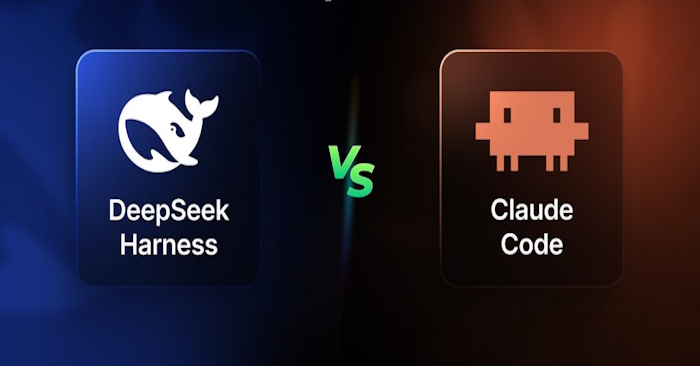
Choose DeepSeek Harness when control over the runtime and replaceable components is the priority. Choose Claude Code when you value a more finished coding experience across terminals, IDEs, desktop, web, and automation. Because DeepSeek Harness is in developer preview, teams should expect compatibility-breaking changes and evaluate it before depending on it in production.
DeepSeek Harness and Claude Code are not exact equivalents
An agent harness is the infrastructure around a model: it supplies tools, manages the execution loop, stores sessions, applies permissions, and connects the model to files or sandboxes. A coding agent is the user-facing system that applies those capabilities to software work.
DeepSeek Harness exposes the harness itself as a composable product. Claude Code packages an opinionated agent loop and development experience, while Anthropic separately offers the Claude Agent SDK for teams building custom agents programmatically.
What is DeepSeek Harness?
DeepSeek Harness, also called dsh, is an MIT-licensed open-source agent harness built on Cordis. Its defining design is that models, tools, skills, sessions, storage, sandboxes, loops, scheduling, and the user interface are supplied as plugins. Developers can select or replace components through configuration instead of rewriting the entire runtime.
The official project currently labels the software a developer preview and warns that breaking changes will occur. The quickest documented local start uses Node.js:
npx @deepseek-ai/dsh webThis starts the local web interface, normally on port 3080. A source installation is also available for contributors and developers who need to inspect or modify the project.
DeepSeek Harness runtime modes
- Standard: the complete coding-agent toolset, including file editing, shell access, search, skills, planning, subagents, and workflows.
- Code: the Standard capabilities exposed through a code-mode SDK so a model can coordinate multiple tool operations in a TypeScript program.
- Minimal: a deliberately small environment with a persistent shell and file editor, useful for controlled model evaluation.
- Creator: a workspace for inspecting the runtime, testing plugins, and assembling custom presets.
DeepSeek Harness also records what the model sees and does in an append-only session log, supporting inspection, replay, resume, and fork workflows. See the official DeepSeek Harness overview and project repository for its current status and setup instructions.
What is Claude Code?
Claude Code is Anthropic's agentic coding tool. It can read a repository, edit multiple files, run commands, search the codebase, and work through development tasks such as fixing bugs, adding tests, refactoring code, and preparing changes for review.
In the terminal, a developer starts Claude Code from a project directory with the claude command. Project instructions can be stored in CLAUDE.md, while permissions, hooks, skills, subagents, and MCP connections can extend or constrain the workflow.
Claude Code is available through several interfaces, including the terminal, supported IDEs, a desktop app, and the web. Anthropic also documents CI/CD and collaboration integrations. Teams that want the underlying loop as a library can use the Claude Agent SDK for Python or TypeScript instead of treating the interactive CLI as an application framework. The official Claude Code overview lists the currently supported surfaces and installation paths.
DeepSeek Harness vs Claude Code comparison
| Area | DeepSeek Harness | Claude Code |
|---|---|---|
| Primary product | Composable agent runtime and web interface | Integrated coding agent |
| Source and license | Open source under the MIT license | Proprietary Anthropic product |
| Maturity | Developer preview with breaking changes expected | Established product with documented terminal, IDE, desktop, web, and automation workflows |
| Agent loop | Loop and supporting capabilities can be supplied or replaced as plugins | Managed as part of Claude Code; behavior can be extended with hooks, skills, subagents, plugins, and MCP |
| Model strategy | Plugin architecture is designed for replaceable model adapters | Designed around Claude; some local interfaces support documented third-party provider paths |
| Setup | Requires Node.js plus provider and profile configuration; deeper use assumes familiarity with the plugin architecture | Install a supported client, authenticate, open a project, and configure permissions or project instructions as needed |
| Interfaces | Local web UI, headless/runtime profiles, and SDK-oriented components | Terminal, IDE, desktop, web, and documented CI or collaboration integrations |
| Best fit | Agent-framework builders, researchers, and teams needing runtime control | Developers and teams wanting a coding agent for day-to-day software delivery |
Which one should you choose?
| Your priority | Better starting point | Reason |
|---|---|---|
| Start using an agent on an existing repository quickly | Claude Code | The product supplies an integrated workflow and multiple supported interfaces. |
| Replace the model, tool layer, storage, sandbox, or loop | DeepSeek Harness | Those capabilities are explicit plugin boundaries. |
| Study or benchmark a model with minimal scaffolding | DeepSeek Harness | Minimal mode deliberately narrows the tool environment. |
| Use project instructions, IDE workflows, and documented CI integrations | Claude Code | These workflows are part of the product documentation and ecosystem. |
| Embed an agent loop in a Python or TypeScript application | Compare both SDK approaches | Evaluate DeepSeek Harness components against Anthropic's Claude Agent SDK rather than comparing only the interactive clients. |
| Adopt a stable production dependency immediately | Claude Code, after your own evaluation | DeepSeek explicitly describes Harness as a rapidly changing developer preview. |
Evaluate both with the same repository
A useful comparison should go beyond feature lists. Run the same bounded task in a non-sensitive test repository and record:
- How accurately each tool understands project structure and local instructions.
- The quality and size of the proposed diff.
- Whether it runs the correct tests and responds well to failures.
- How clearly it requests permission before risky commands.
- How easy it is to inspect tool calls, session history, and costs.
- The work required to configure models, sandboxes, hooks, or external tools.
Do not give either agent unrestricted access to production credentials or deployment systems during an initial evaluation. Review permissions, isolate test environments, keep changes under version control, and require human review for consequential operations.
Bottom line: DeepSeek Harness is the more flexible foundation when the harness itself is what you want to build or change. Claude Code is the more direct choice when the goal is to apply an agent to software work with less runtime assembly. The right comparison is therefore control and composability versus product maturity and workflow integration—not simply which model writes better code.
Related Articles
 What Is an Agent Harness?13 minutes read
 Running DeepSeek V4-Pro in Claude Code21 minutes read
 10 Essential Skills for Claude (and Any Programming Agent)15 minutes read
 Claude Code in VS Code: How to Use AI for Efficient Multi-File Programming9 minutes read
 Claude Code Learns from Mistakes7 minutes read
 How to Work More Effectively With Claude Code12 minutes read
Reader Comments 0
Sign in with email or Google to join the discussion.