Table of Contents
Gemini 3.5 Flash and Claude Opus 4.7 target different operating points. Gemini 3.5 Flash is the better starting point for high-throughput, latency-sensitive, multimodal work. Claude Opus 4.7 is better suited to difficult coding, sustained reasoning, and agent tasks where output quality can justify more time and cost.
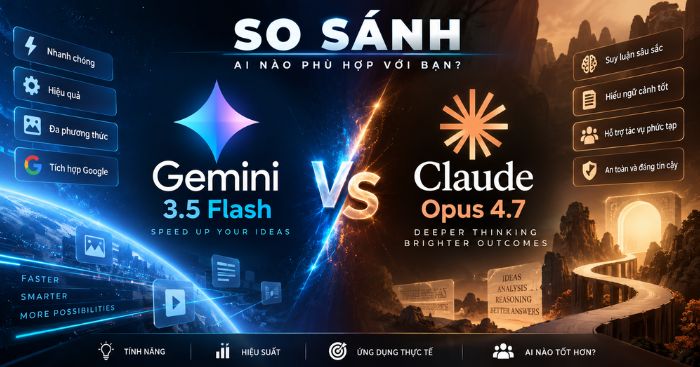
Neither choice should be made from a single leaderboard score. The providers have since added newer models to their catalogs, and model availability, prices, rate limits, and features can change. Use this comparison when you specifically need these model versions, then confirm their current status before starting a new production integration.
Quick comparison
| Decision area | Gemini 3.5 Flash | Claude Opus 4.7 |
|---|---|---|
| Product position | Flash model optimized for speed, scale, and lower operating cost | Opus model optimized for demanding reasoning, coding, and agentic work |
| Typical fit | Classification, extraction, summarization, multimodal processing, and rapid agent loops | Repository-level engineering, complex analysis, long-running tasks, and high-value decisions |
| Input types | Text, images, video, audio, and PDFs | Text and image/document workflows supported by the Claude platform |
| Context | Official model page lists a 1,048,576-token input limit | Context availability can depend on the API and product configuration; verify the current model documentation |
| Latency strategy | Designed for faster, higher-volume execution | Spend more inference effort when deeper reasoning is worth the delay |
| Agent use | Designed for multi-step workflows and rapid tool loops | Strong fit for sustained reasoning and tool-heavy coding workflows |
| Cost strategy | Usually the more economical choice for large request volumes | Reserve for tasks where improved completion quality has higher value than token savings |
Where Gemini 3.5 Flash is a strong fit
Google positions Gemini 3.5 Flash as a fast, cost-conscious model for real-world and agentic tasks. Its model page lists text, image, video, audio, and PDF input, with an input limit of 1,048,576 tokens and an output limit of 65,536 tokens.
Good use cases
- High-volume document processing: extract fields, classify records, summarize long material, or route requests at scale.
- Multimodal ingestion: analyze combinations of text, images, audio, video, and PDFs through one model family.
- Responsive applications: power interactive features where users notice slow responses.
- Rapid agent loops: perform frequent, bounded tool calls or delegate smaller sub-tasks without assigning every step to a premium reasoning model.
- Cost-controlled pipelines: handle routine stages cheaply and escalate only difficult cases.
Tradeoffs to test
A Flash model may require clearer task boundaries, stronger validation, or escalation for ambiguous repository-wide changes and deeply coupled reasoning. A large context limit also does not guarantee that every part of a very long input receives equal attention. Test retrieval quality and citation accuracy instead of assuming that loading an entire data set is sufficient.
Google's Gemini 3.5 Flash model page contains the current input types and token limits. Check the official Gemini API pricing page before estimating production cost.
Where Claude Opus 4.7 is a strong fit
Anthropic introduced Claude Opus 4.7 for complex, multi-step work, with particular emphasis on coding, long-running agents, deeper analysis, and improved multimodal understanding. It is a quality-first option rather than a default choice for every request.
Good use cases
- Complex software changes: reason across multiple files, constraints, tests, and failure states.
- Long-horizon agents: maintain a plan through many tool calls and recover when an intermediate action fails.
- High-value analysis: examine conflicting evidence, identify missing data, and produce a defensible recommendation.
- Technical visual material: interpret diagrams and detailed documents when visual understanding affects the answer.
- Selective escalation: review the difficult minority of cases that a faster model cannot resolve confidently.
Tradeoffs to test
Higher-capability inference can increase cost and latency. It can also be wasteful when the task is deterministic, short, or easily validated by rules. Use an effort setting appropriate to the task and measure whether additional reasoning actually improves accepted results.
Anthropic's Claude Opus 4.7 announcement describes the model's intended strengths. The Claude model selection guide explains how capability, latency, and effort settings should influence a deployment.
Why the original benchmark table is not enough
Benchmark percentages are meaningful only when the model version, prompt, tools, scaffolding, effort setting, number of runs, and scoring method are known. A coding score produced with one agent harness cannot be treated as a direct prediction of results in a different repository or tool environment.
Published benchmark results can also mix provider evaluations, third-party tests, and different versions of similarly named benchmarks. Instead of averaging unrelated scores, create a small evaluation set from your own work.
How to compare the models on your workload
- Select representative tasks: include common requests, difficult edge cases, and inputs that previously caused errors.
- Use the same success criteria: define required facts, tests, schemas, citations, or acceptance checks before running either model.
- Control the environment: provide equivalent tools, context, system instructions, and retry policies.
- Run multiple trials: one successful answer does not reveal consistency.
- Record total cost: include input, output, reasoning tokens, tool calls, retries, cached context, and human review time.
- Measure latency at the application level: track the complete user-visible workflow, not only raw token generation speed.
A practical routing strategy
Many teams do not need to choose only one model. A tiered system can send routine classification, extraction, and summarization to Gemini 3.5 Flash, then escalate low-confidence or high-impact cases to Claude Opus 4.7. Add deterministic validators after both models and route failures to human review.
This approach works only when the router is evaluated. If it escalates too often, cost savings disappear; if it escalates too rarely, quality falls. Track acceptance rate, correction rate, latency, and cost for each task category.
Which model should you choose?
- Choose Gemini 3.5 Flash for speed-sensitive multimodal applications, large volumes, and bounded agent steps.
- Choose Claude Opus 4.7 for demanding coding, sustained reasoning, and complex tasks where a better result is worth higher resource use.
- Use both when a fast model can process routine work and a deeper model can handle exceptions.
- Choose a newer supported model if you are beginning a long-lived integration and these versions are already legacy in the provider's current catalog.
The most powerful model is the one that produces the highest rate of accepted results within your latency, privacy, and cost constraints. Test that outcome directly rather than selecting from marketing labels or isolated benchmark numbers.
Related Articles
 Learn About Claude Opus 4.7: the Latest AI Model from Anthropic, Just Released12 minutes read
 How to Learn About Claude Opus 4.68 minutes read
 Anthropic Launches Claude Opus 4 for Advanced Coding3 minutes read
 Claude vs Gemini Free Plans: Real-World Comparison14 minutes read
 How to Choose the Right Claude Model: Haiku, Sonnet, or Opus8 minutes read
 Which is better: Claude, ChatGPT, or Gemini for building an11 minutes read
Reader Comments 0
Sign in with email or Google to join the discussion.