Table of Contents
This updated guide examines Data Access Type 2016: Data Types in Access 2016 and organizes the essential facts, background, and practical takeaways in clear American English.
MS Access supports different types of data, each with a specific purpose.
- The data type determines the type of value that users can store in the fields.
- Each field can store data that includes only one type of data.
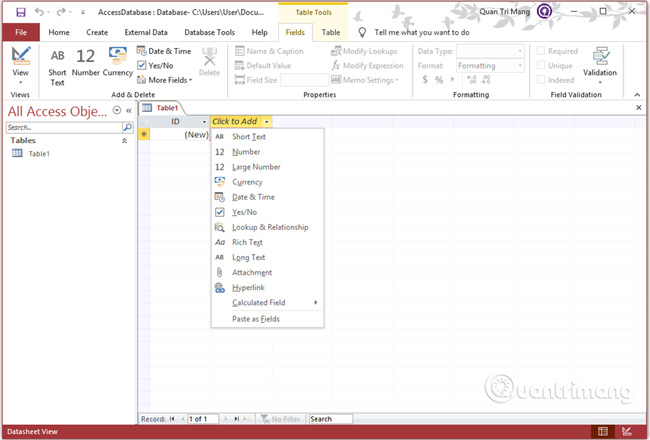
Here are some of the most common data types used in Microsoft Access databases.
DatatypesDescribeSize Short Text Text or number combination text, including numbers that do not require calculations (eg phone numbers, postal codes.), often used to store personal names, addresses, and street names, street name. as many as 255 characters Long Text Long text or combination of text and numbers, consistent with descriptions that require a large amount of text (such as product descriptions). From 63 to 999 charactersNumberDigital data, can be used for calculation, suitable for storing data such as the number of a product, distance, number of students, number of customers. 1, 2, 4 or 8 bytesDate / TimeDate value / time to store time data from 100 to 9999. 8 bytesCurrency Value for currency and digital data is used with calculations of one to four decimal digits Stool, suitable for storing the amount of money of a given currency. 8 bytesAutoNumberA unique sequence number (increment 1) or random number specified by Microsoft Access every time a new record is added to the table. 4 bytesYes / No Data type Yes / No is suitable for answers or fields that only need to store values with or without 1 bit
If you use previous versions of Access, there will be a slight difference in the name of the data types.
From Access 2013, there are short text and long text data types, and in previous versions, it is called text and memo.
There are also some other specialized data types, you can choose in Access.
Here are some of the most common data types used in Microsoft Access databases.
DatatypesDescribeSize
Attachment
Attached files such as digital images are suitable for storing attachments on each record. This data type is not available in previous versions of Access.
as many as 2 GB
OLE objects
OLE objects are used to store images, audio, video or large binary objects (Binary Large Object).
as many as 2 GB
Hyperlink
Character string is used as a hyperlinked address
Dark 2048 characters
Lookup Wizard
Lookup Wizard is not really a data type. When you select this item, the wizard starts to help you identify a simple or complex lookup field.
The lookup field simply uses the contents of another table or value list to authenticate the content of a value on each row. The complex lookup field allows you to store multiple values of the same data type in each row.
Depends on the data type of the lookup field
Calculated
It is possible to create an expression that uses data from one or more fields. You can specify different result data types from expressions.
These are all the different data types you can choose when creating fields in the Microsoft Access table.
Previous article: Create Database (Database) in Access 2016
Next lesson: Create Table (Table) in Access 2016
FAQ
What is Data Access Type 2016: Data Types in Access 2016 about?
It provides a structured overview of data access type 2016, explains the main context, and highlights practical takeaways for readers.
Why does this topic matter?
Understanding the main concepts helps readers evaluate the issue, avoid common mistakes, and make better-informed decisions.
How should readers use this information?
Use the guidance as a practical starting point, confirm details that may have changed, and follow current product, safety, or security recommendations.
Related Articles
 MS Access 2003 - Lesson 22: Using Query Wizards: Microsoft Access15 minutes read
 Edit Tables in Access 20169 minutes read
 MS SQL Server: Data Types in SQL Server6 minutes read
 Work with Data in Access 201610 minutes read
 How to Use Excel Vba Variable Data Types11 minutes read
 Struct in C // C ++: Data Structure in C // C ++3 minutes read
Reader Comments 0
Sign in with email or Google to join the discussion.