Table of Contents
This step-by-step guide explains how to create USB install snow leopard. It covers the required setup, the main actions, and the checks that help prevent common problems.
Network administrators - Every Mac system has a DVD drive, and in most situations you won't need a Snow Leopard USB drive.However, there is no guarantee that your DVD drive will always work stably while you need to reinstall or upgrade your operating system.This is the case where the USB installation drive will become very useful.Also, with this USB drive you can use it for many other systems without CD-ROM drive (eg Netbook). In this article, we will create a USB flash drive that installs the Snow Leopard operating system in place of this operating system DVD. Request Before installing, you need the following devices:




Proceed to create a Snow Leopard USB drive
- Start by connecting the USB drive to the Mac system. Then Backup all data in this USB drive.
- Insert the DVD containing the Snow Leopard installation into the DVD-ROM drive.
- Go to Utility |Disk Utility . You will then see the USB drive and Snow Leopard installation disc displayed in the left panel.
Figure 1: Disk Utility displays the drive that indicates the system is connected to USB and receives the installation disc.
- Select the USB drive. In the right pane, select the Partition tab.
- Here are some things you need to do on this tab:
In the Volume Scheme , select the 1 Partition Item in the drop-down list. In the Name Field, enter a new name for the partition. For example we named it Mac OS X Install DVD . In the Format Field, select the Mac OS Extended (Journaled) item In the drop-down list.
Figure 2: Enter information for the USB partition.
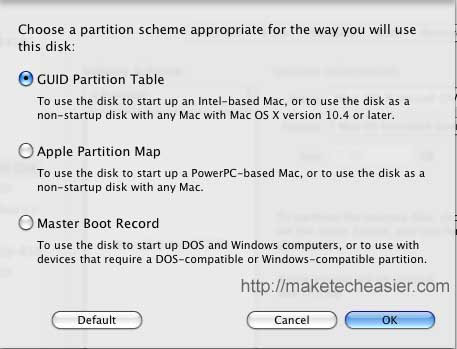
At the end of this tab (Partition) press the Options Button. You will then see a new window displayed with 3 options:
GUID Partition Table This option allows you to use a USB drive to boot an Intel-based Mac system, or use this USB drive as a non-bootable disk with any Mac system using Mac OS X 10. 4 or other versions newer version. Apple Partition Map This option allows you to use this drive to boot a PowerPC Mac system, or you cannot use this drive to boot any Mac system. Master Boot Record This option allows you to use the selected drive to boot DOS and Windows-based computers, or use it with devices that require compatibility with Windows or DOS partitions. Here, select the GUID Partition Table option , then select OK . Then the USB drive will be re-created and reformatted.
Figure 3: Select the configuration option for the USB drive.
- When this process is complete select the Restore Tab, and you will see two Source And Destination Fields.
Drag the Mac OS X Install DVD Item into the Source Field. Next, drag the newly formatted USB drive into the Destination Field.
Figure 4: Insert the Snow Leopard installer into the USB partition.
Next, select the Restore Button.
This will copy the IMAGE of the Snow Leopard installation from the DVD to the USB drive. Then wait until this process is complete (this time depends on the system configuration and USB write speed).
- Once the entire process has finished successfully, you will be able to boot the system and install the Snow Leopard operating system from this USB flash drive.
Figure 5: Select USB as the boot drive for Mac to install Snow Leopard.
FAQ
What should I check before following these steps?
Confirm device and software compatibility, save important data, and make sure you have the required permissions, files, and account access.
Why might the process not work?
Common causes include outdated software, missing permissions, incompatible hardware, an unstable connection, or completing a step in the wrong order.
Can I undo the changes if necessary?
That depends on the tool or setting. Use built-in restore options when available, keep a backup, and record the original configuration first.
Related Articles
 How to Install Snow Leopard: Things You Need to Know17 minutes read
 Scientists Have Discovered 3 New Species of Snow Leopard3 minutes read
 USB: How to Install Snow Leopard on an Intel PC6 minutes read
 How to Create Mac OS X Lion Installation Disk for Mac4 minutes read
 10 Support for Snow Leopard for Admin10 minutes read
 Snow Leopard 3 Points Are Hard to Beat Windows 76 minutes read
Reader Comments 0
Sign in with email or Google to join the discussion.