Here are 5 useful ways to use Excel's Checkbox feature.
1. Task Tracking
As a writer who has to juggle multiple posts each month, creating a checklist in Excel helps you keep track of everything. With checkboxes, you can easily mark tasks as completed, ensuring nothing gets overlooked.
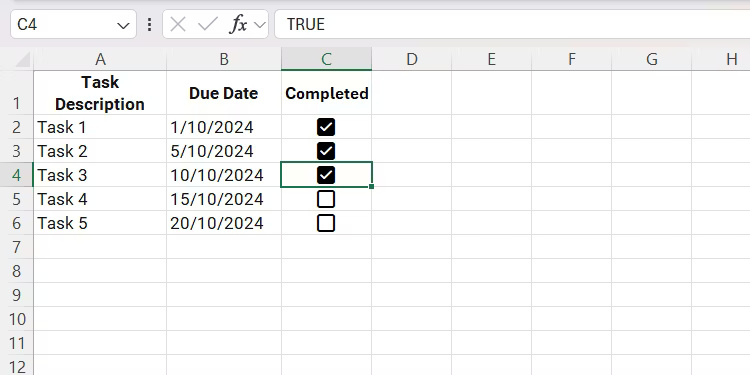
Additionally, you can strikethrough items using conditional formatting to make completed tasks more obvious. This can apply to all to-do lists, including grocery shopping checklists, inventory, event planning, maintenance, or project timelines.
2. Plan the Event
Event planning can be a logistical nightmare, but Excel turns it into something manageable. You can use it countless times to track the progress of tasks for weddings and parties. Along with checkboxes, you can easily use filters in Excel to see this information at a glance.

Once you create a header row at the top, you can easily filter out which tasks are complete or incomplete based on whether the checkbox is checked (True) or not (False).

3. Keep Track of Your Family Budget
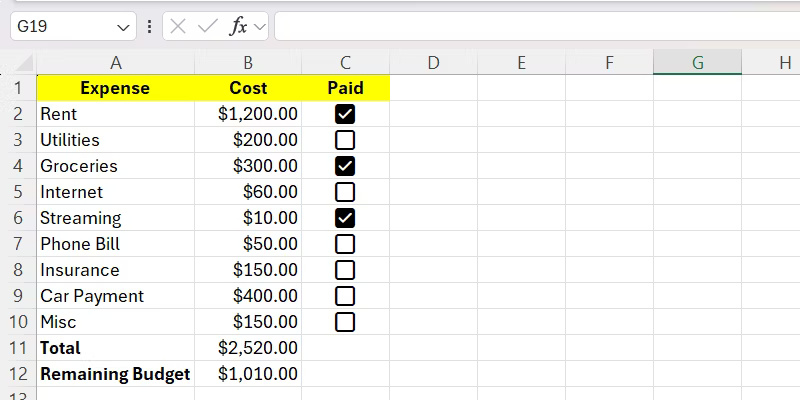
Excel is a great tool for creating a household budget, allowing you to track your expenses easily. Use Checkboxes along with the SUMIF function to see how much is left in your total budget and then plan accordingly. The way it's set up is that whenever you check a budget item, the cost of that item is automatically subtracted from your total budget.
See the screenshot below of a budget template created for this example:
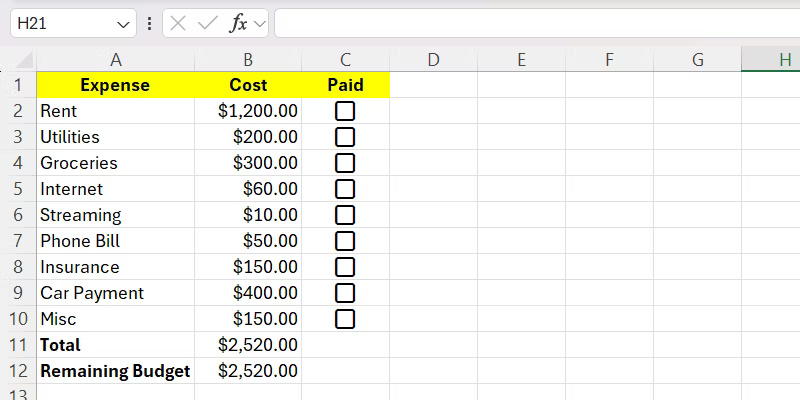
Then enter the formula below in cell B12 so that when the check box is checked, the remaining budget will decrease:
=B11-SUMIF(C2:C10,TRUE,B2:B10)The formula will sum the values from B2 to B10 if the values of the corresponding cells in the next column ( C2 to C10 ) are TRUE. For example, if C2 is TRUE , B2 will be included in the calculation, and so on. The result of the formula will then be subtracted from the total budget ( B11 ), giving us the remaining budget.
4. Create a Goal Tracker
Goals are easier to track when they're visual. You can use Excel not only to track your goals, but also to auto-complete checkboxes as you reach them.
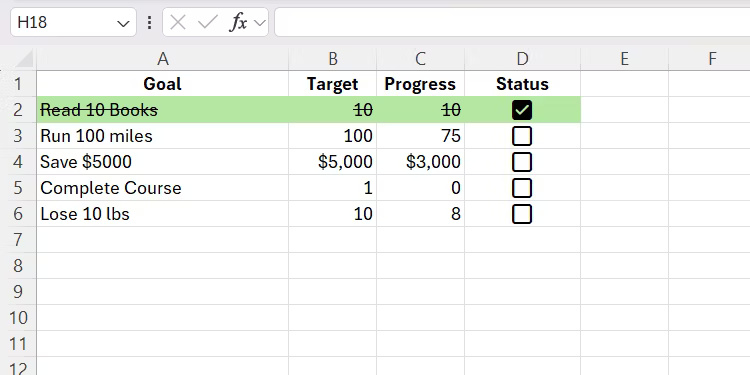
In the screenshot below, the reviewer has set up a simple goal tracker with a goal column (B) and a progress column (C). The corresponding checkbox will be checked whenever the progress reaches or exceeds the goal.
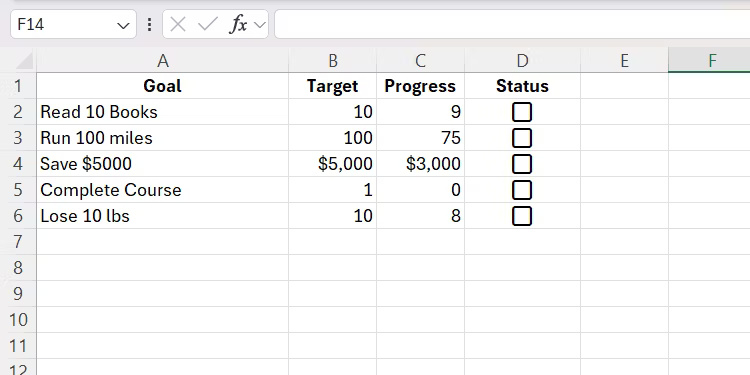
For example, if we complete the goal of Read 10 books (row 2) and update the value of C2 to 10, the corresponding checkbox will be checked. Here is the formula entered in D2 (the cell with the checkbox):
=IF(C2>=B2,TRUE,FALSE)Then apply the formula to other cells so that their checkboxes are also checked when the goal is reached. You can also make it more appealing with conditional formatting to visually highlight that the goal has been checked.
5. Create a Training Challenge
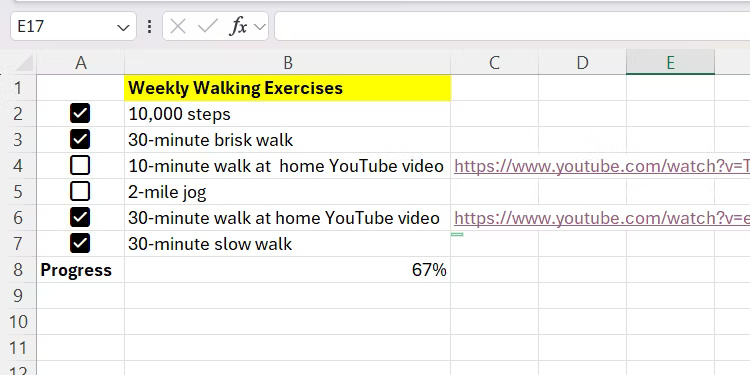
To tackle your sedentary lifestyle, you can create an exercise challenge and use checkboxes in Excel to track your progress as a percentage of completion. This way, you can see how close or far you are to your goal. This is much more motivating than just looking at the checked checkboxes.
For this function, let's look at some examples of walking exercises performed weekly.
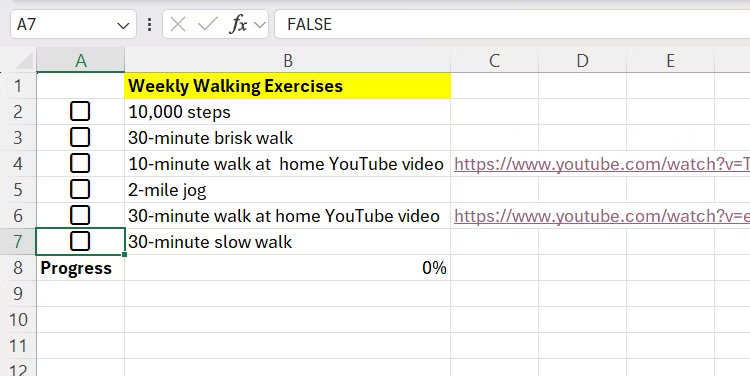
Use the following formula to display progress ( B8 ) when a checkbox is checked:
=COUNTIF(A2:A7,TRUE)/COUNTA(A2:A7)The first part of the formula, COUNTIF, counts the range of checkboxes if they have a value of TRUE (checked). The formula then divides the result by the total number of checkboxes from COUNTA.
Pair them with formulas and conditional formatting, and you can track anything—goals, budgets, workout challenges, and more. If you want to take things a step further, you can create progress bars or other visual aids for even more dynamic tracking. With just a little Excel knowledge, spreadsheets can become a powerful tool for organizing your life.




Reader Comments 0
Sign in with email or Google to join the discussion.